 Haocool

If you’re processing beef, poultry, or seafood for export or wholesale, a 100-ton frozen meat cold room is often the most cost-effective entry point into reliable cold chain infrastructure. But how much does it really cost—and what can you actually store?
This guide provides a complete breakdown of costs, capacity planning, real-world ROI, and actionable advice for choosing the right supplier. Whether you’re a meat processor in Nigeria, a poultry exporter in Vietnam, or a distributor in the Middle East, this article will help you make an informed investment decision.
What Does “100 Tons” Mean in Real Storage Terms?
Before looking at costs, it’s essential to understand what 100 tons of frozen meat actually means in terms of space. The storage density depends on the type of meat and packaging:
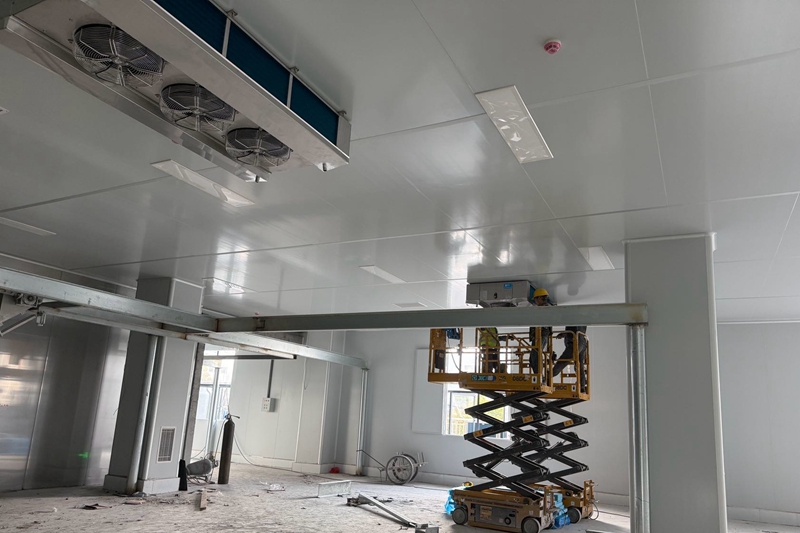
| Meat Type | Density (kg/m³) | Volume per Ton (m³) |
|---|---|---|
| Frozen meat (whole carcass) | ~400 kg/m³ | 2.5 m³/ton |
| Frozen meat (boxed/cartoned) | ~500–650 kg/m³ | 1.5–2.0 m³/ton |
| Frozen poultry | ~400 kg/m³ | 2.5 m³/ton |
| Frozen fish | ~470 kg/m³ | 2.1 m³/ton |
Source: GB50072-2021 cold storage design standard
For practical storage with proper airflow, pallet stacking, and aisle space, the usable volume for frozen meat is typically 4–5 m³ per metric ton. This accounts for packaging, airflow gaps between pallets, and handling space.
A 100-Ton Capacity Requires:
| Metric | Value |
|---|---|
| Usable volume | 400–500 m³ |
| Floor area (assuming 4m clear height) | 100–125 m² |
| Pallet capacity | 200–250 standard EUR/ISO pallets |
| Weight per pallet | ~400–500 kg of boxed frozen meat |
What Can You Actually Store?
A 100-ton frozen meat cold room is sufficient for:
– 100,000 kg of frozen chicken cuts
– 2–3 full 40ft refrigerated containers (FCL)
– 4–6 weeks of production for a medium slaughterhouse
– Approximately 200–250 pallets of boxed frozen meat
Total Investment: $35,000 – $50,000 USD
This turnkey price includes everything needed for a –18°C frozen meat cold room. The cost range reflects differences in equipment brands, insulation thickness, automation level, and installation location.
Detailed Cost Breakdown
| Component | Specification | Why It Matters | Est. Cost |
|---|---|---|---|
| Temperature | –18°C ±1°C (meat safety standard) | IIR-recommended international standard for frozen food | Included |
| Insulation Panels | 150mm PIR/PUR panels, 0.5mm food-grade steel | Determines thermal efficiency; affects energy bills for 10+ years | ~$8,000–12,000 |
| Refrigeration Unit | 40–50HP semi-hermetic screw compressor (Bitzer/Refcomp) | The “heart” of the cold room; reliability determines uptime | ~$12,000–18,000 |
| Evaporator | High-efficiency ceiling cooler with hot-gas defrost | Ensures uniform temperature; hot-gas defrost prevents ice buildup | ~$3,000–5,000 |
| Floor Insulation | 100mm XPS insulation + reinforced concrete (forklift-rated) | Prevents ground freezing; supports heavy equipment | ~$4,000–6,000 |
| Doors | Insulated sliding door + air curtain | Minimizes temperature loss during loading/unloading | ~$2,000–3,000 |
| Controls | Digital PLC system with SMS/email alarms | 24/7 remote monitoring; alerts for temperature deviations | ~$1,500–2,500 |
| Refrigerant | R507 or R448A (low-GWP option available) | R448A has lower environmental impact; future-proofs your facility | Included |
| Installation | Full on-site build, commissioning & training | Ensures proper setup; reduces risk of operational errors | ~$4,000–6,000 |
Cost per Cubic Meter: $70–$100/m³
For frozen cold storage, the industry benchmark is $37–$42 per cubic meter for basic facilities. A 100-ton (400–500 m³) cold room falls within this range, with the higher end reflecting premium components and international shipping.
Cost per square meter: At $35,000–50,000 for 100–125 m², the investment is approximately $280–500 per m². This is consistent with industry benchmarks showing $110–$180/m² for basic fresh cold storage, with frozen storage commanding a premium due to thicker insulation and more powerful refrigeration.
Real-World ROI: A Chicken Processor in Nigeria
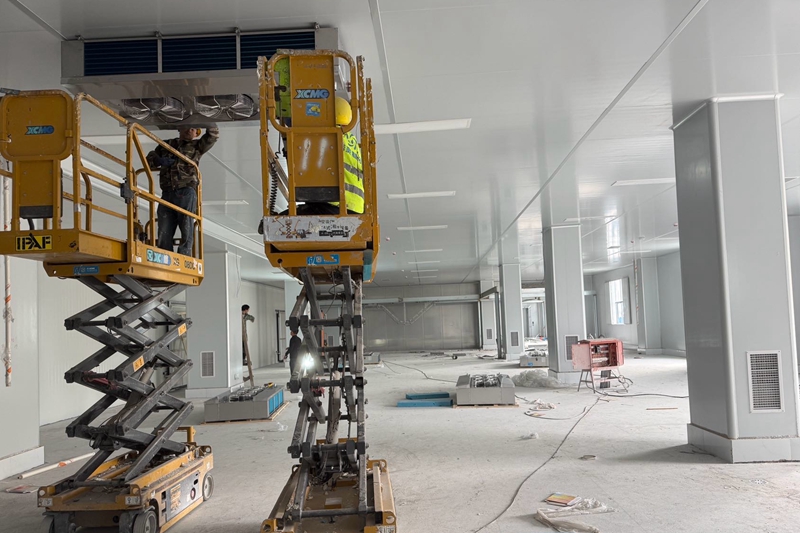
A chicken processor in Nigeria built a 450 m³ (100-ton) frozen meat cold room with the following results:
| Metric | Before | After |
|---|---|---|
| Total Investment | — | $45,000 USD |
| Storage Capacity | Limited | 100 tons frozen chicken parts |
| Spoilage Rate | 22% | 4% |
| Sales Model | Daily fire sales (discounts) | Weekly FCL shipments to Ghana & Cameroon |
| Market Access | Local only | Qualified for supermarket contracts requiring cold chain proof |
| ROI Timeline | — | 10 months |
How the ROI Was Achieved
- Reduced spoilage from 22% to 4% — saving 18% of total production value
- Enabled export — higher-margin international sales vs. discounted local sales
- Qualified for contracts — supermarkets and institutional buyers require cold chain certification
Similar results have been documented across multiple projects. A poultry processor in Nigeria achieved ROI in 13 months after building an 800m² frozen room, while another frozen storage facility reduced spoilage from 22% to 5% and enabled sea freight to the UAE with an 11-month ROI.
Why –18°C? The Science Behind the Standard
The International Institute of Refrigeration (IIR) recommends –18°C as the minimum temperature for frozen food storage. This standard, adopted by Codex Alimentarius in 1966, ensures:
- Microbiological safety: Most pathogens cannot grow at –18°C
- Quality preservation: Enzymatic and chemical reactions that cause spoilage are significantly slowed
- Shelf life: Frozen meat stored at –18°C can maintain quality for 6–12 months
The IIR notes that “storage life of nearly all frozen foods is dependent on the temperature of storage”. Lower temperatures extend shelf life but increase energy costs — –18°C represents the optimal balance between safety, quality, and operating expense.
Factors That Influence Your Final Cost
1. Equipment Brand
| Brand | Price Tier | Reliability |
|---|---|---|
| Bitzer, Refcomp, Copeland (German/European) | Premium | Highest; 15–20 year lifespan |
| Danfoss, Luve | Mid-range | Excellent; 10–15 year lifespan |
| Local/Chinese brands | Budget | Variable; 5–10 year lifespan |
2. Refrigerant Type
- R507: Widely available, cost-effective, higher GWP
- R448A: Lower GWP (environmentally friendly), future-proof, slightly higher upfront cost
3. Installation Location
Costs vary significantly by region due to:
- Freight and shipping costs
- Import duties and taxes
- Local labor rates
- On-site technical support availability
4. Automation Level
- Basic: Manual controls, local temperature display — lowest cost
- Standard: PLC system with SMS/email alerts — included in $35k–50k range
- Advanced: Remote monitoring via mobile app, automated defrost scheduling — additional $3k–5k
5. Climate Conditions
In hot climates (e.g., Middle East, West Africa), additional insulation thickness and higher-capacity refrigeration may be required, increasing costs by 10–20%.
How to Choose the Right Cold Room Supplier
What to Look For
| Criteria | Why It Matters |
|---|---|
| Proven track record with overseas projects | Ensures familiarity with export logistics and international standards |
| Turnkey capability | Single contract for design, manufacturing, installation, and commissioning reduces risk |
| Brand-name components | Bitzer, Refcomp, Danfoss, Copeland, Schneider ensure reliability |
| Remote monitoring | SMS/email alerts and app-based control reduce manual checks |
| After-sales support | On-site installation guidance and technical support after commissioning |
| Customization capability | Designs adapted to local climate, product type, and regulatory requirements |
Red Flags to Avoid
- No physical address or factory visit option — may be a trading company, not a manufacturer
- Refuses to provide references or case studies — lack of proven experience
- Vague pricing — “all-inclusive” with hidden exclusions (shipping, installation, training)
- No warranty or post-installation support — high risk of operational issues
Frequently Asked Questions
Q1: Does the $35,000–$50,000 price include shipping and installation?
Yes, this is a turnkey price that includes design, manufacturing, shipping, on-site installation, commissioning, and training. Always confirm the scope with your supplier before signing.
Q2: How long does installation take?
For a 100-ton cold room, typical installation takes 4–6 weeks from arrival of materials to commissioning. This includes panel assembly, refrigeration installation, electrical work, and testing.
Q3: What is the ongoing operating cost?
Energy consumption is the largest ongoing cost. For a 100-ton frozen meat cold room, expect:
– Daily energy consumption: 200–300 kWh
– Monthly cost: Varies by local electricity rates
– Maintenance: Annual service for compressors and evaporators; filter replacements every 6–12 months
Q4: Can the cold room be expanded later?
Yes. Modular cold room designs allow for future expansion by adding panels and extending the refrigeration system. Discuss expansion plans with your supplier during the design phase.
Q5: What documentation do I need for export compliance?
A qualified supplier provides:
- CE certification for equipment
- ISO 9001 quality management certification
- Installation and commissioning reports
- Temperature mapping and validation documents
- User manuals and maintenance schedules
Ready to Invest?
A 100-ton frozen meat cold room is a proven investment for meat processors and exporters. With a $35,000–50,000 upfront cost and typical ROI in 10–13 months, it’s one of the most cost-effective ways to enter the cold chain and unlock higher-value export markets.
Next steps:
1. Define your product type (chicken, beef, seafood, etc.) and target markets
2. Confirm your site dimensions and local utility capacity
3. Request a site-specific quote from a reputable turnkey supplier
The storage parameters provided above are for reference only. Optimal cold room conditions vary depending on product type, packaging, climate, and operational requirements. Consult with a cold storage specialist for a customized solution.
This guide was updated in August 2026. Prices are in USD and subject to exchange rate fluctuations and market conditions.