 Haocool

What temperature should apples be stored at? How much does it cost to build an apple cold storage facility?
Apples are relatively suitable for long-term storage, but maintaining their quality depends heavily on temperature, relative humidity, air circulation, storage atmosphere and cooling performance.
For commercial apple storage, the refrigeration system should be designed around the specific apple variety, required storage period, incoming fruit temperature, storage capacity and handling process.
As a general reference, many apple varieties are stored close to 0°C, with relative humidity typically around 90–95%. The exact storage temperature should be determined by the apple variety and the required storage period. For example, UC Davis lists Golden Delicious at an optimum of 0°C ± 1°C with 90–95% relative humidity, with a freezing point around -1.7°C.
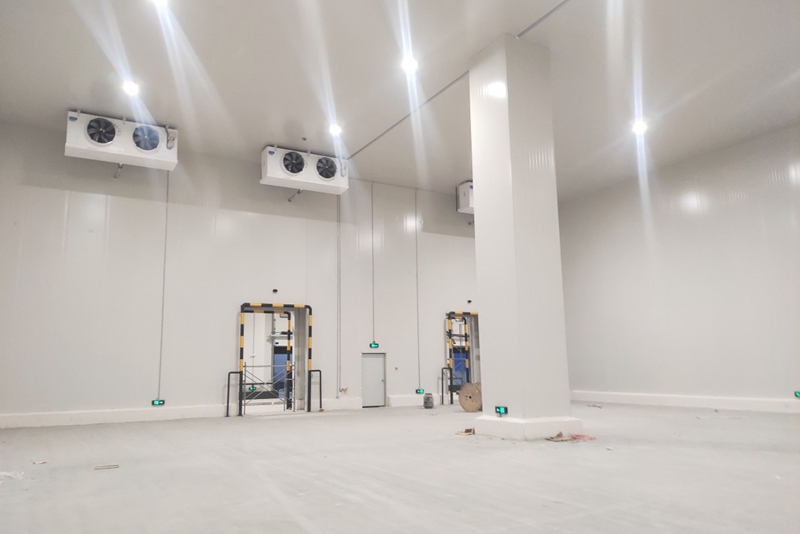
What Temperature Should Apples Be Stored At?
Apple storage temperature should generally be kept close to the product’s recommended storage range while avoiding freezing injury.
For many commercial apple varieties, a target around 0°C is commonly used for long-term refrigerated storage. However, the exact setpoint can vary according to:
- Apple variety
- Harvest maturity
- Storage duration
- Incoming fruit temperature
- Packaging
- Relative humidity
- Whether normal-air or controlled-atmosphere storage is used
For example, Golden Delicious apples are recommended at 0°C ± 1°C with 90–95% RH.
The storage temperature should therefore not be selected simply by applying one number to every apple variety.
Why Is Apple Cold Storage Temperature So Important?
After harvest, apples continue to respire and gradually lose quality.
Lower temperatures can slow respiration and help maintain:
- Firmness
- Crispness
- Acidity
- Flavor
- Weight
- Marketable appearance
However, the temperature cannot simply be reduced as much as possible.
If the fruit approaches its freezing point, low-temperature injury can occur. Golden Delicious, for example, has a freezing point of approximately -1.7°C.
This is why the refrigeration system needs precise temperature control rather than simply maximum cooling capacity.
What Humidity Is Best for Apple Cold Storage?
Relative humidity is another important design parameter.
For many apple-storage applications, approximately 90–95% RH is used to reduce moisture loss and maintain fruit quality. UC Davis lists 90–95% RH for Golden Delicious apples and notes that this variety is particularly susceptible to water loss.
Insufficient humidity can lead to:
- Shriveling
- Weight loss
- Reduced firmness
- Lower market value
However, excessively wet conditions can also increase the risk of condensation and decay.
The refrigeration system should therefore be designed to maintain stable temperature and suitable humidity without creating unnecessary condensation.
How Long Can Apples Be Stored in a Cold Storage Facility?
Storage life depends on the apple variety, harvest maturity and storage technology.
Normal refrigerated storage can preserve apples for an extended period, while controlled-atmosphere (CA) storage can extend storage life further for suitable varieties.
UC Davis notes that apples stored for more than one month can benefit from controlled-atmosphere storage in terms of maintaining firmness, acidity and skin color, and that CA storage potential can reach up to about 10 months for the referenced Golden Delicious conditions, compared with about six months in air.
For commercial projects, the required storage period should therefore be defined before selecting the storage technology.
Does an Apple Cold Storage Facility Need Controlled Atmosphere?
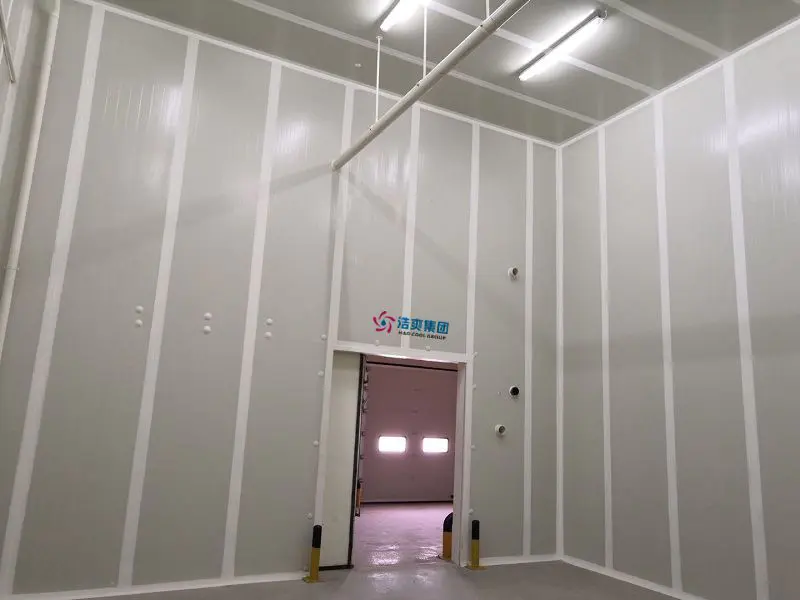
Not every apple cold store requires CA technology.
A conventional refrigerated room may be suitable for:
- Short-term storage
- Seasonal distribution
- Retail supply
- Regional fruit logistics
For longer storage periods, especially for commercial orchards and large-scale storage operators, CA storage may be considered.
A CA facility can control the storage atmosphere in addition to temperature and humidity.
For a real-world example, see our Sichuan Yanyuan County 3888㎡ Apple Controlled Atmosphere Cold Storage Project, which demonstrates how controlled-atmosphere technology can be applied to large-scale apple storage.
Typical parameters that may be controlled include:
- Oxygen concentration
- Carbon dioxide concentration
- Temperature
- Relative humidity
- Ethylene, depending on the system
For projects requiring long storage periods, the refrigeration and CA systems should be designed together rather than added independently.
How Much Does It Cost to Build an Apple Cold Storage Facility?
There is no universal price for an apple cold storage facility because the investment depends on the project scope.
The main cost factors include:
- Storage capacity
- Floor area
- Clear height
- Storage temperature
- Required storage period
- Apple variety
- Incoming fruit temperature
- Refrigeration capacity
- Humidity control
- Controlled-atmosphere system
- Insulated panels
- Cold storage doors
- Flooring
- Racking or bin storage
- Electrical system
- Monitoring and automation
- Building structure
- Installation and commissioning
- Project location
A 500 m² apple cold store used for short-term refrigerated distribution can have a very different investment from a 500 m² CA warehouse designed for long-term seasonal storage.
How Much Does a 500 m² Apple Cold Storage Cost?
For preliminary planning, a 500 m² apple cold storage facility operating around 0°C may require approximately US$90,000–US$135,000 for a basic project configuration based on the original budget range.
Current cold-storage construction benchmarks also show that project costs vary substantially by location, temperature, building scope and refrigeration system. For example, a 2026 U.S. benchmark places refrigerated warehouse construction at roughly US$155–215/ft², while other turnkey benchmarks give broader ranges depending on the facility type and scope. These figures are not directly transferable to an overseas apple project, but they illustrate why floor area alone is not enough to determine cost.
What Is Included in an Apple Cold Storage Project?
A commercial apple cold store may include:
Insulated Cold Room
- Insulated wall panels
- Ceiling panels
- Floor insulation
- Vapor barrier
- Sealing systems
- Cold storage doors
Refrigeration System
- Compressors
- Condensers
- Evaporators
- Refrigerant piping
- Expansion devices
- Temperature controls
- Pressure protection
- Defrost system where required
Humidity and Airflow Control
Apple storage requires stable environmental conditions rather than temperature control alone.
The design should consider:
- Evaporator selection
- Air distribution
- Air velocity
- Product stacking
- Relative humidity
- Condensation control
Proper airflow is especially important when large quantities of apples are stored in bins or pallets.
Monitoring and Automation
A commercial facility may include:
- Temperature sensors
- Humidity sensors
- Data recording
- High/low temperature alarms
- Remote monitoring
- Energy monitoring
- Central control system
For large commercial projects, continuous data logging can help operators identify temperature deviations before they affect large quantities of stored fruit.
How Should Apples Be Arranged Inside the Cold Room?
Storage capacity depends on much more than floor area.
The design needs to consider:
- Bin or pallet dimensions
- Product weight
- Stacking height
- Rack configuration
- Aisle width
- Air circulation
- Evaporator location
- Forklift access
- Receiving and dispatch areas
For example, a bin-storage apple warehouse and a palletized carton-storage warehouse can have significantly different storage capacities even when both have the same floor area.
The room should therefore be designed from the required tons or bins, rather than simply selecting a floor area first.
What Refrigeration Capacity Is Needed for an Apple Cold Store?
Refrigeration capacity should be calculated from the actual heat load.
The design should consider:
- Fruit entering temperature
- Daily receiving quantity
- Required pull-down time
- Storage temperature
- Outdoor design temperature
- Insulation performance
- Door opening frequency
- Lighting
- Fan motors
- Personnel
- Defrost requirements
- Storage volume
For example, a facility receiving freshly harvested apples every day may require a much larger refrigeration system than a facility receiving pre-cooled fruit.
This is why professional refrigeration design is based on product load and operating conditions, not simply on square meters.
How to Reduce Apple Cold Storage Cost?
Cost optimization should focus on total project economics rather than simply selecting the lowest equipment price.
Optimize Storage Capacity
Use suitable bin dimensions, stacking methods and room height to maximize usable storage volume.
Select the Right Refrigeration System
The refrigeration system should be sized according to the actual product load and required pull-down performance.
Oversizing increases capital cost and may also reduce operating efficiency.
Improve Insulation
A well-designed thermal envelope reduces heat gain and helps stabilize room temperature.
Control Door Heat Gain
Door opening frequency can significantly affect the refrigeration load.
Suitable door selection, airlocks and loading procedures can reduce unnecessary warm-air infiltration.
Consider CA Storage Based on Storage Duration
CA technology adds investment, but it may be economically justified for businesses that need to hold apples for many months and sell them later in the season.
The decision should be based on expected utilization, product value, storage duration and revenue.
What Information Is Needed for an Apple Cold Storage Quotation?
To prepare a preliminary design and quotation, provide:
| Project Information | Example |
|---|---|
| Apple variety | Fuji / Gala / Golden Delicious / other |
| Storage capacity | Tons / bins / pallets |
| Storage temperature | Around 0°C or project-specific |
| Relative humidity | Typically around 90–95% |
| Storage period | 1–3 months / 6 months / 10 months |
| Incoming fruit temperature | °C |
| Daily receiving volume | Tons/day |
| Storage method | Bins / cartons / pallets |
| Room dimensions | Length × width × height |
| CA storage | Required / not required |
| Project location | City and country |
| Existing building | Yes / No |
| Scope | Cold room / refrigeration / CA / complete EPC |
With these details, the engineering team can calculate the required cold room volume, refrigeration capacity, insulation specification, equipment configuration and preliminary project investment.
Apple Cold Storage Investment and ROI
For orchard operators, distributors and cold-chain investors, construction cost is only one part of the economic equation.
A proper investment analysis should consider:
- Total project investment
- Apple storage capacity
- Annual throughput
- Storage duration
- Electricity consumption
- Labor requirements
- Maintenance
- Product loss reduction
- Seasonal price differences
- Storage utilization
- Expected revenue
- Payback period
A facility with higher initial investment may be economically justified when it provides longer storage periods, lower product losses or allows the operator to sell apples during higher-price periods.
Request an Apple Cold Storage Quote Today
Contact us for a customized apple cold storage design and quotation based on your apple variety, storage capacity, required temperature, storage period, CA requirements and project location.
We can provide apple cold storage design, refrigeration systems, humidity and airflow control, controlled-atmosphere storage, insulated cold rooms, monitoring systems, installation, commissioning and complete turnkey EPC solutions.