 Haocool

Cold storage construction in Central Asia requires an integrated approach that considers project site selection, process design, equipment configuration and local construction. Site selection should be based on product sources, target markets and transportation conditions. Equipment should be suitable for the local climate throughout the year and the actual refrigeration load. Construction planning should clearly define responsibilities for engineering design, equipment supply, civil works, installation and commissioning.
Countries such as Kazakhstan and Uzbekistan have different climatic, power supply, logistics and construction conditions across their cities and project locations. A standard cold storage configuration should not simply be applied to every Central Asian project. Instead, the business purpose should be established first, followed by an assessment of local conditions and the development of an engineering solution that can be implemented on site.
1. Project Site Selection: Identify the Target Market and Product Flow First
Production-area cold storage facilities, food processing warehouses and urban distribution cold stores require different site selection strategies.
For projects serving fruit and vegetable production areas, important considerations include the distribution of major product sources, harvest seasons, concentrated delivery periods, and coordination with post-harvest pre-cooling, sorting and packaging operations.
Locating a cold storage facility close to production areas can shorten certain transportation stages. However, road access for outbound transportation, vehicle organization and subsequent sales channels must also be confirmed. Site selection should not focus exclusively on the convenience of receiving products.
For cold storage facilities serving food processing plants, the warehouse should be coordinated with the production line location, processing capacity and finished-product dispatch schedule.
Urban distribution projects should focus on delivery coverage, peak receiving and dispatch periods, vehicle access and loading and unloading space. Otherwise, the facility may have sufficient storage capacity but still experience operational bottlenecks at loading docks, roads or handling areas.
For cross-border sales, the project should also evaluate the actual road, rail or multimodal transportation routes, together with border crossings, cargo transfer and temporary waiting conditions.
Transportation efficiency should not be judged solely by map distance, and being close to a border crossing does not automatically mean that a location is suitable for a large-scale cold storage warehouse.
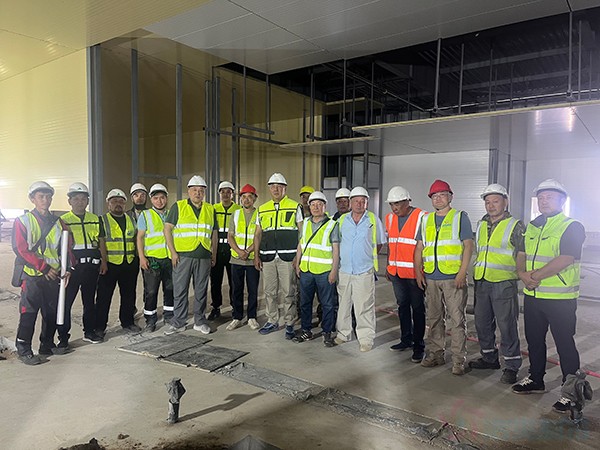
Group photo of construction personnel at the Tashkent food processing cold storage facility
2. Site Assessment: Include Power Supply and Construction Conditions in Site Selection
After initially identifying a suitable location, the project team should verify land and building usage, existing building conditions, electrical connections, water supply and drainage, and vehicle accessibility.
For new-build projects, the design should also consider geotechnical investigations, site topography and drainage, as well as applicable local requirements for seismic resistance, wind loads and snow loads.
Power supply conditions should be confirmed in terms of the actual connection point, available capacity, voltage, frequency and reliability.
The presence of a nearby electrical grid does not automatically mean that sufficient capacity is available for operating a commercial cold storage facility.
Whether a backup power system is required should be determined according to power interruption risks, product value and operational continuity requirements.
When converting an existing industrial building into a cold storage facility, the project should check:
- Clear height beneath beams
- Column spacing and structural layout
- Floor load-bearing capacity
- Fire protection and emergency evacuation
- Equipment installation and maintenance space
When comparing potential sites, the total cost of completing all necessary supporting works should be considered rather than comparing only land prices or rental costs.
3. Process and Layout Design: Separate Pre-Cooling, Rapid Freezing and Storage Requirements
Central Asian cold chain projects may handle fruit and vegetables, meat, seafood and processed food products. Different products have different temperature, humidity, packaging and turnover requirements, and these conditions should not be combined indiscriminately.
Fruit and vegetable projects should distinguish between post-harvest cooling and subsequent storage.
Whether a conventional storage room can also handle concentrated pre-cooling demand must be confirmed through process planning and refrigeration load calculations.
For facilities storing multiple product varieties, compatibility in terms of temperature, humidity, odors and ethylene sensitivity should also be considered. Products should not be stored together simply because there is available space.
Meat and food processing projects should distinguish between product freezing and frozen product storage.
Design inventory, daily processing volume and freezing capacity per batch are different operating indicators. Similarly, the air temperature inside a blast freezer cannot directly replace the required product core temperature.
The facility layout should connect receiving, necessary preliminary processing, pre-cooling or rapid freezing, storage, sorting and dispatch according to the actual operating process.
The number and size of cold rooms should be determined from inventory requirements, product batches and handling procedures. The building size should not be fixed first and then forced to accommodate an unsuitable process layout.
4. Equipment Selection: Consider Both Summer Heat Rejection and Winter Operation
Some areas of Central Asia experience extremely cold winters, while others have hot summers. Significant climatic differences also exist between individual cities.
Equipment selection should be based on the design weather conditions at the actual project location. National average temperatures, historical single-day extremes or weather conditions on a particular day should not be used as substitutes for proper engineering design conditions.
During summer, refrigeration capacity, heat rejection performance and electrical demand should be checked under high ambient temperatures and peak product-receiving conditions.
When outdoor air-cooled condensers are used, sufficient space must be provided for air intake, hot-air discharge and maintenance. Hot-air recirculation should be avoided.
For sites affected by sandstorms or accumulated snow, appropriate equipment protection and cleaning arrangements should also be considered.
Low outdoor temperatures in winter do not mean that refrigeration systems can operate without appropriate controls.
For systems requiring stable liquid supply pressure, excessively low condensing pressure may affect refrigerant supply and system stability.
Fan speed control, condensing pressure regulation and low-ambient startup measures should be determined according to the refrigerant, equipment operating range and manufacturer’s requirements.
Outdoor electrical components, sensors and auxiliary equipment should also be checked for suitability under the expected ambient conditions.
Water systems that may freeze and defrost drainage arrangements should be designed with appropriate frost protection according to their location and operating conditions.
For above-freezing fresh produce storage, the possibility of excessive cooling during winter should also be evaluated, with temperature control designed according to the actual storage process.
Equipment selection should also consider the availability of local spare parts and maintenance resources.
Before choosing refrigerants, control systems and critical components, the project team should verify applicable requirements, maintenance capabilities and supply conditions. This helps prevent situations in which equipment can be delivered to the site but cannot be properly maintained afterward.
5. Insulation and Supporting Construction: Pay Attention to Joints and Coordination Between Trades
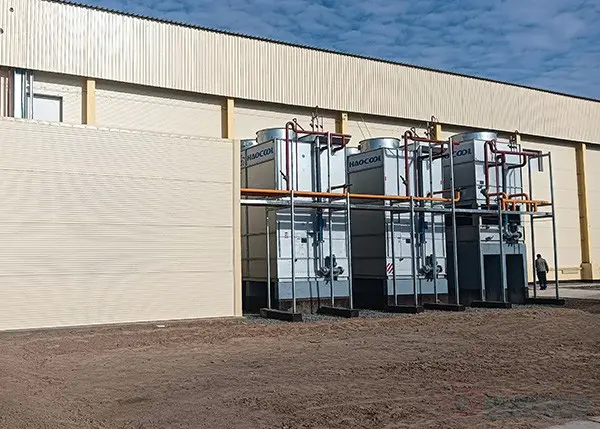
Cold storage insulation performance depends not only on panel thickness but also on panel joints, wall-to-floor connections, roof and ceiling structures, doors and pipe penetrations.
Material performance, fire protection requirements, vapor-barrier construction and floor specifications should be determined according to the storage temperature, building structure and local conditions.
For low-temperature cold rooms, floor frost-heave protection should also be evaluated.
At doorways, loading areas and intersections between different temperature zones, condensation, ice formation and thermal bridging should be addressed according to the operating frequency.
The completion of insulated panel installation alone should not be treated as the completion of the entire thermal envelope.
The separation between refrigeration plant rooms and cold storage areas, equipment maintenance access, pipe supports and electrical control cabinet locations should be clearly defined during the design stage.
Pipe insulation, wall penetrations and defrost drainage must be coordinated with cold room construction to reduce quality problems caused by repeated drilling, dismantling or modifications after installation.
For projects involving winter construction, the environmental requirements for material storage, joint sealing and concrete curing should also be checked.
The construction sequence should be arranged according to local weather conditions rather than directly applying construction schedules from other regions.
6. Local Construction Management: Define Responsibilities and Handover Documents in Advance
Central Asian cold storage projects can be implemented through different cooperation models, including:
- Equipment supply only
- Engineering design and equipment supply
- Installation guidance
- Cooperation with specialized local contractors
- Turnkey project delivery within an agreed scope
Each model involves different responsibilities, which should be clearly specified during quotation and contract negotiations.
If local contractors are responsible for civil works, electrical connections or equipment installation, the following responsibilities should be clearly defined:
- Who prepares and reviews detailed construction drawings?
- Who completes equipment foundations and reserved openings?
- Who provides lifting equipment and installation machinery?
- Who is responsible for on-site quality inspections?
- What is the division of responsibility between installation guidance and actual construction?
Local design approvals, construction permits, equipment conformity assessments and professional personnel requirements should be verified individually according to the country and scope of the project.
Chinese engineering designs and equipment supply documents must be coordinated with local requirements. A single set of documents should not be assumed to be directly applicable in every Central Asian country.
During construction, both parties should use mutually confirmed drawing revisions and an agreed communication language.
Technical briefings, change approvals and issue-reporting procedures should be established.
Records of concealed works, insulation joints, piping and electrical inspections should be prepared throughout construction rather than being completed in large quantities only at project handover.
7. Transportation and Project Schedule: Coordinate Equipment Delivery with Site Readiness
Equipment procurement and cross-border transportation should be coordinated with civil construction, power supply arrangements and installation schedules.
Before shipment, the project team should confirm:
- Transportation routes
- Packaging requirements
- Delivery location
- Customs clearance responsibilities
- Unloading conditions
- Temporary storage space
For oversized, overweight or otherwise specialized equipment, transportation arrangements should be confirmed with the carrier in advance.
The supplier, project owner and local construction contractor should jointly confirm delivery batches.
Cold room materials, embedded components and installation accessories needed for early construction can be arranged separately from later deliveries of refrigeration units and control equipment according to the actual construction sequence.
However, equipment lists, identification numbers and construction drawings must remain consistent throughout the process.
Project schedules should account for the dependencies between manufacturing, transportation, customs clearance, site preparation and commissioning.
For locations where road transportation may be affected by weather conditions, additional time should be allowed based on the actual transportation arrangements.
Transportation durations from other projects should not be directly used as guaranteed delivery schedules for a new project.
8. Phased Construction: Functional Planning Based on a Food Processing Cold Storage Project in Tashkent
A food processing cold storage project in Tashkent, Uzbekistan, publicly presented as a Haocool project, primarily serves the processing, freezing and frozen storage requirements of dairy products and other food products.
The project was developed in two phases:
- Phase I: Approximately 1,000 m², completed in 2019.
- Phase II: An additional approximately 2,000 m², completed in 2022.
- Total facility area: Approximately 3,000 m².
The facility includes separate rapid-freezing and frozen-product storage areas.
This project provides an example of phased construction and functional zoning.
For projects planning to expand their business gradually, the initial design can consider the overall site, electrical supply, equipment areas and piping interfaces according to a clearly defined expansion plan.
Whether additional equipment capacity should be reserved, and how much capacity should be allocated, must still be determined according to actual business requirements and engineering calculations.
The area, process configuration and construction phases described above are specific to this project. Other cold storage facilities in Central Asia should be redesigned according to their products, site conditions and operating requirements.
9. Acceptance and Operation: Verify Performance Under Actual Operating Conditions
Project acceptance should be based on the intended application and the agreed contractual requirements.
In addition to installation quality and equipment startup, acceptance should verify:
- Temperature control performance
- Applicable processing capacity
- Defrost drainage
- Alarm functions
- Protection systems
The environmental conditions, product loading conditions and operating procedures during testing should also be clearly defined.
An empty-room pull-down test cannot directly replace verification of actual product-handling capacity.
If winter low-temperature or summer high-temperature conditions cannot be covered during the acceptance period, the project should establish appropriate follow-up verification methods and seasonal commissioning arrangements in advance.
Project handover documents should include:
- As-built drawings
- Equipment lists
- Control system documentation
- Maintenance requirements
- Spare-parts information
- Staff training records
Responsibilities for remote technical support, on-site service and local maintenance personnel should also be clearly defined.
This allows the facility to continue routine inspections, maintenance and troubleshooting after commercial operation begins.