 Haocool

For a seafood cold chain project at an African fishing port, the process should begin with the types of catch, the condition of the products when they are landed, peak unloading periods and target markets. The facility can then be configured with receiving and sorting areas, pre-cooling and chilled preservation, rapid-freezing processing, low-temperature storage and cold chain dispatch facilities.
Fresh chilled seafood for direct sale, seafood intended for freezing, and products that have already been frozen have different requirements for rooms and equipment. A solution should not be selected solely according to the port area or total storage capacity.
During construction planning, the local climate, power supply, water availability, port logistics and maintenance conditions should also be verified to ensure that processing capacity and storage capacity match actual operational needs. Conditions differ among African countries and ports, so the same equipment configuration should not be applied universally.
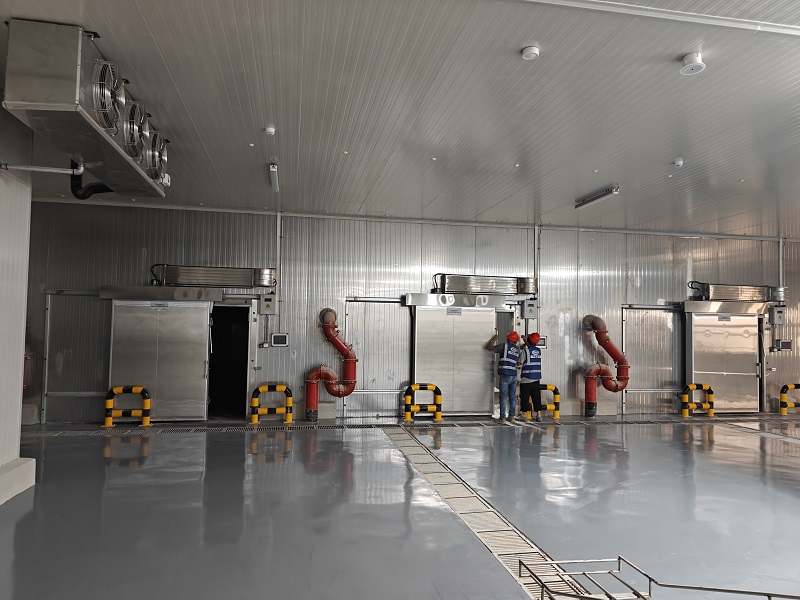
Workers are adjusting the cold storage door.
1. Determine the Product Destination Before Planning the Cold Chain Process
For fresh chilled products intended for local and regional markets, the process should focus on receiving and inspection, ice replenishment or appropriate rapid cooling, sorting and packaging, short-term chilled storage, and distribution.
When the catch has already been adequately chilled on board, the main tasks after landing are to maintain the low temperature and minimize outdoor waiting and repeated handling.
For fresh seafood intended for frozen sales, the process should be arranged according to product requirements and may include preliminary processing, freezing, packaging and frozen storage. Whether packaging takes place before or after freezing should be determined according to the product, such as whole fish, fish portions or shrimp, and the specific packaging format.
For products that have already been frozen on board, the process generally focuses on low-temperature receiving, quality inspection, frozen storage and shipment coordination. There is no need to add redundant pre-cooling or freezing stages simply to follow a standard process.
Live fish, live shrimp and live shellfish require separate assessment of temporary holding, water quality, oxygen supply and transportation conditions. They cannot be managed using the same cold storage solution as chilled fish or frozen seafood.
2. Pre-Cooling and Ice-Making Facilities Should Match Landing and Handling Requirements
The main purpose of pre-cooling at a fishing port is to bring products that require cooling down to an appropriate temperature as quickly as possible and maintain that condition during sorting, temporary storage and transportation.
For conventional fresh chilled fish, preservation conditions are generally maintained close to the melting point of ice. However, the specific handling method should be selected according to the species, product size and sales requirements.
Possible methods include appropriate ice-based cooling, ice-water cooling or other evaluated cooling systems. Selection should consider cooling speed, temperature uniformity, changes in product water absorption or salt content, and the requirements for cleaning and hygiene management.
Ice-making equipment and ice storage facilities should be planned together. Ice demand may include cooling landed seafood, replenishing ice on fishing vessels, adding ice during sorting, and providing ice for transportation.
Ice production capacity should be calculated according to these different uses and peak-period demand. Ice storage capacity should allow for the difference between continuous production and concentrated ice collection. A fixed ice-to-fish ratio should not be applied to every project.
Ice and water that come into contact with seafood must meet the hygiene requirements for their intended use. Contamination must be prevented during production, storage and delivery. The presence of seawater near the port does not mean it can be used directly for ice-making or food processing. The water source and treatment solution must be properly assessed.
A conventional storage cold room should not automatically be expected to handle the rapid cooling of large quantities of warm catch. If in-room pre-cooling is required, the product heat load, loading configuration and allowable cooling time must be calculated separately.
3. Select the Rapid-Freezing Solution According to Product Type and Actual Capacity
Rapid-freezing equipment should be selected only after confirming the product type, dimensions, thickness, packaging method, incoming product temperature and required batch capacity or hourly processing rate.
Air-blast freezing facilities can accommodate various forms of seafood, but loading arrangements and airflow must be carefully designed to avoid insufficient airflow in local areas.
Plate freezers can be evaluated for block-shaped products or products in suitable packaging that allow effective contact heat transfer. For shrimp meat, fish portions and similar products requiring individual quick freezing, suitable continuous freezing equipment can also be assessed.
The final equipment selection should be based on product characteristics and process requirements.
Freezing capacity cannot be determined solely by room temperature or compressor power. The time required for the product core to reach the target temperature also depends on product dimensions, packaging, loading density and heat-transfer conditions.
When calculating daily processing capacity, time needed for loading and unloading, cleaning, defrosting and coordination between batches must also be included.
The nominal capacity per batch and the actual daily production capacity are two different performance indicators.
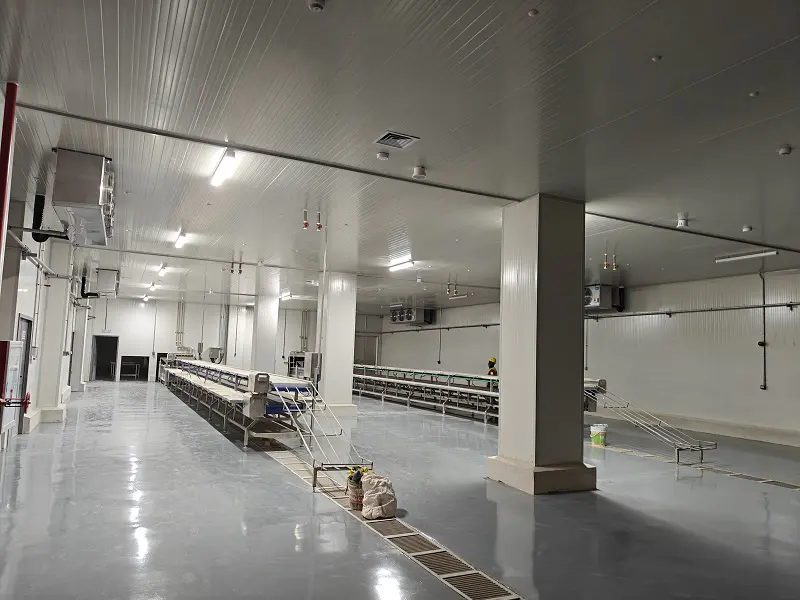
View of the completed cold storage facility at the Kilwa Masoko fishing port in Tanzania
4. Define Chilled and Frozen Storage Requirements Separately
Chilled storage rooms for fresh seafood mainly serve short-term preservation and product turnover. Their capacity should be determined according to unloading schedules, sorting capacity, waiting times and delivery arrangements.
The room layout should accommodate ice replenishment, drainage, cleaning and batch management to prevent products from remaining in storage for excessive periods.
Frozen storage rooms are intended primarily for products that have already completed the freezing process. For conventional frozen seafood, the product is generally maintained at -18°C or below. The exact storage conditions should be determined according to the species, packaging, planned storage period and requirements of the target market.
Equipment selection should also distinguish between the required product temperature and the cold room air setpoint.
Frozen storage capacity should be calculated based on planned inventory, shipment batch sizes and logistics cycles. Export projects need to account for consolidation, inspection and transportation arrangements, but daily processing volume should not be treated as equivalent to static storage capacity.
Storage locations should be organized by product type and batch, while preserving sufficient space for airflow, handling and maintenance. Where different products require incompatible conditions, separate zones should be evaluated rather than mixing products merely to increase loading density.
5. The Facility Layout Should Connect Receiving, Processing, Storage and Loading
A fishing port cold chain facility should be arranged around the actual operating sequence. Receiving, sorting, processing, freezing, storage and dispatch should be connected through clear material-handling routes to reduce unnecessary transfers and exposure to ambient temperatures.
Areas for raw material receiving, clean packaging, finished-product storage and waste handling should be separated according to hygiene management requirements.
The movement of personnel, packaging materials, products and waste should also be coordinated to prevent contamination from spreading through vehicles, containers or drainage systems.
Receiving and dispatch areas should be designed according to vehicle parking, loading and unloading methods, and temperature-control requirements.
During periods of concentrated unloading, the facility should provide suitable arrangements to maintain product temperature while waiting. An outdoor waiting area should not be treated as a substitute for cold storage capacity.
Floors, walls and drainage facilities should be easy to clean and maintain. Low-temperature areas also require appropriate insulation, vapor barriers and sealed joints.
Evaporators should be positioned with sufficient space for supply and return airflow, defrost drainage and maintenance access. Goods, racks and packaging materials should not obstruct equipment airflow.
6. Equipment Selection Should Consider Local Heat Rejection, Water, Power and Maintenance Conditions
For coastal projects, equipment corrosion protection, enclosure protection and maintenance requirements should be assessed according to actual salt spray, humidity and sand or dust exposure.
Refrigeration equipment capacity should be calculated using the environmental design conditions of the project rather than directly copying an equipment configuration from another region.
When air-cooled condensers are used, they should be installed in a well-ventilated outdoor equipment area. Hot-air recirculation should be avoided, and sufficient space should be provided for heat rejection and maintenance.
If a water-cooled system is considered, the water source, water quality, water treatment requirements and available maintenance resources must first be confirmed. Equipment purchase price should not be the only factor in the comparison.
The electrical design should verify the available voltage, frequency, phase configuration, electrical capacity and power-supply stability.
Where power interruptions are possible, backup power and arrangements for restoring operation should be evaluated according to the products and operational requirements.
Renewable energy options, such as solar photovoltaic systems, should also be assessed against the actual load profile and energy storage conditions. Continuous refrigeration throughout the day should not be promised based only on the installed photovoltaic capacity.
Equipment brands and control systems should be selected with local maintenance resources in mind. Critical spare parts, routine maintenance, temperature records, alarm handling and staff training should be defined during procurement so that operation and fault response after handover are properly supported.
7. Haocool’s African Project: Kilwa Masoko Fishing Port Cold Chain Project in Tanzania
The Kilwa Masoko Fishing Port Cold Chain Project in Tanzania, undertaken by Haocool (Shanghai Haocool Industrial Co., Ltd.), covers a total integrated facility area of approximately 12,600 m².
The facility was planned around the processing, freezing, storage and logistics requirements of seafood after landing. The stated area refers to the overall facility, including processing, storage and supporting areas.
The project includes a preliminary processing area, fish sorting area, processing preparation area, rapid-freezing area, chilled and low-temperature storage areas, as well as supporting areas for post-freezing packaging, ice-making, transfer between stages, receiving and dispatch.
The processing preparation area is connected to the rapid-freezing stage. After freezing, products can enter the appropriate packaging and storage areas before being dispatched through the receiving and shipping platform.
The project also includes a refrigeration plant room, electrical distribution area and auxiliary rooms, integrating the space required for production operations and equipment operation into the overall facility layout.
Ice-making, processing, freezing, storage and loading operations collectively form the engineering scope of a fishing port seafood cold chain facility.
From an engineering planning perspective, this project provides a reference for combining functions and coordinating operational areas in African fishing port cold chain developments.
Similar projects must still determine their own pre-cooling, ice-making, rapid-freezing and storage requirements according to the main seafood species, landing temperature, peak unloading demand, sales model and local water and power conditions. The scale and equipment configuration of this case should not be copied directly without project-specific assessment.