 Haocool

Cold storage construction in the Middle East must address several key challenges, including refrigeration performance under high ambient temperatures, outdoor equipment heat rejection, insulation and vapor barriers, the infiltration of hot and humid air during loading and unloading, and the resistance of equipment and electrical controls to dust, sand and salt spray.
The project design should be developed according to the specific location, products to be stored and operating procedures. Refrigeration equipment should not be selected based on cold room floor area alone.
Climatic conditions vary across the Middle East. Some inland areas are primarily affected by high temperatures, dry conditions and sand or dust, while certain coastal areas also experience high humidity and salt spray. For cold storage facilities serving food processing, fruit and vegetable distribution, meat and seafood storage, or fresh food delivery, the actual site conditions should be established before refrigeration load calculations, system selection and construction design begin.
For a regional project reference, see our Dubai 5,000-Ton Agricultural Cold Chain EPC Project, which showcases a large-scale agricultural cold chain project in the Middle East.
1. Determine Local Design Conditions Before Selecting Equipment
Cold storage design should begin with the project location, altitude, outdoor temperature and humidity conditions, and the surrounding environment where the refrigeration equipment will be installed.
Average annual temperatures do not represent summer design conditions, while a single record-high temperature should not automatically be used as the design basis for every project.
Engineers should use local meteorological data, applicable design requirements and the facility’s operating schedule to establish outdoor design conditions. They should also evaluate operating arrangements during prolonged periods of high temperatures or when ambient conditions exceed the design limits.
Equipment areas on rooftops, in narrow courtyards or near other heat-rejection equipment require particular attention because their actual inlet air temperatures may be higher than the temperatures indicated by regional weather data.
Operating information is equally important, including product entering temperature, daily receiving volume, target storage temperature, door opening frequency and operating hours.
Pre-cooling, rapid freezing and frozen storage serve different purposes. The required refrigeration capacity cannot be determined solely from the static inventory in tons.
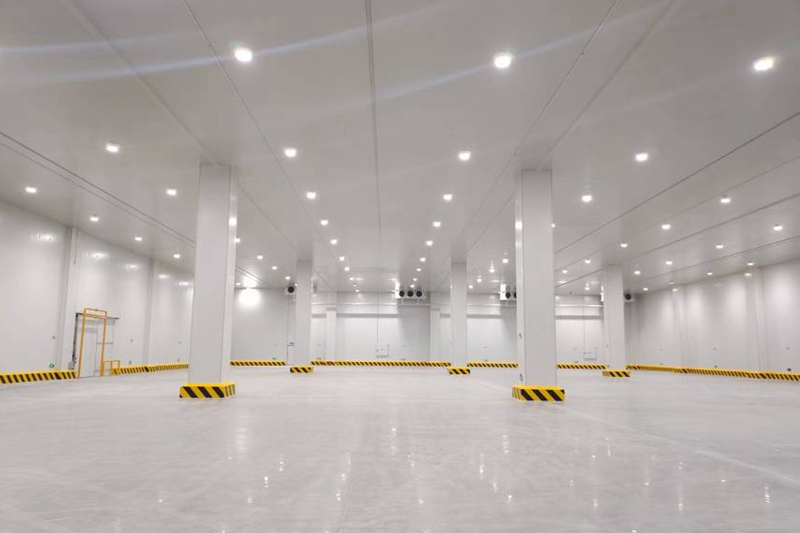
Completed cold storage facility interior
2. Verify Actual Refrigeration Capacity Under High Ambient Temperatures
As outdoor temperatures rise, the heat-rejection conditions of air-cooled condensing systems change. Condensing temperatures and pressures may increase, affecting both refrigeration capacity and energy consumption.
Equipment selection should be supported by performance data corresponding to the project’s actual operating conditions. Engineers should verify the refrigeration capacity, power input and permissible operating range for the selected refrigerant, evaporating temperature and condensing temperature.
Checking only the equipment model, compressor horsepower or nominal refrigeration capacity is not sufficient to determine whether a system can meet its requirements during the hottest summer conditions.
The refrigeration load calculation should include heat transmission through the building envelope, product cooling, door infiltration and internal equipment loads. Defrost requirements and operating schedules must also be considered.
Any additional capacity allowance should be supported by engineering calculations rather than applying the same percentage increase to every Middle East project.
3. Ensure Reliable Heat Rejection from Condensers
Outdoor air-cooled condensers should be installed in well-ventilated equipment areas, with sufficient space for air intake, hot-air discharge, maintenance and safe access.
When multiple units are installed close together, engineers should check whether discharged hot air could be drawn back into the same unit or into neighboring equipment.
Walls, louvers, decorative screens and shading structures can all affect airflow. Where shading is provided, the intake and discharge arrangements must be checked to ensure adequate ventilation.
The equipment area should also allow convenient cleaning of heat exchangers and maintenance of condenser fans. Poor access after commissioning can make it difficult to maintain heat-rejection performance.
The choice between air-cooled, water-cooled and evaporative condensing systems should be evaluated according to local dry-bulb and wet-bulb temperatures, water availability, water quality, water costs and maintenance capabilities.
For systems using circulating water, make-up water, blowdown and water treatment requirements must also be addressed.
High ambient temperatures do not mean that one type of condensing system is automatically the best choice for every project.
4. Integrate Insulation, Vapor Barriers and Joint Sealing
The large temperature difference between the cold room interior and outdoor environment increases heat transmission through the building envelope. Roofs and external walls may also be exposed to substantial solar radiation.
The insulation material, thickness, construction details and fire performance should be selected according to the actual project requirements. A single panel specification should not be applied to every project in the Middle East simply because it is located in a hot climate.
In addition to the insulated panels themselves, attention must be paid to panel joints, wall-to-ceiling connections, wall-to-floor junctions, cold storage doors and pipe or cable penetrations.
The vapor barrier and its joints should form an effective continuous barrier on the warm side of the insulation, as required by the building design. This helps reduce moisture migration into the insulation system, where condensation or freezing could occur.
The insulated enclosure should also provide appropriate separation between technical rooms and refrigerated storage areas.
For facilities operating at low temperatures over extended periods, floor insulation and frost-heave protection must be designed according to site conditions.
Hot outdoor weather does not eliminate the possibility of ground freezing and frost heave beneath a low-temperature cold room.
5. Control the Infiltration of Hot and Humid Air During Loading and Unloading
In coastal areas with high humidity, frequent door opening introduces both heat and moisture into refrigerated spaces. This can increase condensation, evaporator frosting and defrost requirements.
Simply increasing refrigeration capacity may not solve the continuous heat and moisture loads created by an inefficient loading process.
Receiving and dispatch frequency, vehicle positioning and personnel access should all be considered when designing loading areas, buffer zones and cold storage doors.
Rapid-opening and closing doors, proper door seals and well-organized operating procedures should work together to reduce product exposure to outdoor conditions and prevent doors from remaining open unnecessarily.
Evaporator placement and product stacking must maintain unobstructed supply and return airflow. Space must also be provided for defrost drainage and equipment maintenance.
Defrost controls, drainage gradients and necessary frost-protection measures should be designed according to the actual operating conditions.
If persistent ice develops around doorways or condensation repeatedly appears on packaging, the source of air infiltration and the relevant construction details should be investigated rather than simply changing the temperature setpoint.
6. Account for Sand, Dust and Salt Spray in Equipment Selection and Maintenance
Sand and dust can accumulate on heat exchanger surfaces, increasing airflow resistance and reducing heat-transfer performance.
Equipment positioning, fin configuration and cleaning access should be evaluated according to the dust conditions at the site.
Dust-protection measures must also be checked for their effect on ventilation. Protective screens and filters should not be installed in ways that restrict equipment airflow excessively.
For coastal projects, salt spray and other corrosive conditions should be assessed when selecting materials and protective treatments for heat exchangers, equipment enclosures, fasteners and support structures.
The corrosion-protection specification should be confirmed with the equipment manufacturer while taking heat-transfer performance, cleaning methods and future maintenance into account.
Cleaning and inspection frequencies should be adjusted according to actual dust accumulation, corrosion conditions and operating data.
For overseas projects, appropriate spare parts can be planned in advance, and local maintenance resources and technical support arrangements should be clearly defined to reduce delays when equipment failures occur.
7. Coordinate Electrical Cooling, Power Supply and Operational Reliability
Under high ambient temperatures, the operating conditions of electrical control cabinets, variable-frequency drives and other electrical components must also be verified.
Control cabinets should be located in dry areas with convenient access for operation and maintenance. Their protection should address dust, moisture and internal heat dissipation.
When ambient temperatures are high or dust levels are significant, the appropriate cabinet cooling or heat-dissipation method should be selected according to the internal heat load and the permissible operating temperatures of the components.
Simply making a cabinet more airtight may prevent internal heat from escaping. Dust protection and thermal management therefore need to be designed together.
The available voltage, frequency, phase configuration and electrical capacity should be confirmed using actual site information.
For facilities requiring continuous operation, the project should also assess backup capacity, power-failure alarms, restart procedures after power restoration and the need for emergency power.
These arrangements should be determined according to product characteristics and the consequences of downtime rather than applied uniformly to every project.
8. Include Construction Quality, Commissioning and Maintenance in the Handover Plan
Construction inspections should focus on insulation and vapor-barrier joints, cold storage door seals, pipe insulation, pipe supports, penetrations through walls and drainage arrangements.
Even when equipment has been selected correctly, air leakage, damaged insulation or poor piping installation can adversely affect system performance.
Performance acceptance criteria should clearly define the ambient conditions, loading conditions, target storage temperature, product-handling requirements and measurement methods.
An empty-room pull-down test conducted during winter or under relatively mild outdoor conditions does not, by itself, demonstrate that the system can meet all performance requirements during summer heat and actual product receiving operations.
If the agreed high-temperature operating conditions are not available at handover, the contract should define how equipment performance data will be verified, which alternative testing methods are acceptable, and whether additional verification during the subsequent hot season is required.
Project handover should also include operating records, alarm tests, maintenance training, spare-parts documentation and a clear description of service responsibilities.
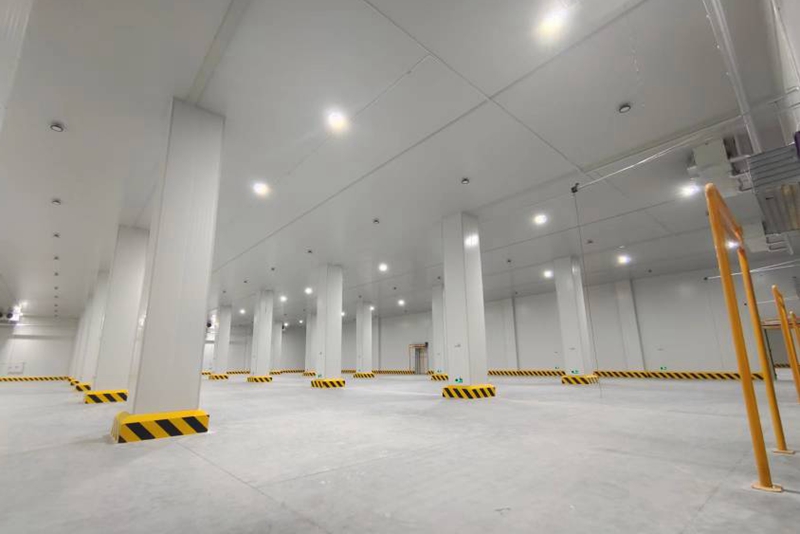
Completed cold storage warehouse interior and finished installation
9. How to Plan a Cold Storage Project in the Middle East
At the initial planning stage, provide the project country and city, site drawings, cold room floor area and clear height, products to be stored, design inventory, daily inbound and outbound volume, required temperatures and available power supply.
If water-cooled or evaporative condensing systems are being considered, additional information about water availability, water quality and drainage should be provided.
For coastal or heavily dust-affected sites, photographs of the equipment area and surrounding environment can also help with the initial assessment.
On this basis, the project should clearly define responsibility for engineering design, equipment supply, on-site installation and local supporting works. The applicable building, fire-safety, equipment and refrigerant requirements in the project location should also be verified.
Budget comparisons should include supporting infrastructure, maintenance conditions and the scope of services, rather than comparing refrigeration equipment purchase prices alone.