 Haocool

How many cubic meters of cold storage are needed to store 120 tons of fruit and vegetables at 0–5°C?
This is one of the first questions asked by fruit and vegetable distributors, growers and cold-chain operators when planning a fresh produce cold storage facility.
The answer depends on more than the total weight of the products. Product type, packaging, palletization, stacking height, aisle layout, airflow requirements and handling equipment all affect the required cold room volume.
For more information about complete cold storage planning, refrigeration and temperature-controlled handling for fresh produce, see our Fruit and Vegetable Cold Storage Solutions.
As a preliminary engineering estimate, 120 tons of fruit and vegetables may require approximately 600–750 m³ of total cold storage volume for a conventional 0–5°C facility. The actual requirement should be confirmed based on the specific products and storage configuration.
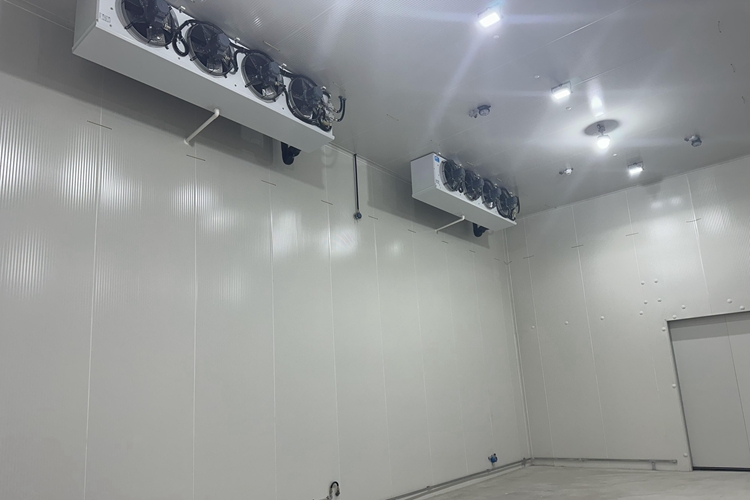
How Is Cold Storage Volume Calculated for 120 Tons of Produce?
A simple preliminary calculation starts with the storage density of the produce.
For many fruit and vegetable projects, a practical planning range is approximately 4–5 m³ per ton, depending on the product and packaging.
For 120 tons:
120 tons × 4–5 m³/ton = 480–600 m³ of net product volume
However, this is not necessarily the required size of the complete cold room.
A commercial cold store also needs space for:
- Product aisles
- Pallet gaps
- Air circulation
- Evaporators and refrigeration equipment
- Doors and loading areas
- Handling and maneuvering
- Structural elements
- Safety clearance
- Maintenance access
Cold storage design references distinguish between total volume, gross usable storage volume and net product-stacking volume because these spaces are not equivalent. Storage capacity is also influenced by stacking method, handling equipment, access requirements and airflow distribution.
Therefore, 480–600 m³ should be treated as the approximate product-space requirement rather than the final room volume.
120 Tons of Fruit and Vegetables: Recommended Cold Storage Volume
For an initial project estimate, the following range can be used:
| Item | Preliminary Estimate |
|---|---|
| Storage capacity | 120 tons |
| Storage temperature | 0–5°C |
| Product volume requirement | Approx. 480–600 m³ |
| Recommended total cold room volume | Approx. 600–750 m³ |
| Actual volume | Depends on product, packaging and layout |
For example, a facility storing palletized apples and a facility storing leafy vegetables in plastic crates may both have a nominal capacity of 120 tons, but their space requirements can be quite different.
For a commercial project, the final capacity should therefore be calculated from the actual pallet dimensions, product weight per pallet, stacking height and required aisle space.
Why 120 Tons Does Not Equal a Fixed Number of Cubic Meters
The amount of cold storage space required depends heavily on how the produce is packed and stored.
Fruit and Vegetable Type
Different products have different bulk densities.
For example:
- Leafy vegetables generally require more volume per ton.
- Apples, oranges and other dense fruit may allow higher storage density.
- Potatoes and onions may use bulk or ventilated storage systems.
- Delicate produce may require larger air gaps and lower stacking heights.
This means that a single “m³ per ton” number should only be used for preliminary planning.
Packaging
Packaging has a direct effect on storage efficiency.
Typical options include:
- Plastic crates
- Cartons
- Wooden bins
- Pallet boxes
- Open-top containers
- Bulk storage
Vented packaging can also be important because cooling depends on airflow through and around the product. Research on refrigerated produce storage shows that packaging design and airflow paths can significantly affect cooling performance.
Palletization and Stacking
The number of pallets required can be calculated from the total weight and the average product weight per pallet.
For example, if the average load is:
- 500 kg/pallet → about 240 pallets
- 750 kg/pallet → about 160 pallets
- 1,000 kg/pallet → about 120 pallets
The final room size then depends on how these pallets are arranged and how high they can be stacked.
How Much Space Should Be Reserved for Airflow?
A cold storage room cannot simply be filled from floor to ceiling.
The refrigeration system needs sufficient airflow around the stored products to remove heat and maintain a uniform temperature.
In refrigerated fruit and vegetable storage, airflow distribution is strongly influenced by stack arrangement, spacing, fan position and the location of air passages. Research on industrial fruit stores has shown that room layout and the spacing between product stacks can significantly influence airflow distribution.
This is particularly important when the products enter the facility at a higher temperature and need rapid cooling.
Therefore, the storage layout should reserve sufficient space for:
- Main aisles
- Air circulation paths
- Evaporator airflow
- Product-to-wall clearance
- Product-to-ceiling clearance
- Pallet gaps
- Equipment maintenance access
The objective is not to maximize the number of boxes inside the room, but to achieve the required storage capacity and temperature uniformity at the same time.
Example: 120-Ton Fruit and Vegetable Cold Storage Layout
Suppose a project needs to store approximately 120 tons of palletized fruit and vegetables at 0–5°C.
A preliminary design might use:
- 150–200 pallet positions
- 3–5 m effective stacking height
- One or more evaporators
- Central or side aisles
- Dedicated receiving and dispatch areas
- Insulated cold storage doors
- Temperature and humidity monitoring
The exact arrangement depends on pallet size and the desired storage density.
For larger projects, racking can be considered to increase vertical space utilization, while low-rise floor stacking may be more suitable for certain products and packaging formats.
Should 120 Tons of Produce Be Stored in One Cold Room?
Not always.
The best solution depends on product compatibility.
A single 0–5°C room may be appropriate when the products have similar:
- Temperature requirements
- Humidity requirements
- Storage periods
- Ethylene sensitivity
- Turnover rates
However, different fruit and vegetables can have different temperature and humidity requirements. Some products may also produce or be sensitive to ethylene.
For mixed-commodity projects, multiple rooms or zones can provide better control than putting all products into one large room.
For example:
| Storage Zone | Possible Application |
|---|---|
| 0–2°C | Certain fruits and vegetables |
| 2–5°C | General fresh produce |
| Higher-temperature zone | Products requiring warmer storage |
| Pre-cooling area | Recently harvested produce |
| Dispatch area | Short-term staging before shipment |
The actual temperature ranges should be determined according to the specific commodities being stored.
What Refrigeration Capacity Is Needed for 120 Tons?
Refrigeration capacity cannot be calculated from the 120-ton storage quantity alone.
The refrigeration system must consider:
- Product entering temperature
- Product load
- Daily throughput
- Desired pull-down time
- Outdoor design temperature
- Cold room volume
- Insulation performance
- Door opening frequency
- Personnel and lighting
- Evaporator fan heat
- Defrost requirements
- Required safety margin
For example, storing 120 tons of fruit that enters the facility at 5°C is very different from receiving 20 tons per day of newly harvested produce at 20–30°C.
Fresh produce may require rapid pre-cooling immediately after harvest, and forced-air cooling is commonly used to accelerate heat removal from palletized produce.
Therefore, the refrigeration system should be designed according to the daily throughput and incoming product temperature, not just the final storage capacity.
How Much Does a 120-Ton Fruit and Vegetable Cold Storage Cost?
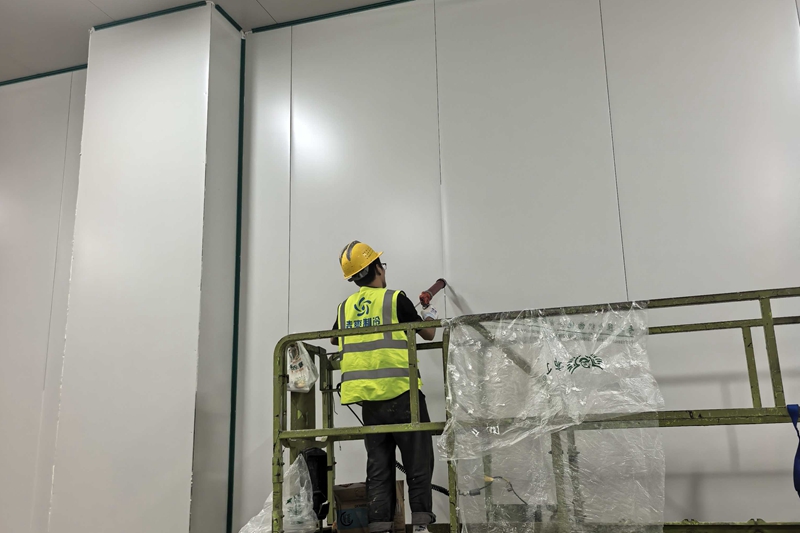
There is no reliable fixed cost based only on “120 tons.”
The total investment can vary depending on:
- Cold storage volume
- Refrigeration capacity
- Insulated panel thickness
- Floor construction
- Cold storage doors
- Evaporator and condensing equipment
- Temperature and humidity controls
- Pre-cooling equipment
- Pallet racking
- Electrical system
- Monitoring and automation
- Building structure
- Installation and commissioning
- Project location
A 120-ton warehouse designed for short-term produce distribution can have a very different investment from a 120-ton facility designed for long-term controlled storage or rapid pre-cooling.
For this reason, a professional quotation should be based on the complete operating profile rather than a simple price per cubic meter.
What Information Is Needed to Design a 120-Ton Cold Storage Facility?
To prepare a preliminary design and quotation, provide:
| Project Information | Example |
|---|---|
| Storage capacity | 120 tons |
| Product type | Apple / orange / vegetables / mixed produce |
| Storage temperature | 0–5°C |
| Relative humidity | Project-specific |
| Packaging | Carton / crate / pallet box / bulk |
| Product weight per pallet | kg/pallet |
| Incoming temperature | °C |
| Daily receiving volume | tons/day |
| Daily dispatch volume | tons/day |
| Required storage period | Days / weeks / months |
| Available building size | m² |
| Available height | m |
| Project location | City and country |
| Storage method | Floor stacking / racking |
| Pre-cooling | Required / not required |
These details allow the engineering team to determine the actual room dimensions, refrigeration load, equipment configuration and estimated project investment.
Recommended Dimensions for a 120-Ton Cold Storage Room
There is no single standard dimension for a 120-ton cold room.
For example, a preliminary design could use a room such as:
15 m × 10 m × 4.5 m = 675 m³
or:
12 m × 12 m × 5 m = 720 m³
Both are within a reasonable preliminary volume range, but they may produce very different storage layouts depending on the pallet size, aisle arrangement and cooling equipment location.
The final dimensions should therefore be selected according to the storage configuration rather than simply choosing a target cubic-meter number.
Why Cold Storage Design Is More Than a Volume Calculation
A properly designed fruit and vegetable cold store needs to balance:
Storage capacity + airflow + refrigeration + accessibility + energy efficiency
A facility that is too small may not hold the required quantity.
A facility that is too large may increase construction and refrigeration costs unnecessarily.
A facility with insufficient airflow may also experience temperature differences between product stacks, even when the refrigeration system itself has enough nominal capacity. Research on commercial fruit storage confirms that airflow distribution is closely related to product arrangement and room geometry.
The goal is therefore to design the right volume, not simply the largest possible volume.
120-Ton Fruit and Vegetable Cold Storage: Preliminary Recommendation
For a project requiring storage of approximately 120 tons of fruit and vegetables at 0–5°C, a reasonable starting point is:
- 120 tons target storage capacity
- 480–600 m³ approximate net product volume
- 600–750 m³ preliminary total cold room volume
- Final design based on product type and packaging
- Separate pre-cooling where required
- Adequate space for airflow and product handling
- Refrigeration capacity calculated from daily product load and incoming temperature
This range should be treated as a preliminary planning estimate, not a final engineering specification.
Request a 120-Ton Fruit and Vegetable Cold Storage Quote Today
Contact us for a customized 120-ton fruit and vegetable cold storage design and quotation based on your product type, storage temperature, packaging, daily throughput, storage period and project location.
We can provide cold storage design, refrigeration systems, pre-cooling solutions, insulated panels, cold storage doors, temperature monitoring, installation, commissioning and complete turnkey cold chain solutions.