 Haocool

For medium-to-large food processing plants—meat processing, seafood processing, central kitchens—a 4,000-square-meter low-temperature cold storage facility is often the standard configuration. It’s large enough to handle raw material refrigeration, semi-finished product freezing, and finished product blast freezing under one roof.
But what does it really cost? How much can you actually store? And what are the ongoing operating costs?
This guide provides a complete breakdown of costs, capacity planning, design considerations, and ROI analysis for 4,000㎡ food factory cold storage facilities.
Storage Capacity: What Fits in 4,000㎡?
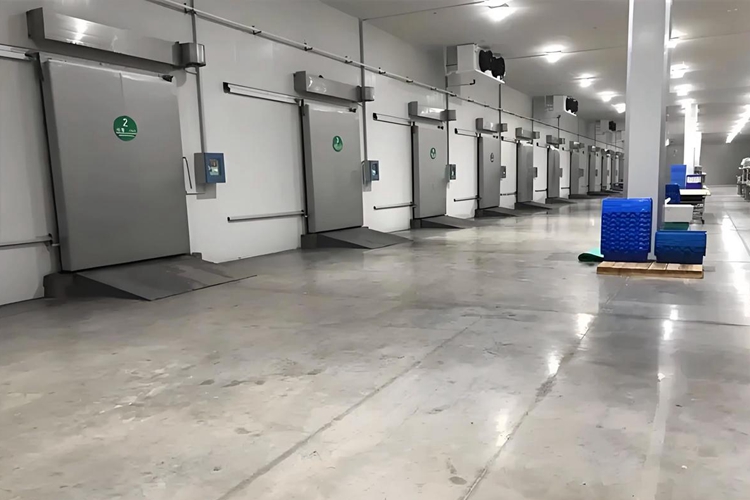
Assuming 5.0m clear height (standard for forklift operations), a 4,000㎡ facility provides approximately 20,000m³ of usable volume. Storage capacity varies by temperature zone and product type:
| Zone Type | Area Allocation | Temperature | Storage Density | Estimated Capacity |
|---|---|---|---|---|
| Chilled Storage (Raw Materials) | 1,500 m² | 0–4°C | 250–300 kg/m³ | 1,875–2,250 tons |
| Frozen Storage (Semi-Finished) | 1,500 m² | -18°C to -25°C | 350–400 kg/m³ | 2,625–3,000 tons |
| Blast Freezing (Finished Products) | 500 m² | -35°C to -40°C | — | 5–8 tons/hour |
| Buffer Zone / Loading Dock | 500 m² | 10–15°C | — | Staging & turnover |
Total storage capacity: Approximately 4,500–5,250 tons of mixed food products.
Factors That Affect Actual Capacity
- Racking System: Pallet racking vs. drive-in racking vs. block stacking — 20–30% capacity difference
- Aisle Width: Forklift access requires wider aisles than manual handling
- Packaging: Cartons vs. bulk bins vs. pallet wrap
- Product Density: Different food products have different densities (meat vs. vegetables vs. seafood)
Total Investment: 3.5–4.5 Million RMB ($480,000–620,000 USD)
A turnkey 4,000㎡ low-temperature cold storage facility for a food factory typically costs 3.5–4.5 million RMB (approximately $480,000–620,000 USD).
💡 Industry Context: According to 2026 industry data, the national average cost for large cold storage facilities (≥3,000㎡) is approximately 2,860 RMB/m² . At 875–1,125 RMB/m², this project is significantly below the national average—reflecting the use of an existing building shell rather than ground-up construction.
Price per Square Meter Reference
| Metric | Value |
|---|---|
| Total Investment | 3.5–4.5 million RMB |
| Floor Area | 4,000 m² |
| Cost per m² | 875–1,125 RMB/m² |
For comparison, 2026 industry benchmarks show:
- Food cold storage (0–15°C): 700–900 RMB/m²
- Food frozen storage (-18°C): 950–1,250 RMB/m²
- Food blast freezing (-35°C): 2,000–4,000 RMB/m²
Detailed Cost Breakdown
| Cost Category | Share | Estimated Cost (RMB) | Key Specifications |
|---|---|---|---|
| Insulation Panels | 25–30% | 900,000–1,100,000 | 100–150mm PU panels, B1/B2 fire-rated |
| Refrigeration System | 30–35% | 1,100,000–1,300,000 | Bitzer screw compressor parallel units |
| Evaporators | 8–10% | 300,000–400,000 | DL/DD/DJ series ceiling-mounted units |
| Control Systems | 5–8% | 200,000–300,000 | PLC controls + remote monitoring |
| Floor System | 8–10% | 300,000–400,000 | XPS insulation + reinforced concrete (frost-heave protection) |
| Doors & Dock Equipment | 3–5% | 100,000–200,000 | Insulated doors + loading dock + dock seals |
| Installation & Commissioning | 8–10% | 300,000–400,000 | On-site build, testing, training |
| Total | 100% | 3,500,000–4,500,000 |
What Determines the Final Price?
| Factor | Impact on Cost | Explanation |
|---|---|---|
| Temperature Requirements | High | -18°C frozen vs. -35°C blast freezing can double the cost per m² |
| Equipment Brand | 30–50% | Bitzer (Germany) vs. domestic brands—significant price difference |
| Construction Method | 15–25% | Panel assembly vs. spray foam insulation |
| Automation Level | 10–30% | Basic PLC vs. full WMS (warehouse management system) |
| Climate Conditions | 10–20% | Hot climates require thicker insulation and higher-capacity refrigeration |
Why 100mm vs. 150mm Insulation Panels?
| Temperature Zone | Recommended Thickness | Why |
|---|---|---|
| Chilled (0–4°C) | 100mm | Sufficient for moderate temperature differential |
| Frozen (-18°C to -25°C) | 120–150mm | Minimizes heat gain; critical for energy efficiency |
| Blast Freezer (-35°C+) | 150–200mm | Extreme temperature differential requires maximum insulation |
Key specifications:
- B1/B2 fire rating: Safety requirement for food processing facilities
- Food-grade cladding: Stainless steel or aluminum for hygiene and corrosion resistance
- Vapor barrier: Prevents moisture infiltration and ice buildup
Multi-Zone vs. Single-Zone: Which Configuration?
A 4,000㎡ food factory cold storage typically requires multiple temperature zones:
| Configuration | Pros | Cons | Best For |
|---|---|---|---|
| Single-Zone (-18°C) | Lower cost, simpler controls | Limited flexibility | Single product line |
| Multi-Zone (Chilled + Frozen + Blast) | Flexible; serves multiple production lines | Higher upfront cost | Food factories with diverse product portfolios |
Recommendation: Most food factories benefit from a multi-zone configuration—chilled storage for raw materials, frozen storage for semi-finished goods, and blast freezing for finished products.
Operating Costs & Total Cost of Ownership (TCO)
Energy is the single largest operating cost for cold storage facilities—typically 60–70% of total operating expenses.
Estimated Annual Energy Consumption
| Facility Type | Annual Consumption (kWh/m³) | 20,000m³ Annual Total |
|---|---|---|
| Chilled (0–4°C) | 120–180 kWh/m³ | 2,400,000–3,600,000 kWh |
| Frozen (-18 to -25°C) | 180–250 kWh/m³ | 3,600,000–5,000,000 kWh |
| Blast Freezer (-35°C+) | 300–500 kWh/m³ (during operation) | Varies by duty cycle |
Actual consumption varies by ambient temperature, door opening frequency, and system efficiency.
Estimated Annual Maintenance Costs
| Item | Frequency | Estimated Annual Cost (RMB) |
|---|---|---|
| Compressor service | Annual | 30,000–50,000 |
| Evaporator cleaning | Quarterly | 15,000–25,000 |
| Refrigerant top-up | As needed | 5,000–15,000 |
| Door seal inspection/replacement | Bi-annual | 5,000–10,000 |
| Control system updates | Annual | 5,000–10,000 |
| Total Maintenance | — | 60,000–110,000/year |
10-Year Total Cost of Ownership (TCO) Model
| Cost Category | 10-Year Estimate (RMB) |
|---|---|
| Initial Investment | 3,500,000–4,500,000 |
| Energy (10 years)* | 2,500,000–4,500,000 |
| Maintenance (10 years) | 600,000–1,100,000 |
| 10-Year TCO | 6,600,000–10,100,000 |
Energy costs vary significantly by local electricity rates. Estimates based on 0.6–0.8 RMB/kWh.
💡 Key Insight: Over 10 years, operating costs can exceed the initial investment. Investing in high-efficiency equipment and quality insulation may cost more upfront but pays back in 3–5 years through energy savings.
How to Choose the Right Cold Storage Configuration
| Your Product Mix | Recommended Zones | Temperature | Insulation | Compressor Type |
|---|---|---|---|---|
| Meat processing | Chilled + Frozen | 0–4°C / -18°C | 100mm / 150mm | Screw parallel |
| Seafood processing | Frozen + Blast Freeze | -25°C / -35°C | 150mm / 200mm | High-capacity screw |
| Central kitchen | Chilled + Frozen | 0–4°C / -20°C | 100mm / 150mm | Scroll + Screw |
| Mixed food factory | Multi-zone | Various | Zone-dependent | Mixed |
Frequently Asked Questions
Q1: Does the 3.5–4.5 million RMB price include land and building construction?
No. The price assumes an existing building shell—it covers insulation, refrigeration, flooring, doors, controls, and installation. Land acquisition and building construction are additional costs. If building from scratch, costs increase significantly.
Q2: How long does construction take?
For a 4,000㎡ facility using an existing shell, typical construction takes 8–12 weeks from material arrival to commissioning.
Q3: What is the annual operating cost?
Energy is the largest operating cost—60–70% of total operating expenses. For a 20,000m³ facility:
- Chilled: 120–180 kWh/m³ annually
- Frozen: 180–250 kWh/m³ annually
- Maintenance: 60,000–110,000 RMB/year
Q4: Can I build a smaller cold storage now and expand later?
Yes. Modular panel designs allow for future expansion. However, expansion requires careful planning of the refrigeration system capacity from the start. Discuss expansion plans with your supplier during the design phase.
Q5: How does high ambient temperature affect design?
In hot climates (Southeast Asia, Middle East, Africa):
- Thicker insulation may be required
- Higher-capacity refrigeration systems
- More frequent maintenance cycles
- Higher energy consumption (10–30% increase)
Q6: What is the difference between panel assembly and spray foam insulation?
| Method | Pros | Cons |
|---|---|---|
| Panel Assembly (PU panels) | Quality controlled, faster installation, better finish | Higher material cost |
| Spray Foam Insulation | Lower material cost, seamless coverage | Requires skilled labor, longer curing time, less consistent quality |
Ready to Invest?
A 4,000㎡ food factory cold storage facility is a proven investment for medium-to-large food processors. With upfront costs of 3.5–4.5 million RMB and typical ROI in 18–24 months, it’s one of the most cost-effective ways to build scalable cold chain infrastructure.
Next steps:
1. Define your product mix and required temperature zones
2. Assess your site (existing shell or ground-up construction)
3. Determine your target production volume and storage duration
4. Request a site-specific quote with recommended layout, turnkey cost, and monthly energy estimate
The storage parameters provided above are for reference only. Optimal cold room conditions vary depending on product type, packaging, climate, and operational requirements. Consult with a cold storage specialist for a customized solution.