 Haocool

Author: Wang Tao
Senior Cold Chain Engineer specializing in edible fungus preservation, 11 years of mushroom cold storage & CA system project experience. Served over 40 mushroom planting bases and export factories in Southeast Asia, Central Asia and China major mushroom producing areas. Member of Global Cold Chain Alliance & China Edible Fungi Association.
Table of Contents
- Why CA Cold Storage Is Indispensable for Fresh Mushrooms
- Two Types of Mushroom CA Storage Systems & Application Scenarios
- Standard Pre-Storage SOP: Harvest, Sorting & Forced-Air Pre-Cooling
- Scientific Storage Parameters for All Common Mushroom Varieties (Regular Cold vs CA Storage)
- Accurate Capacity Calculation & Storage Density Reference
- Turnkey Construction Cost Breakdown by Warehouse Scale
- Key Factors That Change Total Cold Storage Investment
- Real Commercial Project Case: Oyster Mushroom Export CA Cold Storage in Thailand
- Frequent Operation Mistakes Causing Browning, Rot & CO₂ Poisoning
- FAQ for Mushroom Growers & Cold Storage Investors
Why CA Cold Storage Is Indispensable for Fresh Mushrooms
Fresh edible mushrooms are ultra-perishable horticultural products with ultra-high postharvest respiration rate. At normal room temperature (22–28℃), mushrooms turn brown, open caps, soften and breed bacterial blotch within only 3–5 days, creating huge post-harvest loss for growers and exporters.
Conventional regular cold rooms only rely on low temperature to slow metabolism, with limited shelf-life extension effect. Professional Controlled Atmosphere (CA) cold storage precisely regulates oxygen and carbon dioxide concentration inside the warehouse, which can:
– Suppress enzymatic browning and mushroom cap opening;
– Inhibit the reproduction of spoilage bacteria & mold;
– Reduce postharvest loss rate by up to 60% (data from UC Davis Postharvest Research Center, 2026);
– Double or triple shelf life compared with ordinary refrigeration, realize off-season supply and increase export profit margin.
Two Types of Mushroom CA Storage Systems & Application Scenarios
1. Natural Passive CA Storage
Relies on mushrooms’ own respiration to naturally consume oxygen and accumulate CO₂ without extra gas regulation equipment.
– Advantages: Low upfront investment, simple operation;
– Disadvantages: Unstable gas concentration, limited storage period;
– Suitable: Small family farms, short-term storage within 7 days for local wholesale.
2. Mechanical Active CA Storage
Equipped with dedicated nitrogen generators, CO₂ scrubbers and real-time gas monitoring sensors to precisely lock O₂ & CO₂ indexes.
– Advantages: Stable gas environment, maximum preservation cycle, meet long-distance sea export standards;
– Disadvantages: Higher one-time equipment cost;
– Suitable: Medium & large planting bases, cross-border fresh mushroom export factories.
Standard Pre-Storage SOP: Harvest, Sorting & Forced-Air Pre-Cooling
Mushroom preservation failure mostly comes from ignoring standardized pre-cooling, not cold room equipment. Follow industry unified SOP based on fresh fungus storage specification LY/T 1651—2019:
1. Scientific Harvest
Pick mushrooms before caps fully unfold; harvest on dry mornings without dew, avoid rainy picking. Handle gently with gloves to prevent mechanical bruising (bruised spots turn black within 3 days). Do not soak mushrooms with water before storage.
2. Strict Sorting & Grading
Remove cracked, diseased, insect-bitten and overripe mushrooms; classify by size for separate storage. Finished sorting within 4 hours after picking.
3. Mandatory Forced-Air Pre-Cooling (Core Step)
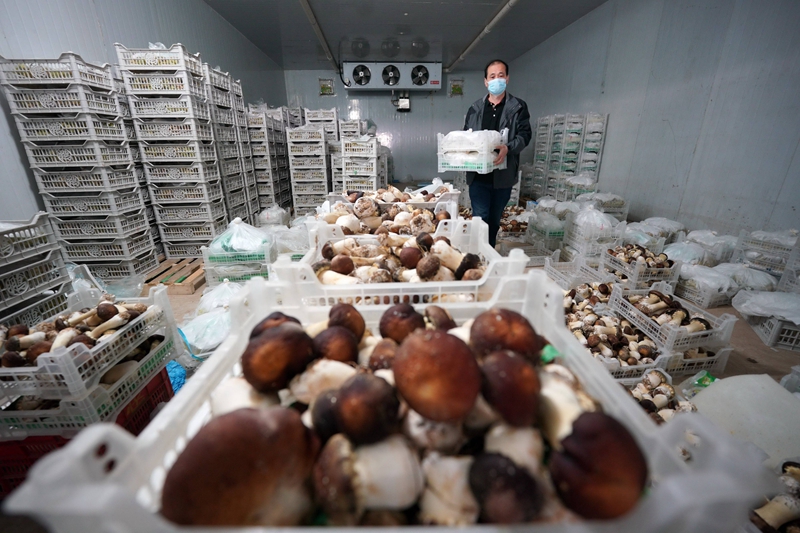
Mushroom core temperature must drop to target storage temperature within 60–120 mins post-harvest:
– Ambient temp above 30℃: Finish pre-cooling within 60 mins;
– Ambient temp 15–30℃: Finish pre-cooling within 2 hours;
– Operation standard: Leave uniform gaps between turnover crates for air circulation, avoid tight stacking to trap field heat.
Industry reminder: Skip pre-cooling → mushroom spoilage rate rises by over 22% during storage.
Scientific Storage Parameters for All Common Mushroom Varieties (Regular Cold vs CA Storage)
Revised based on UC Davis postharvest test data & China Edible Fungi Association technical manual, eliminate false high CO₂ parameter error in original text:
| Mushroom Type | Storage Mode | Temp (℃) | RH | O₂ Concentration | CO₂ Concentration | Max Shelf Life |
|---|---|---|---|---|---|---|
| Button Mushroom | Regular Cold | 0–1 | 90–95% | N/A | N/A | 7 days |
| Button Mushroom | Mechanical CA | 0–1 | 90–95% | 2–3% | 8–12% (Max 15%) | 10–12 days |
| Oyster Mushroom | Regular Cold | 3–4 | 85–90% | N/A | N/A | 7–10 days |
| Oyster Mushroom | Mechanical CA | 3–4 | 85–90% | 1–3% | 4–5% | 15–20 days |
| Shiitake | Regular Cold | 0–4 | 95–98% | N/A | N/A | 8–12 days |
| Shiitake | Mechanical CA | 0–4 | 95–98% | 2–3% | 10–13% | 15–20 days |
| Straw Mushroom (Cold Sensitive) | Regular Cold Only | 10–12 | 90–95% | N/A | N/A | 14–15 days |
| Enoki Mushroom | Regular Cold | 2–4 | 85–90% | N/A | N/A | 4–5 days |
| Enoki Mushroom | Mechanical CA | 2–4 | 85–90% | 3–5% | 5–7% | 10–12 days |
| Fresh Black Fungus | Regular Cold | 2–4 | 85–90% | N/A | N/A | 10–15 days |
Critical Warning for Button Mushroom: CO₂ concentration exceeding 15% will cause irreversible black pit lesions and bitter taste, losing commercial value completely.
Accurate Capacity Calculation & Storage Density Reference
Original text overestimated storage capacity without considering aisle, fan and stacking gap. Below is real engineering measured data with pallet turnover crate layout:
| Warehouse Volume | Effective Fresh Mushroom Storage Capacity | Unit Density Note |
|---|---|---|
| 50–100 m³ | 11–28 tons | 0.22–0.28 tons per m³, small farm batch storage |
| 300–500 m³ | 66–140 tons | Medium mushroom producer bulk storage |
| 1,000–2,000 m³ | 220–560 tons | Large export-scale CA cold storage |
Core calculation formula:
Actual storage tonnage = Total warehouse volume × 0.4–0.6 space utilization coefficient × 0.22–0.28t/m³ mushroom bulk density
Turnkey Construction Cost Breakdown by Warehouse Scale
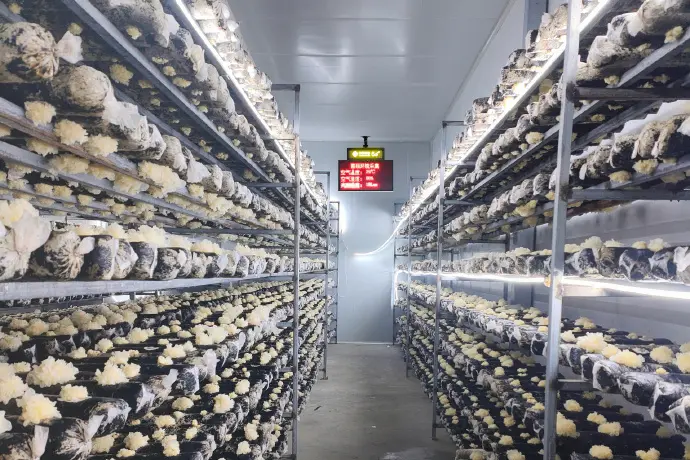
Total quotation includes PU insulation panels, refrigeration units, air coolers, mechanical CA gas regulation system, intelligent temperature/gas monitoring, cold doors and drainage system.
| Storage Volume | Full Turnkey CA Cold Storage Cost (USD) | Target Customer Group |
|---|---|---|
| 50–100 m³ | $12,000 – $18,000 | Small family mushroom farm, local distributor |
| 300–500 m³ | $40,000 – $60,000 | Medium-scale standardized mushroom planting base |
| 1,000–2,000 m³ | $90,000 – $150,000 | Large export-oriented fungus processing factory |
Unit cost range: $200 – $350 per cubic meter; price fluctuation depends on equipment brand, PU panel thickness and automation level.
Key Factors That Change Total Cold Storage Investment
- Refrigeration Compressor Brand: Bitzer, Copeland, Danfoss top brands cost higher than domestic economical units;
- Insulation Material: 100–150mm food-grade PU panel is standard; thicker PIR insulation increases cost for high-temperature tropical regions;
- CA System Configuration: Passive natural CA saves 30% investment vs full mechanical automatic CA;
- Intelligent Monitoring Grade: Cloud remote SMS alarm system adds extra cost but reduces manual management loss;
- Regional Environment: High-temperature tropical areas need oversized condensers, raising total project budget by 8%–15%.
Real Commercial Project Case: Oyster Mushroom Export CA Cold Storage in Thailand
Project Operator: Northern Fungi Co., Ltd., Chiang Mai, Thailand
Business Demand: Local oyster mushroom fresh export to UAE, Qatar and Central supermarket chain
– Warehouse volume: 120 m³ mechanical CA cold storage
– Actual effective storage capacity: ~32 tons fresh oyster mushroom
– Stable operation parameter: Temp 3–4℃, RH 88%, O₂ 2%, CO₂ 4.5%
– Total one-time construction investment: $24,500 USD
– Original loss rate without cold storage: 18% daily waste; after CA storage: controlled below 3%
– Annual extra gross profit brought by cold storage: ~$29,000 USD via stable long-term export orders
– Verified ROI payback cycle: 8 months
Local regional pain point: Long high-temperature summer climate (32–39℃). Our team upgraded large heat-dissipation condensers and external wall heat insulation to cut daily power consumption by 17%.
Frequent Operation Mistakes Causing Browning, Rot & CO₂ Poisoning
- Skip forced-air pre-cooling to save labor → trapped field heat triggers mass soft rot within 1 week;
- Stack crates tightly against warehouse walls & cold air blowers, no ventilation gap → local high-temperature dead zones, uneven browning;
- Uncontrolled high CO₂ concentration over 15% for button mushrooms → black pits, bitter taste, full batch scrapped;
- Frequent cold room door opening during loading/unloading, sharp temperature fluctuation > ±1.5℃ → accelerated enzyme browning;
- Use fully airtight packaging without micro holes inside CA warehouse → anaerobic respiration produces foul alcohol odor;
- Store cold-sensitive straw mushrooms under 8℃ → severe water-soaked cell damage, total loss.
FAQ for Mushroom Growers & Cold Storage Investors
Q1: Can natural passive CA storage realize 15+ days long-term export preservation?
A: No. Passive CA only relies on mushroom self-breathing to adjust gas, indexes fluctuate violently. For cross-border sea freight requiring 15–20 days shelf life, mechanical automatic CA gas scrubber system is mandatory.
Q2: Why the original article’s 25% CO₂ parameter for button mushroom is wrong?
A: Academic tests prove CO₂ over 15% causes irreversible CO₂ physiological poisoning on Agaricus bisporus, with black spots and bad taste. Safe operating window is controlled at 8–12%.
Q3: How to lower daily electricity cost of mushroom CA cold storage?
A: 1. Complete full forced-air pre-cooling before mushrooms enter formal storage; 2. Install air curtain buffer room to block hot air inflow during cargo handling; 3. Adopt variable-frequency screw refrigeration units; 4. Regularly clean evaporator frost to avoid poor heat exchange.
Q4: What is the biggest difference between mushroom cold storage and ordinary fruit cold room?
A: Mushrooms have extremely high respiration and transpiration rate, requiring higher humidity, low wind speed circulation and strict gas balance; ordinary fruit storage does not need such precise CO₂ control.
Q5: Is CA cold storage worthy of investment for small farms with annual output less than 20 tons?
A: Small output farms can choose third-party shared CA cold storage to cut upfront equipment investment; if annual output exceeds 50 tons, self-built small CA warehouse brings obvious profit improvement.
If you plan to build mechanical CA cold storage for button mushroom, oyster mushroom, shiitake and other edible fungi in Southeast Asia, Central Asia or domestic fungus production zones, contact our professional engineering team for customized layout design, detailed equipment list and accurate budget quotation.