 Haocool

For restaurant owners and food-service operators, kitchen space is precious—and so is ingredient freshness. A dual-temperature cold room combines chilled and frozen storage in one compact footprint, solving the space challenge while keeping vegetables, dairy, meats, and seafood at their optimal temperatures.
This guide provides a complete breakdown of dual-temperature cold room costs, size selection criteria, technical considerations, and real-world ROI analysis for restaurant applications.
Why Restaurants Need Dual-Temperature Cold Rooms
Restaurant kitchens have two distinct storage needs:
- Chilled storage (0–10°C): Vegetables, fruits, dairy products, beverages, fresh herbs, prepared sauces
- Frozen storage (-18°C and below): Meats, seafood, frozen vegetables, ice cream, long-term bulk stocks
Traditionally, restaurants used two separate units—a reach-in fridge and a reach-in freezer. But as menus grow and ingredient costs rise, many operators are upgrading to dual-temperature cold rooms for three key reasons:
- Space efficiency: One structure instead of two, saving 30–40% of kitchen floor space
- Cost efficiency: Lower upfront investment than two separate cold rooms
- Operational efficiency: Organized, walk-in access reduces time spent retrieving ingredients
How a Dual-Temperature Cold Room Actually Works
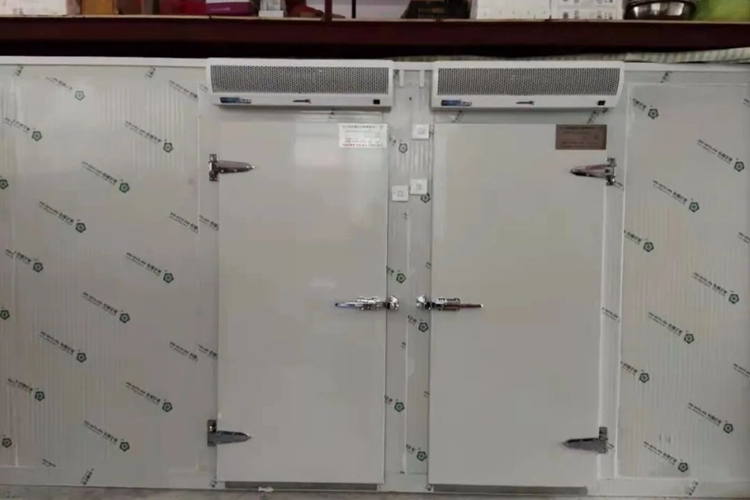
A dual-temperature cold room is not simply one room with two temperatures—it’s a carefully engineered structure with:
Two Technical Approaches
| Approach | Description | Best For |
|---|---|---|
| Shared Wall + Single Compressor | One insulated enclosure divided by a partition wall; one compressor with dual evaporators and solenoid valves | Small to medium restaurants; most cost-effective |
| Two Independent Systems | Two fully separate insulated rooms; independent compressors and controls | Large operations; precise temperature control required |
The Critical Component: The Partition Wall
The partition wall between chilled and frozen zones is the most technically challenging part of a dual-temperature cold room:
- Temperature differential: Up to 28°C difference between sides (10°C vs -18°C)
- Insulation thickness: Frozen side typically requires 150mm panels; chilled side 100mm
- Sealing: Any gap allows cold air to migrate, causing the chilled side to run colder than intended—which can damage vegetables and increase energy costs
- Moisture control: Condensation on the partition wall can lead to ice buildup and structural issues
💡 Key Insight: The partition wall is where most cost-cutting mistakes happen. A poorly insulated or poorly sealed partition wall will cause the chilled section to be “pulled down” by the frozen section, leading to vegetable damage and skyrocketing energy bills.
Size & Capacity Guide
Choosing the right size depends on your restaurant’s daily volume, menu type, and storage duration.
| Room Size | Chilled Capacity | Frozen Capacity | Best For | Est. Cost (USD) |
|---|---|---|---|---|
| 10 m² | 2–3 tons | 1–1.5 tons | Small restaurants, cafés, coffee shops | $7,000 – $8,500 |
| 20 m² | 4–5 tons | 2–3 tons | Mid-sized restaurants, hotel kitchens | $9,500 – $11,500 |
| 30 m² | 7–8 tons | 3–4 tons | Large restaurants, boutique hotels | $14,000 – $17,000 |
| 50 m²+ | 12–14 tons | 6–8 tons | Central kitchens, cafeterias, large chains | $18,000 – $22,000 |
Capacity estimates based on industry averages: chilled foods ≈ 0.25–0.30 tons/m³; frozen foods ≈ 0.40–0.50 tons/m³.
Cost Per Square Meter Reference
| Size | Cost Range | Cost per m² (approx.) |
|---|---|---|
| 10 m² | $7,000–8,500 | $700–850/m² |
| 20 m² | $9,500–11,500 | $475–575/m² |
| 30 m² | $14,000–17,000 | $467–567/m² |
| 50 m² | $18,000–22,000 | $360–440/m² |
💡 Economies of scale: Smaller rooms have higher cost per square meter because fixed costs (compressor, controls, installation) don’t scale down proportionally.
Why the Price Range? What Determines the Final Cost?
1. Insulation Thickness
| Zone | Standard Thickness | Hot Climate (Middle East, SE Asia) |
|---|---|---|
| Chilled Side (0–10°C) | 100mm PU panels | 120mm |
| Frozen Side (-18°C) | 150mm PU panels | 175–200mm |
Thicker panels cost more but reduce energy consumption over the long term.
2. Compressor & Refrigeration Brand
| Brand | Price Tier | Reliability | Typical Lifespan |
|---|---|---|---|
| Bitzer, Copeland, Danfoss | Premium | Highest | 15–20 years |
| Tecumseh, Embraco | Mid-range | Good | 10–15 years |
| Local/Chinese brands | Budget | Variable | 5–10 years |
3. Control System
- Basic: Mechanical thermostats, manual defrost → lowest cost
- Standard: Digital controllers, automatic defrost → included in most quotes
- Advanced: PLC with remote monitoring, SMS/email alerts → additional $500–1,500
4. Installation Complexity
Kitchen installations are often more challenging than warehouse installations due to:
- Limited access for equipment delivery
- Existing plumbing, electrical, and ventilation systems
- Need to minimize disruption to restaurant operations
5. Climate Conditions
In hot climates (Dubai, Bangkok, Lagos, Riyadh), additional insulation thickness and higher-capacity refrigeration may be required, increasing costs by 10–20%.
Restaurant Selection Guide: Which Size Fits Your Business?
| Restaurant Type | Recommended Size | Chilled/Frozen Ratio | Why |
|---|---|---|---|
| Café / Bakery | 10 m² | 70% chilled / 30% frozen | Mostly dairy, cream, eggs; some frozen pastry dough |
| Fast Food / QSR | 15–20 m² | 50% chilled / 50% frozen | Balanced mix of fresh produce and frozen proteins |
| Mid-Range Restaurant | 20–30 m² | 60% chilled / 40% frozen | High volume of fresh ingredients + frozen backup |
| Seafood / Steakhouse | 25–35 m² | 30% chilled / 70% frozen | Large quantities of frozen meats and seafood |
| Central Kitchen / Chain | 50 m²+ | 50% chilled / 50% frozen | Bulk storage; flexible allocation |
Real-World ROI: Restaurant in Kuala Lumpur, Malaysia
A mid-range restaurant in Kuala Lumpur (average daily customers: 150–200) replaced two standalone refrigerator/freezer units with a 25 m² dual-temperature cold room.
Project Details
| Metric | Value |
|---|---|
| Total Investment | $10,800 USD |
| Configuration | 5°C chilled section + -18°C frozen section |
| Storage Capacity | 6–7 tons total (chilled + frozen) |
| Energy Consumption | ~18–25 kWh per m² per day |
Results
| Metric | Before | After |
|---|---|---|
| Food Spoilage Rate | 12% | 4% |
| Monthly Electricity Cost | Baseline | ~15% lower |
| Kitchen Floor Space Used | 2 units | 40% less |
| ROI Timeline | — | 10–16 months |
How the ROI Was Achieved
- Reduced spoilage from 12% to 4%: Saving 8% of monthly food purchases
- Monthly food purchases: ~$3,000
- Annual savings: $3,000 × 8% × 12 = $2,880/year
- Lower electricity costs: Dual-temperature system with efficient compressors vs. two older units
- Estimated annual savings: $300–500/year
- Space efficiency: 40% less kitchen floor space used
- Enabled better kitchen workflow and additional prep space
- Bulk purchasing: Larger storage capacity allowed buying in bulk at lower prices
Total annual savings: ~$3,500–4,500 → Payback in 10–16 months
Frequently Asked Questions
Q1: Dual-temperature cold room or two separate cold rooms—which is better?
| Factor | Dual-Temperature | Two Separate Rooms |
|---|---|---|
| Upfront Cost | Lower (shared structure) | Higher |
| Space Required | 30–40% less | More |
| Temperature Independence | Good (with proper partition) | Excellent |
| Energy Efficiency | Better (shared walls reduce heat gain) | Good |
| Maintenance | One system to maintain | Two systems |
Recommendation: For most restaurants (10–50 m²), dual-temperature is the more cost-effective choice. For large operations (100m²+) with high-volume frozen storage, separate rooms may be better.
Q2: Will the chilled section get too cold from the frozen section?
With a properly designed partition wall (sufficient insulation thickness + proper sealing), no. The chilled section maintains its set temperature independently. Poorly designed partition walls are the #1 cause of problems in dual-temperature cold rooms.
Q3: What’s the minimum space required for a restaurant dual-temperature cold room?
A 10 m² unit (approximately 3m × 3.3m) is the smallest practical size. This requires about 12–14 m² of floor space including clearance for doors and airflow.
Q4: How long does installation take? Will it affect restaurant operations?
Typical installation takes 3–5 days for a 20–30 m² unit. Most installations can be scheduled during off-hours or on closed days to minimize disruption. Pre-fabricated panels allow for faster on-site assembly.
Q5: What is the ongoing maintenance cost?
Annual maintenance typically includes:
- Compressor service: $200–400/year
- Evaporator cleaning: $100–200/year
- Door seal inspection/replacement: as needed
- Refrigerant top-up: as needed
Total annual maintenance: approximately $300–600/year.
Q6: Can the cold room be expanded later?
Modular panel designs allow for future expansion, but expansion requires careful planning—especially for the partition wall between chilled and frozen zones. If you anticipate growth, discuss expansion capability with your supplier during the design phase.
Ready to Invest?
A dual-temperature cold room is a proven investment for restaurants of all sizes. With upfront costs of $7,000–22,000 (depending on size) and typical ROI in 10–16 months, it’s one of the most cost-effective ways to reduce food waste, lower energy costs, and optimize kitchen space.
Next steps:
1. Assess your daily ingredient volume and menu type
2. Measure your available kitchen space (including door access)
3. Determine your ideal chilled/frozen ratio
4. Request a site-specific quote from a supplier with restaurant experience
The storage parameters provided above are for reference only. Optimal cold room conditions vary depending on product type, kitchen layout, climate, and operational requirements. Consult with a cold storage specialist for a customized solution.