 Haocool

Author: National Germplasm Bank Special Cold Chain Engineer
11 years EPC & quotation experience for agricultural research institutes, seed breeding companies & Southeast Asian seed export factories. Familiar with NY/T 4152 Crop Germplasm Repository Specification, GB/T 3543 Seed Testing Rules, GB 50072 Cold Storage Standard, specialize in low-humidity long-term germplasm cold storage design for subtropical high-humidity regions.
Seed vitality directly determines germination rate and breeding value; temperature and relative humidity are the two core control indicators for seed storage. High humidity triggers lipid oxidation, mold and aflatoxin production, resulting in irreversible loss of seed embryo activity. Many seed investors only refer to rough temperature ranges without distinguishing long/medium/short-term germplasm warehouse low-humidity matching standards, leading to massive seed scrapping.
1 Official NY/T 4152 Graded Seed Storage Standard (By Storage Term & Crop Type)
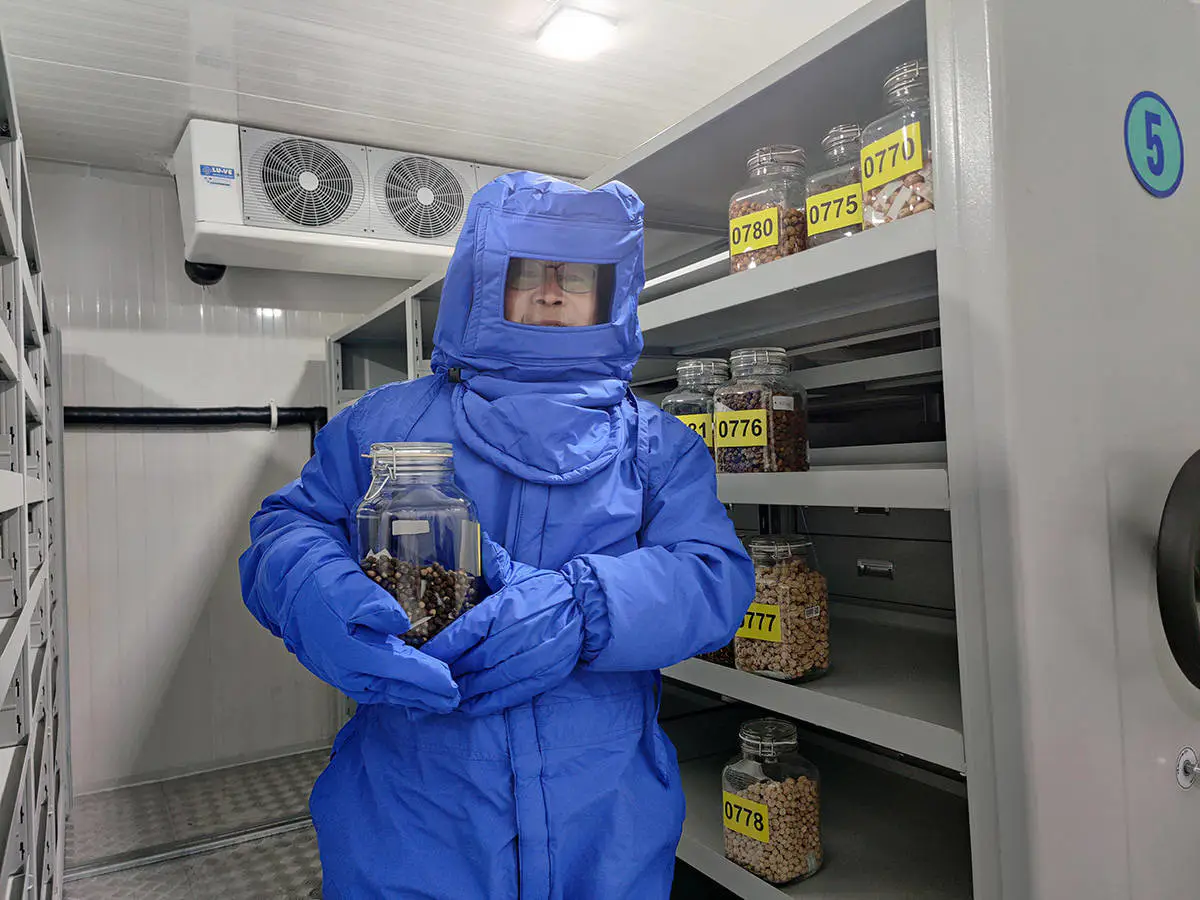
Low humidity germplasm seed cold storage complying NY/T4152 standard
Unified Mandatory Rules
- Temp fluctuation limit ≤±0.5℃; RH fluctuation ≤±3%
- Safe seed moisture content: Long-term 5±1%; Medium 6–9%; Short ≤12%
- All germplasm warehouses must equip independent low-temperature rotary dehumidifier (ordinary cooling cannot reach RH<45)
| Warehouse Type | Standard Temp | Mandatory RH | Valid Storage Life | Adapted Crop & Packaging |
|---|---|---|---|---|
| Long-Term Germplasm Bank | -18 ±2℃ | 30–40% | 30–50+ years | Vegetable / Rice / Wheat, airtight aluminum foil cans |
| Medium-Term Production Seed Warehouse | -4 ~ 0℃ | 40–45% | 10–30 years | Grain hybrid seeds, composite barrier bags |
| Short-Term Commercial Seed Warehouse | 10 ~ 15℃ | 50–55% | 2–5 years | Bulk retail paper/plastic bags |
Crop-Specific Fine-Tuning Supplement
- Leafy vegetable seeds: Long-term storage fixed RH 28–35% (higher oil content easy oxidation)
- Legume seeds: Medium warehouse max RH 42% to prevent hard seed coat
- Tropical fruit seeds: Cannot be stored below 0℃ to avoid chilling injury
2 GB 50072 Standard Seed Storage Capacity Calculation
Official Formula
Usable Seed Ton G = Total Volume V × Volume Utilization Coefficient η × Bagged Seed Density ρ
Fixed Standard Parameters
- Seed warehouse volume ≤5000m³ → η = 0.42 (Reserve sample inspection aisle)
- Woven bag seed unified density ρ = 0.26 t/m³
Reference Capacity Table
| Total Volume | Calculated Seed Tonnage | Project Scenario |
|---|---|---|
| 1200 m³ | 1200 × 0.42 × 0.26 = 131 tons | Medium seed breeding factory |
| 3000 m³ | 300 × 0.42 × 0.26 = 328 tons | Provincial germplasm resource bank |
3 Full Turnkey Cost Breakdown (Benchmark: Temperate Zone, 1200m³ Standard Medium Seed Warehouse)
Benchmark: 100mm B1 PU, dual redundant scroll unit, independent rotary dehumidifier
| Warehouse Category | Total 1200m³ Investment | Extra Cost For Low-Humidity Long-Term Library |
|---|---|---|
| Medium-Term Seed Warehouse | USD 68,000 | +22–30% |
| Long-Term -18℃ Germplasm Bank | USD 86,000 – 94,000 | Full 200mm thick panel + deep cold two-stage unit |
Main Cost Premium Factors
- Southeast tropical high humidity oversized condenser + double vapor barrier: +9–14%
- Import Bitzer parallel redundant rack: +26–33%
- Independent defective seed isolation room: Extra $5,000 – 8,000
- 5-year non-editable germplasm data logging system: Extra $4,000 – 7,000
4 Four Core Fixed Cost Proportion (Seed Warehouse Exclusive)
- Insulation & Vapor Barrier Enclosure (30–38%): Double HDPE warm-side vapor barrier for anti-moisture
- Refrigeration + Independent Dehumidification System (38–48%): Largest cost gap for germplasm projects
- High-Precision Monitoring (10–16%): ±0.2℃ PT100 RH sensors
- Installation & 72h Low-Humidity Commissioning (12–18%)
5 Mandatory Germplasm Cold Storage Technical Design
Humidity Control Hard Rule
Ordinary cold machine can only cool down but cannot dehumidify under low temperature; each chamber must match industrial rotary silica gel dehumidifier to lock RH below 45.
Refrigeration Safety
Every independent seed room 1-main-1-standby unit; dual municipal power + 72h UPS to avoid seed embryo inactivation during power outage.
HACCP Germplasm Zoning
Three physical separated zones: Pending inspection / qualified seed storage / deteriorated seed isolation, forbidden mixed stacking.
Envelope Anti-Condensation
All wall & roof laid double full vapor barrier, heating air curtain for each loading vestibule to block outdoor humid air inflow.
6 Real Thailand Tropical Seed Factory 1200m³ Case
Basic Info
- Scale: Medium-term -4~0℃ seed cold storage, total investment $68,000
- Local climate year-round RH 85%+, equipped oversized condenser + double vapor barrier
Measurable 12-Month Operation Benefits
- Seed mold & oxidation scrap rate reduced from 13.6% down to 2.8%
- Average germination rate improved by 11% compared to ordinary cold room
- Annual refrigeration & dehumidification power consumption 32–38 kWh/ton
- Full investment payback period: 18–22 months via reduced seed replacement cost
7 7 Common Germplasm Warehouse Inspection & Procurement Pitfalls
- Omit independent rotary dehumidifier → RH over 60, seed embryo rapid oxidation
- Use single compressor without standby → Power outage causes full batch seed loss
- Long-term library only 100mm thin panel instead of mandatory 200mm → Continuous overload & high power cost
- Mixed qualified & deteriorated seeds → Fail agricultural germplasm audit
- Single-layer vapor barrier for tropical regions → Wall condensation mold contamination
- Ordinary low-precision sensor over ±1℃ → Unstable storage life
- No encrypted seed storage data log → Cannot pass national germplasm filing inspection
Simple Seed Warehouse ROI Formula
Annual Net Profit = Seed Replacement Cost Saving − Annual Electricity & Maintenance − Mold Spoilage Loss Reduction
Full Payback Months = Total Turnkey Investment ÷ Average Monthly Net Income
FAQ For Seed Companies & Germplasm Institutes
Q1 What RH standard for long-term germplasm bank?
Per NY/T4152 standard, stable RH 30–40% under -18℃ storage.
Q2 Why seed warehouse needs independent dehumidifier?
Conventional evaporator can not remove moisture under sub-zero environment, high RH accelerates seed lipid peroxidation and mold growth.
Q3 Temperature difference between long-term and medium seed warehouse?
Long-term germplasm: -18±2℃; medium production seed: -4~0℃, cannot use 10–15℃ for multi-year storage.
Q4 Extra cost for tropical Southeast seed warehouse?
Oversized heat exchanger + double vapor barrier add 9–14% total investment.
Custom Seed Cold Storage Inquiry
Provide seed type, storage term (long/medium/short) and local max humidity to get low-humidity layout & itemized quotation.