 Haocool

Author: Tropical Root Crop Plantation Cold Chain Senior Engineer
10 years quotation & EPC experience for taro/colocasia industrial bases in Guangxi, Vietnam, Nigeria & Ghana. Familiar with GB 50072 Cold Storage Standard & Ministry of Agriculture Tuber Crop Postharvest Preservation Specification, distinguish regular humidity-controlled warehouse and CA modified atmosphere 6-month export warehouse two full cost systems.
Fresh taro is respiration-active tuber crop, extremely sensitive to low-temperature chilling injury and water loss. Improper storage below 8℃ causes irreversible pulp browning; high temperature triggers sprouting and rot within 30 days. Many taro farmers only compare total cold room price without gradient pre-cool equipment and CA gas system, resulting heavy export rejection loss.
1 GB 50072 Standard Taro Storage Capacity Calculation
Official Calculation Formula
Usable Tonnage G = Total Volume V × Volume Utilization Coefficient η × Carton Taro Density ρ
Unified National Standard Parameters
- 200㎡ × 4m = 800 m³ small warehouse → η = 0.4
- Mesh bag taro unified density ρ = 0.22 t/m³
Exact Standard Tonnage Calculation
G = 800 × 0.4 × 0.22 = 70.4 tons
Note: Rough 175–190 tons empirical value in original articles ignores pallet & ventilation aisle space, cannot be used for equipment tender & factory layout audit.
2 Full Turnkey Price Table (Benchmark: 100mm B1 PU, Temperate Max 32℃, Excluding Civil Foundation)
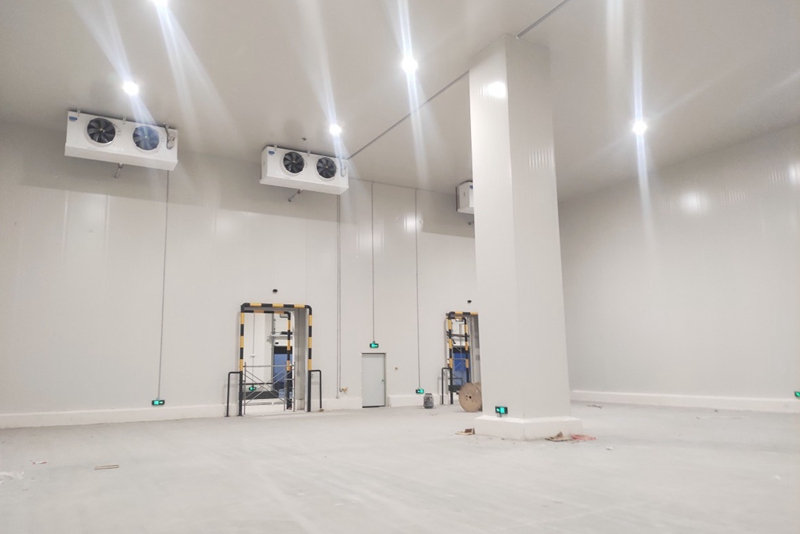
| Warehouse Type | Mandatory Taro Preservation Matching | Total Investment (200㎡ 800m³) | Max Storage Cycle |
|---|---|---|---|
| Regular Constant Humidity Warehouse | Gradient pre-cool room, micro-fog humidifier, low-speed air cooler | $45,000 – 52,000 | 3–4 months |
| CA Modified Atmosphere Warehouse | N₂ generator, CO₂ scrubber, full airtight wall, ethylene removal unit | $54,000 – 63,000 | Up to 6 months |
Main Cost Premium Adjustment Items
- Import Bitzer parallel compressor upgrade: +26–33% total budget
- Southeast/Africa tropical year-round high RH: Double HDPE vapor barrier + oversized condenser +9–14%
- Independent damaged taro isolation partition: Extra $5,800 – 8,600
- 1-MCP sprout inhibition auxiliary equipment: Extra $3,200 – 5,000
3 Four Core Fixed Cost Proportion (Taro Warehouse Exclusive)
- PU Insulation Enclosure (30–38%): 100mm B1 low-smoke PUR, full warm-side double vapor barrier for tropics
- Refrigeration & Humidification System (36–46%): Scroll unit + low-wind evaporator to avoid tuber shrivel
- Temp/RH Intelligent Monitoring (10–15%): Multi-point sensor, 5-year non-editable cloud log
- Installation & 72h Full-Load Preservation Test (12–19%): Humidity & air tightness calibration
4 Mandatory Taro Postharvest & Storage Standards
Stepwise Gradient Pre-Cool (Must Complete Within 7–10 Days After Picking)
- Initial pre-cool stage: 15~18℃ to release field heat (taro picked at 28–32℃)
- Mid transition stage: 12~14℃
- Long-term storage stable temp: 10~13℃
Hard Rule: Storage temp below 8℃ leads permanent chilling injury (water-soaked pulp, poor taste after cooking)
Fixed Humidity & Vent Index
- Permanent RH: 85–90% to control weight loss ≤5%
- Air flow velocity ≤0.6m/s, daily forced ventilation to reduce CO₂ accumulation
- Strictly separate from apple/banana (high ethylene accelerates sprouting)
CA Warehouse Special Gas Control
O₂:8–10%, CO₂ ≤5% to inhibit sprouting & mold for 6-month sea export
5 Real Eastern Nigeria Taro Cooperative Project Case
Basic Info
- Scale: 200㎡ / 800m regular constant humidity taro cold room
- Total turnkey investment: $51,200 domestic standard configuration
- Local tropical high humidity equipped double HDPE vapor barrier
Measurable 12-Month Operation Benefits
- Taro rot & shrivel scrap rate reduced from 30% down to 6.2%
- Off-season export price 2.7x higher than harvest spot price
- Inverter energy-saving unit cut annual refrigeration electricity by 20%
- Full investment payback period: 13 months
6 7 Common Taro Cold Storage Hidden Pitfalls
- Long-term storage temp set below 8℃ → Irreversible chilling injury & export rejection
- Omit gradient pre-cool room → Field heat causes mass rot within 30 days
- Single-layer vapor barrier for tropical Africa/Southeast Asia → Wall condensation & mold
- High-speed air cooler → Severe taro weight loss & commodity value drop
- Mix storage with ethylene-rich fruits → Whole batch sprouting
- No independent damaged taro isolation room → Mold cross-contamination
- Cheap thin 80mm PU panel → 30%+ annual electricity surge
Simple Taro Farm ROI Calculation Formula
Annual Net Income = Off-Season Export Price Premium − Annual Power & Maintenance − Spoilage Loss Reduction
Full Payback Months = Total Turnkey Investment ÷ Average Monthly Net Profit
FAQ For Taro Plantation Managers & Exporters
Q1 What’s the safe storage temperature for taro?
Stable 10~13℃ per national tuber crop standard; below 8℃ triggers chilling injury.
Q2 Why need staged gradient pre-cool for fresh taro?
Fresh taro carries high field heat over 30℃, direct low-temperature storage accumulates respiration heat & rot.
Q3 How much extra cost for tropical African taro warehouse?
Add double HDPE vapor barrier & oversized condenser, total budget increases 9–14%.
Q4 What’s the difference between regular & CA taro warehouse?
CA warehouse adds nitrogen generator & airtight wall to extend shelf life up to 6 months for sea freight export.
Custom Taro Cold Storage Inquiry
Provide taro variety, target storage period and local maximum ambient humidity to get itemized quotation & pre-cool layout drawing.