 Haocool

A 300-square-meter chilled storage room is one of the most common cold chain investments for farms, packing houses, and wholesale markets. It’s large enough to handle a week’s peak harvest output—yet compact enough to be a manageable first step into cold chain infrastructure.
But what does it really cost? How much can you actually store? And will it pay for itself?
This guide provides a complete breakdown of costs, capacity planning, crop-specific storage requirements, and real-world ROI analysis.
Storage Capacity: How Much Produce Fits in 300m²?
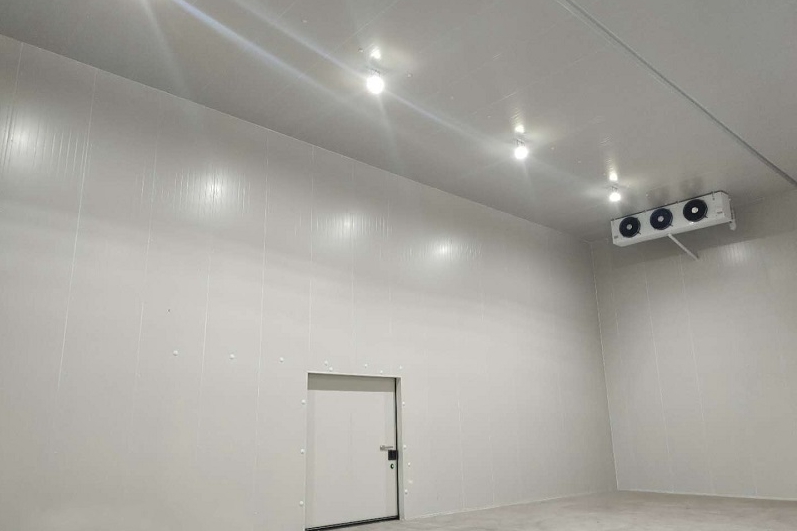
A 300m² room with 3.0m clear height provides approximately 900m³ of usable volume. Storage capacity varies by crop type, packaging, and stacking method.
| Parameter | Specification |
|---|---|
| Room Dimensions | 300 m² × 3.0 m height = 900 m³ |
| Storage Method | Palletized cartons or bulk bins with airflow gaps |
| Typical Density | 200 – 250 kg/m³ (varies by crop) |
| Usable Capacity | 180 – 225 metric tons of fresh produce |
Capacity by Crop Type
| Crop | Density Range | Estimated Capacity (300m²) | Packaging |
|---|---|---|---|
| Tomatoes | 220–250 kg/m³ | ~200–225 tons | Cartons (15–20 kg/box) |
| Mangoes | 210–240 kg/m³ | ~190–215 tons | Cartons (10–12 kg/box) |
| Leafy Greens (packed) | 170–200 kg/m³ | ~155–180 tons | Cartons with ice packs |
| Citrus | 230–260 kg/m³ | ~210–235 tons | Bulk bins / mesh bags |
| Onions / Garlic | 200–220 kg/m³ | ~180–200 tons | Mesh bags / bulk bins |
Factors That Affect Actual Capacity
- Packaging: Cartons stack more efficiently than bulk bins but add weight and volume
- Racking System: Block stacking vs. pallet racking vs. drive-in racking can create 20–30% capacity differences
- Ventilation Requirements: Different crops need different airflow gaps between stacks
- Aisle Space: Forklift access requires wider aisles than manual handling
This space typically holds 7–10 days of peak harvest output—giving you time to sort, pack, and negotiate better prices.
Total Investment: What You Actually Pay
A turnkey 300m² fresh produce cold room (0–5°C, humidity-controlled) typically costs $42,000–$48,000 USD.
Detailed Cost Breakdown
| Cost Category | Share | Estimated Cost | Key Specifications |
|---|---|---|---|
| Insulation Panels | 25–30% | ~$12,000 | 100mm fire-rated PU panels, food-grade steel cladding |
| Refrigeration System | 30–35% | ~$15,000 | 30HP Bitzer/Copeland compressor (equivalent to “30P”) |
| Evaporators | 10–15% | ~$5,000 | 2× DL210 ceiling-mounted units with electric defrost |
| Humidity Control | 5–8% | ~$3,000 | 85–95% RH adjustable per crop |
| Controls & Monitoring | 5–8% | ~$3,000 | Digital thermostat + remote monitoring via mobile app |
| Floor System | 5–8% | ~$3,000 | Insulated + reinforced concrete |
| Doors & Dock Equipment | 3–5% | ~$2,000 | Insulated doors + loading dock |
| Installation & Commissioning | 8–10% | ~$4,000 | On-site build, testing, training |
| Total | 100% | $42,000–48,000 | ✅ Everything needed to operate day one |
Price per Square Meter Reference
| Metric | Value |
|---|---|
| Total Investment | $42,000–48,000 |
| Floor Area | 300 m² |
| Cost per m² | $140 – $160/m² |
What Determines the Final Price?
- Equipment brand: Bitzer/Copeland (international) vs. local brands — 15–20% difference
- Automation level: Basic thermostat vs. mobile app monitoring with alarms
- Installation location: Freight, tariffs, and local labor costs vary by country
- Humidity control precision: Basic vs. precision humidity control systems
- Climate conditions: Hot climates require thicker insulation and higher-capacity refrigeration
Why Temperature Stability Is Critical
The article mentions “temperature must be stable within ±0.5°C”—here’s why:
- Temperature fluctuation → condensation → mold growth → supermarket rejection
- Fresh produce continues to “breathe” after harvest. For every 10°C increase in temperature, respiration rate increases 2–3×, accelerating spoilage.
- ±0.5°C precision is the minimum requirement for accessing premium supermarket chains (European retailers, GCC buyers).
- Achieving ±0.5°C requires: quality controller + properly positioned evaporators + good air circulation.
Humidity Control: Different Crops, Different Needs
| Crop Type | Optimal RH | Risk if Wrong |
|---|---|---|
| Leafy Greens (lettuce, spinach) | 90–95% RH | Too dry → wilting |
| Tomatoes, Peppers | 85–90% RH | Too humid → mold |
| Onions, Garlic | 65–75% RH | Too humid → sprouting, rot |
| Root Crops (carrots, potatoes) | 90–95% RH | Too dry → shriveling |
⚠️ Critical Warning: Storing onions at 90% RH (ideal for leafy greens) will cause them to sprout and rot within weeks. Humidity control must be adjusted per crop.
Pre-Cooling: The Most Critical Step in Fresh Produce Storage
Pre-cooling is arguably more important than the cold room itself:
- What it is: Reducing produce temperature to storage temperature within 2–4 hours of harvest
- Why it matters: Every 1-hour delay in pre-cooling reduces shelf life by 1 day
- Methods: Forced-air cooling, vacuum cooling, hydrocooling
- Cold room design must account for: Sufficient refrigeration capacity + proper air distribution
💡 Pro Tip: A cold room without a pre-cooling plan is like a highway with no on-ramp. The cold room can maintain temperature, but if you don’t get the produce cold fast enough, you’ve already lost shelf life.
Real-World ROI: Mango Exporter in Krabi, Thailand
A mango exporter in Krabi, Thailand built a 300m² chilled room to serve EU and GCC buyers.
Project Details
| Metric | Value |
|---|---|
| Total Investment | $44,000 USD |
| Crop | Nam Dok Mai mangoes |
| Storage Capacity | 195 tons |
| Temperature | 0–5°C |
| Target Markets | EU and GCC (Middle East) |
Results
| Metric | Before | After |
|---|---|---|
| Post-Harvest Loss | 25% | 5% |
| Shelf Life | 8 days | 21 days |
| Shipping Method | Air freight | Sea freight to Dubai |
| Freight Cost | Baseline | Saved $2.80/kg |
| ROI Timeline | — | 9 months |
How the ROI Was Achieved
- Reduced loss from 25% to 5%: Saving 20% of total production value
- Extended shelf life from 8 to 21 days: Enabled sea freight instead of expensive air freight
- Saved $2.80/kg on freight: Sea freight to Dubai vs. air freight
- Market timing: Can now ship when market prices are favorable, not when fruit is rotting
“Before this cold room, we lost a truckload every week. Now, we ship when the market is right—not when the fruit is rotting.”
— Operations Manager, Andaman Fresh Exports
Choosing the Right Cold Room Configuration for Your Crop
| Your Crop | Recommended Temperature | Recommended RH | Special Requirements |
|---|---|---|---|
| Leafy Greens | 0–2°C | 90–95% RH | Rapid pre-cooling; avoid ethylene exposure |
| Tomatoes (ripe) | 8–12°C | 85–90% RH | Below 8°C causes chilling injury |
| Tomatoes (mature green) | 12–15°C | 85–90% RH | Requires ethylene for ripening |
| Mangoes | 10–13°C | 85–90% RH | Below 8°C causes chilling injury |
| Citrus | 3–8°C | 85–90% RH | — |
| Onions / Garlic | 0–2°C | 65–75% RH | Requires ventilation |
Frequently Asked Questions
Q1: What is the actual usable space in a 300m² cold room?
After accounting for insulation thickness (100mm walls), aisles, and ventilation gaps, usable floor space is typically 260–280m². Usable volume is approximately 780–840m³.
Q2: Why does capacity vary so much between crops?
Different crops have different densities. Tomatoes are denser (220–250 kg/m³) than leafy greens (170–200 kg/m³) because greens are lighter and require more packaging. Packaging methods also affect capacity.
Q3: Why does temperature fluctuation cause mold?
When temperature fluctuates, moisture condenses on the surface of produce and packaging. Condensation creates the perfect environment for mold growth—which leads to supermarket rejection.
Q4: Does the $42,000–48,000 price include land and building construction?
No. The price assumes an existing building shell—it covers insulation, refrigeration, humidity control, flooring, doors, controls, and installation. Land acquisition and building construction are additional costs.
Q5: How long does construction take?
For a 300m² facility using an existing shell, typical construction takes 4–6 weeks from material arrival to commissioning.
Q6: What is the operating cost of a 300m² fresh produce cold room?
Energy is the largest operating cost. For a 900m³ facility:
- Energy consumption: 150–250 kWh per m³ annually
- Monthly cost: Varies by local electricity rates
- Maintenance: $2,000–4,000/year for compressor service, evaporator cleaning, and system checks
Q7: Can I build a smaller cold room now and expand later?
Yes. Modular panel designs allow for future expansion. However, expansion requires careful planning of the refrigeration system capacity from the start. Discuss expansion plans with your supplier during the design phase.
Ready to Invest?
A 300m² fresh produce cold room is a proven investment for farms, packing houses, and exporters. With upfront costs of $42,000–48,000 and typical ROI in 9–12 months, it’s one of the most cost-effective ways to reduce post-harvest loss, access premium markets, and gain negotiating power.
Next steps:
1. Define your crop type and required temperature/humidity
2. Assess your site (existing shell or ground-up construction)
3. Determine your peak harvest volume and storage duration needs
4. Request a site-specific quote from a supplier with relevant crop experience
The storage parameters provided above are for reference only. Optimal cold room conditions vary depending on crop variety, harvest maturity, growing region, and market requirements. Consult with a cold storage specialist for a customized solution.