 Haocool

If you are in the garlic trade in Jakarta, you already know the problem. Garlic prices spike when supply is tight, and they crash during harvest season. Without proper cold storage, you are stuck selling when everyone else is selling – and you take whatever price the market gives you.
A garlic cold storage changes that. It lets you hold your stock, wait out the low-price period, and sell when prices recover. But the first question is always the same: how much does it cost to build a 1,000-ton garlic cold storage in Jakarta?
Here is a practical breakdown – from the space you need, to the storage conditions, to the final price.
First, How Much Space for 1,000 Tons of Garlic?
Garlic is not as dense as meat or frozen fish. It is bulky, and it needs ventilation to prevent mould and sprouting.
The industry standard for garlic storage density is 180–220 kg per cubic metre. For 1,000 tons (1,000,000 kg), that works out to roughly:
- 1,000,000 kg ÷ 200 kg/m³ = 5,000 m³ of net storage volume.
But you also need aisles for forklifts, ventilation gaps between pallets, and space for loading and unloading. So the total volume required is closer to 5,500–6,000 m³.
Assuming a ceiling height of 5 metres, the floor area you need is roughly:
- 6,000 m³ ÷ 5 m = 1,200 m².
So a 1,000-ton garlic cold storage in Jakarta typically needs about 1,200 square metres of floor space.
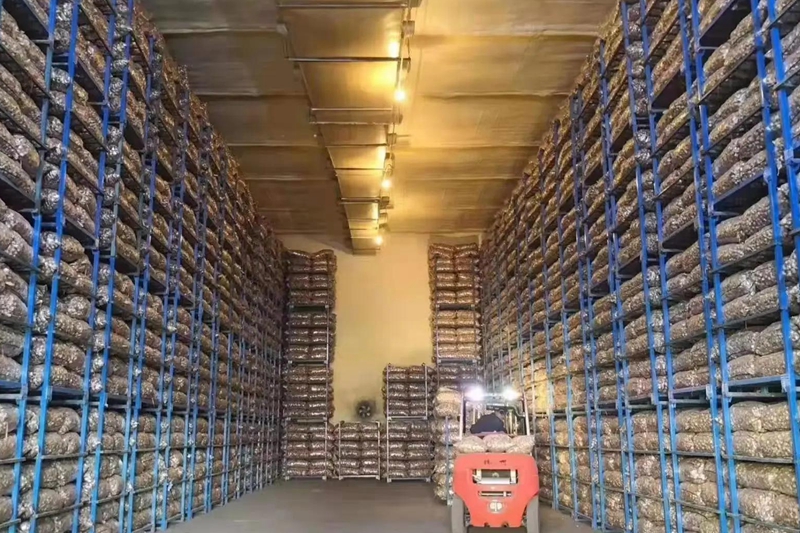
What Temperature and Humidity Does Garlic Need?
Garlic is not like other vegetables. It has specific requirements:
| Parameter | Recommended Value |
|---|---|
| Temperature | 0°C – 2°C (32–36°F) |
| Relative humidity | 65% – 75% |
| Ventilation | Regular air exchange to remove ethylene and CO₂ |
| Light | Dark storage (light triggers greening and bitterness) |
Temperature: Garlic must be stored above freezing. Below 0°C, it suffers from freezing injury – the bulbs become soft, and decay sets in quickly. The ideal range is 0–2°C, which suppresses sprouting without damaging the bulbs.
Humidity: Too dry, and the bulbs shrivel and lose weight. Too wet, and mould develops. The sweet spot is 65–75% RH.
Ventilation: Garlic breathes even after harvest. It produces heat, ethylene, and CO₂. Without proper air exchange, these gases build up and accelerate spoilage.
Estimated Cost for a 1,000-Ton Garlic Cold Storage in Jakarta
A garlic farmers’ cooperative in Kartasura, Indonesia, recently built a 1,200m² cold store for 1,220 tons of garlic at a total cost of $235,000 USD. A 1,000-ton facility in Jakarta would fall in a similar range.
Here is a rough breakdown:
| Component | Estimated Cost (USD) |
|---|---|
| Insulation panels (120mm polyurethane, rodent-resistant cladding) | $60,000 – 75,000 |
| Refrigeration equipment (compressors, evaporators, condensers) | $55,000 – 65,000 |
| Ventilation system (forced-air circulation) | $15,000 – 20,000 |
| Electrical and control systems (cloud-based monitoring with alerts) | $12,000 – 18,000 |
| Installation and labour (Jakarta) | $30,000 – 40,000 |
| Engineering, design, and permits | $10,000 – 15,000 |
| Contingency and miscellaneous | $15,000 – 25,000 |
| Total (approx.) | $197,000 – 258,000 |
A 1,000-ton garlic cold storage in Jakarta typically costs between $200,000 and $260,000 USD (roughly 3.2 – 4.2 billion Indonesian Rupiah, depending on the exchange rate).
For more details on garlic cold storage design, pricing and preservation best practices, review our full guide on Garlic Cold Storage: Essential Guidelines & Key Factors for Successful Preservation.
What Drives the Cost Up or Down in Jakarta?
1. Location in Jakarta
Building inside Jakarta itself means higher land costs and more complex permitting. But it also means better access to the port, major markets, and skilled technicians. Building on the outskirts – like in Bekasi or Tangerang – can reduce land costs but add transport time for goods.
2. Insulation Panel Quality and Thickness
For a 0–2°C garlic room, 120mm polyurethane panels are standard. Thicker panels cost more upfront but reduce electricity consumption. In Jakarta’s hot and humid climate, skimping on insulation is a false economy – your compressors will run harder and your electricity bill will be higher.
3. Ventilation System
Garlic needs regular air exchange – typically every 2 hours. A good ventilation system with forced-air circulation and automated timers adds to the cost but is essential for preventing mould and sprouting.
4. Equipment Brand
Premium brands like Bitzer, Copeland, or GEA cost 20–30% more than good Chinese brands. They are more reliable and energy-efficient, which matters for a facility that runs 24/7. The long-term savings often justify the higher initial investment.
5. Monitoring and Controls
A cloud-based monitoring system with SMS alerts for temperature and humidity drift adds $3,000–5,000 to the cost. For garlic, this is a worthwhile investment – a few hours of temperature drift can ruin a whole batch.
6. Number of Compartments
A single large room is cheaper than multiple smaller rooms. But if you want to store different garlic grades separately – or if you want to open only one small door at a time to save energy – expect to pay more for additional insulation walls, doors, and independent controls.
Practical Considerations for Jakarta
Power Supply
Jakarta’s electricity grid is generally reliable, but voltage fluctuations are common. A voltage stabiliser or automatic voltage regulator is a good investment. For a garlic cold storage, a backup generator is also recommended – a power outage on a hot day can raise the temperature above 2°C and trigger sprouting.
Humidity Control
Jakarta is humid – which is actually helpful for maintaining 65–75% RH. But too much humidity can cause mould. You may need a dehumidifier for the rainy season.
Imported vs. Local Materials
Most refrigeration equipment in Indonesia is imported. That means shipping costs, customs duties, and lead times. Working with a contractor who has established supply chains can save you time and money.
Is a 1,000-Ton Garlic Cold Storage Worth It in Jakarta?
The short answer is yes – for anyone who handles garlic in volume.
Indonesia imports over 200,000 tons of garlic annually, and domestic production is limited. Prices in Jakarta regularly spike to $3.08 per kilogram – well above the government’s reference price. With a cold storage, you can:
- Buy when prices are low (during harvest season in China or India)
- Store for 6–9 months
- Sell when Jakarta’s market is tight and prices are high
A garlic farmers’ cooperative in Indonesia built a similar facility and achieved full ROI in 14 months. They reduced post-harvest loss from 28% to 5% and sold 70% of their stock at 2.4 times the harvest price.