 Haocool

If you are planning to build a cold storage in Bangladesh, the first question on your mind is probably the cost. A 1,000 cubic metre cold room typically falls between $48,600 and $62,500 USD (roughly 35–45 lakh Bangladeshi Taka, depending on the exchange rate).
But that is just a ballpark figure. The actual price depends on several factors — what you are storing, how cold you need it, where you are building, and what equipment you choose. Here is a practical breakdown of what goes into that number.
For a more detailed look at pricing factors, visit our cold storage construction cost page.
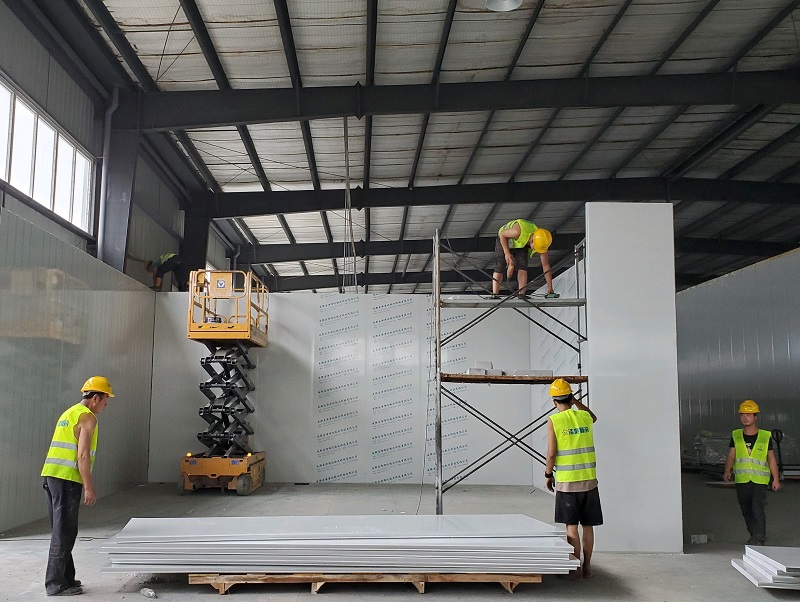
What Goes Into the Cost of a 1,000m³ Cold Storage?
1. Design and Layout
The size of the cold storage is the most obvious factor. A larger volume costs more overall, but the cost per cubic metre actually goes down as the project gets bigger. If you need multiple rooms — for example, separate areas for sorting, pre-cooling, and storage — the total price will increase a bit. For fruit and vegetable storage, it is common to include a pre-cooling room and a sorting area. Pre-cooling is important because it pulls field heat out of the produce quickly, which extends shelf life significantly.
2. Temperature Requirements
Once you know the volume, the next question is temperature. Lower temperatures require more powerful equipment and thicker insulation.
- A fruit and vegetable cold room at 0–5°C typically uses 100mm polyurethane panels and a medium-temperature condensing unit.
- A meat or seafood freezer at -18°C or lower needs 120–150mm panels and a larger compressor.
- A blast freezer at -35°C is a completely different level — more on that later.
For a typical 1,000m³ cold storage in Bangladesh, most operators choose reputable compressor brands like Bitzer or Copeland (Emerson). They cost more upfront but are reliable and energy-efficient.
3. Location in Bangladesh
Where you build matters. Construction costs, labour rates, and material transport vary significantly between Dhaka, Chittagong, and rural areas.
- Dhaka: Higher labour and transport costs, but better access to equipment suppliers and technicians.
- Chittagong: Close to the port, which can reduce import costs for equipment.
- Rural areas: Lower labour costs but higher transport fees for materials and limited access to skilled installers.
Site conditions also matter. You need a solid concrete floor, good drainage, and reliable access to electricity and water. If the site needs significant preparation, that adds to the budget.
4. Equipment and Material Choices
There are many ways to configure a cold storage, and each choice affects the final price.
| Component | Options | Cost Impact |
|---|---|---|
| Insulation panels | Polyurethane (standard) vs. polystyrene. Thickness: 100mm, 120mm, 150mm. | Thicker = higher cost but lower energy bills |
| Compressor | Imported (Bitzer, Copeland) vs. Chinese or local brands | Imported cost 20–30% more |
| Evaporator | Air cooler (DL/DD series) vs. water-cooled vs. pipe coils | Air coolers are most common and cost-effective |
| Cold room door | Sliding, swing, strip curtains, insulated | Each type adds different costs |
| Control system | Manual vs. automated PLC with remote monitoring | Automation adds $2,000–5,000 |
A good engineer will design a system that balances upfront cost with long-term operating efficiency.
5. Other Costs
There are always smaller expenses that add up:
- Refrigerant piping and insulation
- Electrical wiring and control cables
- Installation labour and transport
- Taxes and customs duties (especially for imported equipment)
These items usually account for about 10–15% of the total budget. While not insignificant, they are smaller than the main equipment and insulation costs.
Typical Specifications for a 1,000m³ Cold Storage in Bangladesh
Here is what a standard 1,000m³ fruit and vegetable cold room might look like:
| Specification | Detail |
|---|---|
| Volume | 1,000 m³ (e.g., 20m × 20m × 2.5m) |
| Temperature | 0°C to 5°C |
| Insulation panels | 100mm polyurethane, double-face steel (0.426mm thickness) |
| Compressor | Copeland or Bitzer (medium-temperature) |
| Evaporator | DL series air cooler (2–3 units) |
| Door | Insulated sliding door |
| Control | Digital thermostat with manual backup |
Is a 1,000m³ Cold Storage Worth It in Bangladesh?
The short answer is yes, for most agricultural businesses and food distributors.
Bangladesh produces large quantities of fruits and vegetables — potatoes, mangoes, bananas, onions, and more. But post-harvest losses are high, sometimes exceeding 20–30% due to lack of proper storage. A well-built cold storage can reduce those losses to under 5%.
Beyond reducing waste, you can also store products during the harvest season and sell them later when prices are higher. Many operators recover their investment within 2 to 3 years through reduced spoilage and better pricing.