 Haocool

Lithium battery electrolyte cold storage is fundamentally different from standard food cold rooms. The materials stored are flammable, volatile, and sensitive to both temperature and humidity. A conventional cold room designed for fruits or meat cannot safely handle electrolyte — the risks of fire, explosion, and chemical degradation are simply too high.
Before designing a -10°C battery cold storage, you need to establish the material properties, required storage temperature, storage capacity, turnover frequency, explosion-proof classification, and site fire protection conditions. If the electrolyte or related battery materials need to be stored at -10°C, the cold room design must prioritise stable temperature control, moisture and explosion protection, temperature and humidity monitoring, ventilation and pressure relief, and electrical safety. Do not treat it as a standard low-temperature warehouse.
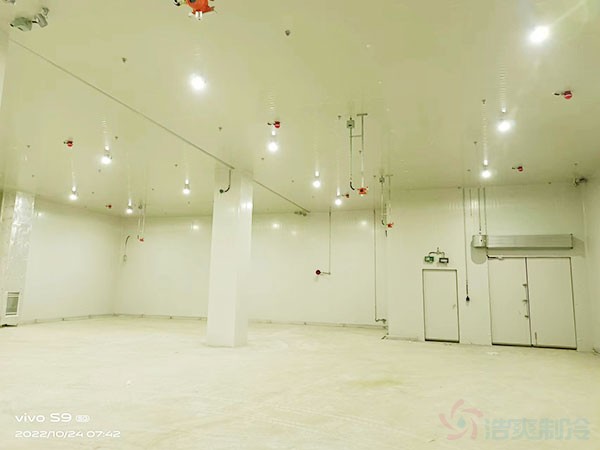
What Storage Scenarios Are Suitable for a -10°C Battery Cold Room?
A -10°C battery cold room is primarily used for storing lithium battery electrolytes, battery materials, chemical auxiliaries, and related new energy components that require temperature stability. However, not all electrolytes require -10°C storage. Different electrolyte formulations have different optimal temperature ranges.
Conventional lithium battery electrolytes typically store best at 0°C to 10°C, with some high-end formulations requiring 0°C to 5°C and temperature fluctuations controlled within ±1°C. Some electrolytes, particularly those designed for low-temperature applications, can be stored at lower temperatures, but the actual storage temperature should always be determined based on the product’s Material Safety Data Sheet (MSDS), the manufacturer’s technical documentation, fire protection requirements, and process conditions.
For a -10°C battery cold storage, temperature control is only the foundation. Explosion protection, anti-static measures, leak containment, vapour control, and alarm systems are equally important. If the storage area contains flammable or volatile materials, explosion-proof equipment of the appropriate classification must be installed, along with ventilation, fire suppression, pressure relief, and monitoring systems to ensure overall operational safety. To see how these principles are applied in a real-world large-scale project, take a look at our CALB (Anhui Hefei) 11,940 m³ Battery Electrolyte Explosion-Proof Cold Storage Construction Project. This facility, completed for a major Chinese lithium battery manufacturer, features a 0°C to 10°C adjustable temperature range, B1-grade flame-retardant PIR panels, Emerson Copeland compressors, and Exd-rated explosion-proof safety systems throughout.
What Components Does a Lithium Battery Electrolyte Cold Storage Require?
A lithium battery electrolyte cold storage typically includes the following systems: refrigeration, insulation, electrical controls, safety monitoring, and ancillary facilities.
Refrigeration System
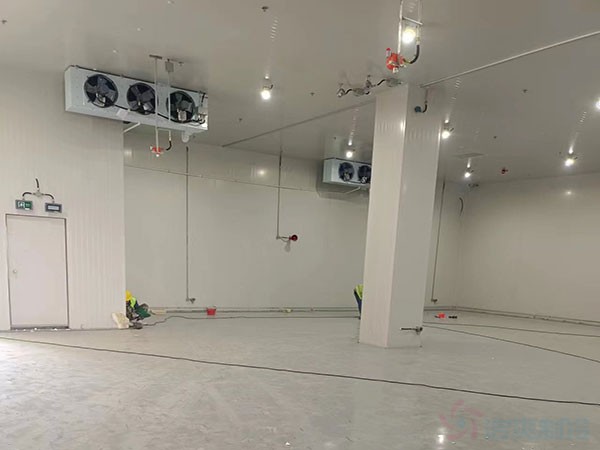
The refrigeration system maintains the required temperature and typically consists of condensing units, evaporators, condensers, expansion devices, copper piping, valves, fittings, and insulation materials. If the project involves a hazardous (explosion-proof) environment, the condensing units, air coolers, electrical control cabinets, switches, lighting fixtures, and conduits must all be explosion-proof rated.
For example, in a large-scale 11,940 m³ electrolyte explosion-proof cold storage project for CALB (China Aviation Lithium Battery), the facility used six sets of Emerson Copeland air-cooled condensing units with twelve custom high-efficiency industrial evaporators (28 kW, side-blowing type) featuring dual condensate trays to prevent dripping. The temperature range was adjustable from 0°C to 10°C.
Insulation System
The insulation system includes polyurethane or PIR insulation panels, cold room doors, sealing strips, floor insulation, and thermal bridge prevention details. For a -10°C cold room, insulation performance is critical. Panel thickness, fire-retardant rating, joint sealing, and door frame treatment all affect long-term energy consumption and temperature stability.
B1-grade flame-retardant polyurethane PIR panels are commonly used, with 100mm thickness and 0.5mm double-sided colour steel finish. For facilities with frequent access, consider installing buffer rooms, high-speed doors, or air curtain systems to reduce the infiltration of warm, humid outside air. In the CALB project, twelve custom explosion-proof air curtain machines (Exd rated) were installed at entry points.
Explosion-Proof & Safety Configuration
Lithium battery electrolyte is classified as a flammable and corrosive hazardous chemical. It contains volatile organic solvents that standard cold rooms cannot safely accommodate. Explosion-proof cold storage must comply with GB50016 (Code for Fire Protection Design of Buildings), GB50058 (Code for Design of Electrical Installations in Explosive Atmospheres), and GB50072 (Code for Design of Cold Storage).
Common safety configurations include:
| Component | Specification / Requirement |
|---|---|
| Explosion-proof electrical control cabinet | Certified for hazardous area classification |
| Explosion-proof lighting fixtures | Anti-corrosion, anti-moisture, Exd IIBT4 or higher |
| Explosion-proof switches and conduits | Compliant with GB3836 standards |
| Combustible gas detectors | Real-time monitoring of volatile organic vapours |
| Temperature/humidity alarm system | 24/7 continuous monitoring with data logging |
| Forced ventilation system | Auto-activates when gas concentration exceeds 50% LEL |
| Explosion venting / pressure relief panels | Structural pressure relief to mitigate explosion damage |
| Anti-static flooring | Spark-resistant materials to prevent static discharge |
| Leak containment | Independent bund walls and collection channels |
Explosion-proof classifications are not determined by experience alone. The appropriate classification (IIA, IIB, IIC) and temperature class (T4, T6, etc.) must be selected based on the material properties, the area of use, and the equipment installation location. For example, Exd IIBT4 is a common classification for electrolyte cold storage applications.
In a recent project for Chongqing CAPCHEM, the facility used IIC-level explosion-proof configuration with anti-static flooring, flame-retardant insulation materials, and pressure-relief structures, with temperature controlled at 2–8°C.
Temperature & Humidity Control and Monitoring
Lithium battery electrolyte cold storage requires a stable temperature and humidity monitoring system. Install multi-point temperature sensors, humidity sensors, data loggers, and remote alarm devices throughout the room to provide timely alerts for temperature fluctuations, humidity anomalies, equipment failure, or power outages.
For humidity-sensitive materials, consider installing a dehumidification system or dry air system to reduce condensation, moisture damage, and packaging degradation.
At -10°C operating conditions, special attention must be paid to:
- Evaporator defrost cycles — ensure defrost does not cause temperature spikes
- Drainage freeze protection — prevent ice blockages in condensate drains
- Door frost accumulation — manage ice buildup at door openings
- Air distribution — avoid cold air blowing directly onto materials; arrange racking, air ducts, and return air paths to ensure even temperature distribution and minimise localised temperature differences
Construction, Installation, and Commissioning
During construction of a lithium battery electrolyte cold storage, pay close attention to:
- Panel joint sealing
- Floor insulation and leak-proof layer
- Pipe and conduit wall penetrations
- Cold room door sealing
- Electrical circuit protection
After the refrigeration system is installed, conduct:
- Pressure testing — verify system integrity
- Vacuum processing — remove moisture and non-condensable gases
- Refrigerant charging — correct type and quantity
- Trial operation — verify performance under load
- Temperature stability testing — confirm temperature uniformity
For explosion-proof electrical equipment, inspect wiring, grounding, anti-static measures, and equipment labelling to ensure all systems operate correctly together.
During the commissioning phase, record:
- Pull-down time
- Temperature fluctuation range
- Defrost cycle performance
- Alarm response time
- Ventilation effectiveness
- Equipment operating current
The cold storage should only be released for formal operation after the refrigeration system, safety systems, monitoring systems, and electrical systems are all verified as stable.
Recommendations for Lithium Battery Electrolyte Cold Storage Planning
Lithium battery electrolyte cold storage is a comprehensive engineering project. It cannot be quoted simply by area or volume. A proper solution must consider:
- Storage material — specific electrolyte formulation and hazard classification
- Temperature requirement — based on MSDS and process needs
- Storage capacity — total volume and throughput
- Turnover frequency — inbound/outbound patterns
- Explosion-proof classification — determined by material properties and regulatory requirements
- Fire protection conditions — site compliance with local codes
- Building structure — existing site constraints
The clearer the upfront parameters, the easier it is to control equipment selection, project cost, and approval risk later.
If you are planning a lithium battery electrolyte cold storage, start by providing:
- Storage material name and MSDS
- Temperature range required
- Room dimensions (or desired capacity)
- Daily inbound/outbound volume
- Explosion-proof classification needed
- Site drawings and existing fire protection conditions
A professional engineering team can then develop a complete design, equipment configuration, construction plan, and commissioning protocol tailored to your specific requirements.
Note: Explosion-proof classifications and safety standards vary by jurisdiction. Always consult with qualified engineers and local regulatory authorities before commencing design and construction.