 Haocool

Author: Zhang Lei, Senior Fruit Cold Chain Engineer
11 years of turnkey cold storage design experience for fruit cooperatives & export distributors. Completed dozens of 50–300 ton fruit cold room projects across Central Asia, Southeast Europe and Southeast Asia. Member of Global Cold Chain Alliance (GCCA), familiar with GB 50072 cold storage design standard.
1 Standard Capacity Calculation for 100-Ton Fruit Cold Room
1.1 Basic Spatial Parameter
According to industry unified storage density standard for bulk fruits (apple, citrus, potato, onion, garlic):
1 ton fresh fruit occupies about 5 m³ of total warehouse space (including pallet gaps, operation aisles and air cooler reserved space)
– Total required nominal volume: 500 m³
– Recommended internal dimension: 125 ㎡ floor area × 4 m clear height
1.2 Effective Storage Logic
Adopt standard 1.2m×1.0m wooden pallets stacking design, overall space utilization coefficient controlled at 0.60–0.65 (industry standard for small and medium fruit cold storage).
– Suitable stored commodities: apples, oranges, grapes, potatoes, onions, garlic (0–4°C long-term fresh storage varieties)
– Target customer group: village farm cooperatives, regional fruit wholesalers, small-scale seasonal export suppliers
2 Full Turnkey Cost Breakdown (0–4°C Fruit Fresh Cold Room, 2026 Global Standard)
Total complete set includes insulated panels, refrigeration host, ceiling evaporators, automatic humidifier, digital temperature control cabinet, anti-freeze cold doors and air curtains, excluding land, civil foundation and external power transformation expenses.
Total turnkey investment range: 21,000 – 26,000 USD
2.1 Standard Matching Configuration
| Module | Specification & Function Description | Price Fluctuation Reason |
|---|---|---|
| PU Insulated Panels | 100–120mm thick food-grade polyurethane double color steel board, B2 flame retardant | Thicker panels increase cost, suitable for high-temperature tropical areas |
| Refrigeration Compressor | Semi-hermetic screw/compressor brands Bitzer, Copeland or equivalent 8–12HP unit | Import brands cost 15% higher than domestic economical models |
| Air Cooling System | Low-speed ceiling evaporators, uniform air supply to avoid fruit surface dehydration | Extra humidifier matching for long-term fruit storage |
| Intelligent Control System | Digital thermostat, high/low temperature automatic alarm, timing auto defrost | Cloud remote monitoring function is optional extra upgrade |
2.2 Key Factors That Change The Final Quotation
- Regional climate: Tropical regions with 38–42℃ summer ambient temperature need oversized condensers, total cost rises by 8%–12%;
- Storage fruit type: Soft berries need independent high-humidity modules, adding extra cost;
- Auxiliary upgrade: Air curtain buffer doors, pallet racking, remote SMS alarm will increase overall investment.
3 Real Overseas Project Case: 100-Ton Apple Cold Storage for Georgia Fruit Cooperative
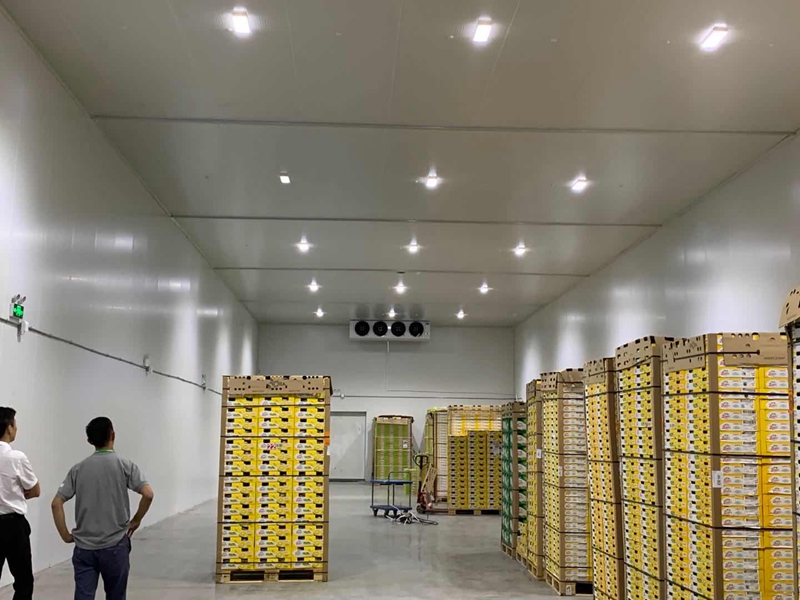
Project Background
Client: Joint planting cooperative with 12 local apple orchards, main sales channels for EU and Russian fresh fruit wholesale markets
Core demand: Stock autumn harvested apples for off-season sales to avoid price slump during picking period
Cold room standard: 500 m³ constant temperature & humidity fresh storage, stable 0–2°C operation with full automatic humidification system
Actual total construction investment: 24,000 USD
Measurable Post-Operation Economic Benefits
- Original room-temperature shelf life: only 15 days; after cold storage: up to 2+ months of fresh retention cycle
- Off-season selling price reaches 2.8 times the harvest-season purchase price, forming obvious seasonal profit spread
- Postharvest fruit spoilage rate reduced from original 15% down to below 3%
- Verified full investment payback cycle: only 9 months
4 Common Cost & Operation Mistakes When Building 100-Ton Fruit Cold Room
- Cut insulation thickness to save upfront cost → severe cold leakage, power consumption surges long-term;
- Match high-speed air coolers without independent humidification → massive fruit weight loss and peel shrivel;
- Ignore air curtain cold buffer doors, frequent temperature fluctuation during loading & unloading accelerates fruit ripening;
- Select small-power compressors to lower budget, unable to quickly remove field heat after large batch fruit warehousing;
- Do not reserve pallet operation aisles, reduce actual effective storage tonnage far below 100 tons.
5 Standard ROI Calculation Formula For Fruit Cold Storage Investors
Core Calculation Logic
Annual Net Profit = (Off-season price spread income + spoilage loss reduction revenue) − Annual operating expenditure (electricity, equipment maintenance, labor)
Full Payback Months = Total Turnkey Investment ÷ Monthly Average Net Profit
Main Income Sources
- Price premium obtained by stockpiling fruits in low-price harvest season and selling off-season;
- Direct cost saving from reducing fruit rot loss;
- Additional revenue from short-term external storage leasing for surrounding small growers.
Regular Operating Cost Reference
Average power consumption: 1.0–1.4 kWh per ton of fruit per day; annual maintenance cost accounts for 4%–6% of total equipment investment.
6 FAQ For Fruit Growers & Cold Storage Investors
Q1 Can the 500 m³ cold room really hold a full 100 tons of fruit?
A Under standard pallet stacking and 0.6–0.65 space utilization coefficient for bulk hard fruits (apple, potato), the 500 m³ nominal volume can stably store 95–100 tons. If storing soft fruits with large packaging, actual capacity will drop to about 75–85 tons.
Q2 What’s the cheapest configuration to cut construction budget reasonably?
A Choose domestic qualified compressors without cloud remote monitoring, keep 100mm standard PU panels, retain basic temperature alarm function; do not cut thickness of insulation or cancel humidifier to avoid heavy post-operation losses.
Q3 Is 0–4°C suitable for all fruits in this cold room?
A This standard temperature range fits apples, pears, citrus, root vegetables. Tropical fruits like mango, banana need separate 13–15°C constant temperature cold rooms to prevent irreversible chilling injury.
Q4 How to reduce long-term electricity expenditure of small fruit cold storage?
- Complete forced-air pre-cooling before mass fruit warehousing;
- Install air curtain buffer doors to block hot air inflow during cargo handling;
- Timely clean evaporator frost to improve heat exchange efficiency;
- Use valley electricity period to reserve cooling capacity.
Custom Fruit Cold Storage Budget Inquiry
If you plan to build 50–300 ton fresh fruit cold room for planting bases, cooperatives or wholesale markets in Europe, Central Asia and Southeast Asia, provide your storage fruit varieties, local maximum summer temperature and target storage tonnage, we can send free layout drawing and detailed itemized quotation.