 Haocool

Author: Senior Cold‑Chain Park Cost Engineer (12‑year EPC quotation & design experience for 8,000‑15,000‑ton agri‑industrial parks across China, Southeast Asia and Africa. Hands‑on experience applying GB 50072‑2021 Cold‑Storage Design Code and NY/T4696 post‑harvest preservation specifications, distinguishing conventional humidity‑controlled warehouses versus fully‑sealed CA export‑grade parks.)
Many large‑scale fruit and vegetable industrial park investors make critical planning mistakes when scoping a 10 000‑ton‑capacity cold‑storage complex. A very common error is comparing bottom‑line price figures alone, without accounting for fire‑rating requirements, N+1 redundant refrigeration, CA gas‑regulation hardware, or tropical‑climate anti‑corrosion upgrades. Poor early‑stage specification choices lead to unplanned extra expenditure, excessive ongoing power bills, and heavy post‑harvest produce spoilage.
Disclaimer: All investment numbers in this article represent real‑world observed turn‑key reference ranges derived from our completed EPC projects. Figures are for planning guidance only. Final project cost will shift with local climate, import duties, civil‑shell conditions and custom‑tailored safety redundancy. Request our site‑specific layout for formal itemised quotation.
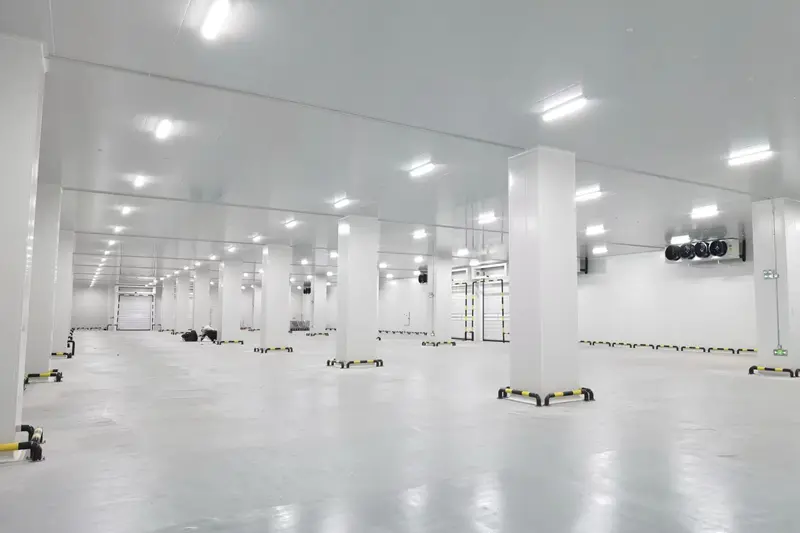
Working Out Required Warehouse Volume per GB 50072 Design Standard
Many freely‑circulated online articles quote a rough empirical total volume of 60 000 m³ for a 10 000‑ton fruit‑vegetable park. This simplified number is not acceptable for formal tender documentation or government‑audited park planning.
The industry‑standard calculation formula for nominal cold‑storage volume:
V = G ÷ (η × ρ)
Key input parameters for large carton‑packed produce warehouses ≥ 10 000 m³:
1. Design storage tonnage G = 10 000 tons
2. Volume‑utilisation coefficient η = 0.6
3. Carton‑packed fruit‑vegetable stacking density ρ = 0.23 t/m³
Calculated result:
V = 10000 ÷ (0.6 × 0.23) ≈ 72 464 m³
Corresponding building footprint references:
– Standard 5 m clear‑height layout: approx. 14 493 m² floor area
– High‑rack 6 m layout: approx. 12 077 m² floor area
Practical note: This nominal volume does not include separate sorting halls, loading vestibules or office spaces; those zones add extra building area on top of these figures.
Reference Turn‑Key Investment Benchmarks (Real‑Project Observations)
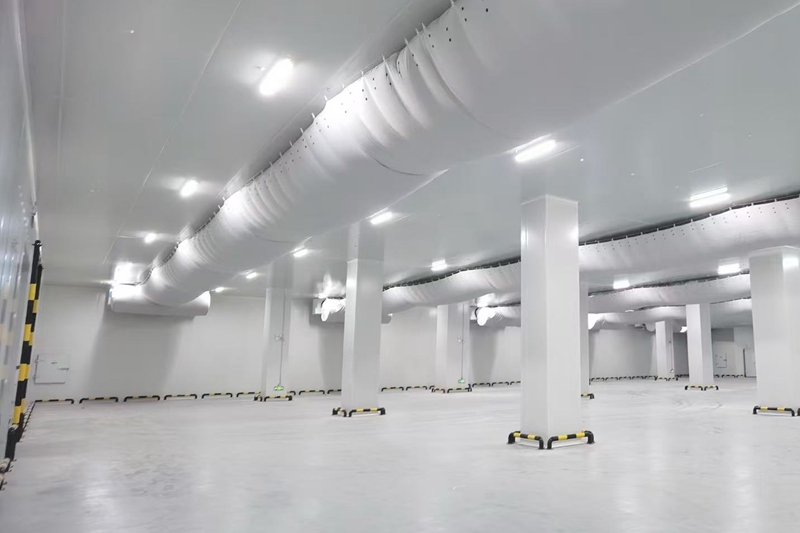
Baseline assumptions: Domestic‑spec B1 PU panels; temperate‑zone maximum ambient temperature 32 °C; excludes civil steel‑structure building shells and site transformer installation.
| Park Type | Core Equipment & Layout Scope | Reference Total (USD) | Usable Maximum Storage Cycle |
|---|---|---|---|
| Regular Multi‑Temp Fresh‑Produce Park | Independent pre‑cooling rooms, rotary dehumidifiers, N+1 parallel screw refrigeration racks | $1,040,000 – $1,110,000 | 30‑45 days |
| CA Controlled‑Atmosphere Export‑Oriented Park | Full air‑tight wall construction, nitrogen‑CO₂ generator, ethylene scrubber hardware | $1,420,000 – $1,600,000 | 90‑150 days |
Regional Cost Premiums Seen In Our Overseas Deliveries
These percentage uplifts come directly from our Southeast‑Asia, African and South‑American park project datasets:
1. Southeast‑Asia year‑round RH > 85 %: Oversized condensers + double HDPE vapour‑barrier + anti‑corrosion steel components → +9‑15 % of total project budget
2. Africa / South‑America: Ocean freight for heavy hardware, import customs duties, remote‑site installation labour → +16‑25 %
3. Upgrade from domestic compressors to imported Bitzer / Copeland parallel racks → +28‑35 %
4. Each additional independent physical temperature partition → +8‑12 %
5. Optional hydraulic loading‑dock groups plus heated air‑curtain vestibule assembly: extra \$65 000 – 100 000
Typical Cost‑Component Break‑Down For A 10 000‑Ton‑Class Park
These proportional splits are aggregated from multiple completed large agri‑cold‑park EPC hand‑overs:
1. PU insulation envelope (30‑38 %): Mandatory 100 mm B1 low‑smoke zero‑halogen PUR panels for fresh‑produce zones; reinforced air‑tight boards for CA chambers
2. Parallel‑rack refrigeration system (35‑45 %): N+1 standby screw racks plus hot‑gas‑defrost pipework (largest cost gap between equipment brands)
3. Multi‑zone intelligent monitoring (10‑16 %): Multi‑point RH / O₂ sensors, 5‑year non‑editable cloud log storage, multi‑stage SMS remote alarm chains
4. Site‑wide installation plus full‑load performance validation (12‑20 %): 72‑hour continuous temperature‑uniformity test; dedicated air‑tightness pressure‑drop inspection for CA warehouses
Non‑Negotiable Design Rules Derived From Park‑Site Experience
Drawing on our multi‑park delivery track‑record, these specifications cannot be downgraded for a 10 000‑ton‑scale commercial fruit‑vegetable facility:
Insulation Requirements
- Conventional fresh‑produce cold zones (0‑10 °C): Minimum 100 mm B1 low‑smoke zero‑halogen PUR. EPS foam panels must not be deployed for long‑term food‑storage chambers.
- CA gas‑regulated warehouses: Additional reinforced air‑tight sealing layers applied across all wall‑to‑ceiling panel joints.
Refrigeration Safety Rule
Every physically‑isolated temperature chamber requires independent N+1 standby parallel‑screw hardware. Dual municipal‑grid power input together with 72‑hour UPS backup for monitoring systems prevents mass produce loss during unexpected black‑outs.
HACCP Food‑Safety Zoning Requirement
Only solid physical wall partitions are acceptable, fabric curtains do not satisfy audit expectations:
1. Post‑harvest pre‑cooling buffer zone
2. Main qualified fruit‑vegetable bulk‑storage area
3. Isolated cold compartment for defective / spoilage‑risk batches
Enforce strict one‑way personnel‑and‑goods workflow to eliminate cross‑contamination.
Fresh‑Produce Preservation Operating Baselines
- Maintain RH 90‑95 % with micro‑fog humidification hardware
- Limit internal air velocity ≤ 0.6 m/s to avoid fruit peel weight‑loss and surface shriveling
- Physically segregate ethylene‑heavy produce (apples, bananas) away from ethylene‑sensitive vegetable stock
Real‑World Reference Case: 73 000 m³ Sub‑Tropical Orchard Cold‑Storage Park
Context: This completed domestic park operates under subtropical plum‑rain high‑humidity conditions and implements double‑sided HDPE vapour‑barrier construction.
– Nominal volume: 73 000 m³ multi‑temperature fruit park
– Final turn‑key investment: CNY 7.72 M (~ \$1 070 000)
– Measured 12‑month operational KPIs after commissioning:
✅ Fruit mould‑and‑shrivel spoilage dropped from original 13.8 % down to 3.1 %
✅ Inverter‑driven parallel‑rack design reduced annual refrigeration‑related electricity consumption by 22 %
✅ Off‑season sales price premium offsets incremental construction‑spec upgrade costs
✅ Calculated full investment payback window: 22‑28 months
👉 Related case reference: Read our Zunyi mountain‑region vegetable cold‑storage project to see how high‑humidity local climate shapes envelope and dehumidification choices for agri‑cold‑chain builds.
Eight Costly Procurement & Design Mistakes Observed Across Large Cold‑Park Projects
Summarised from site‑audit and post‑project reviews of multiple 8 000‑15 000‑ton‑scale facilities:
1. Downgrade insulation from B1‑rated PU to cheaper B2‑grade or EPS foam → sharp 30 %+ rise in annual power draw plus latent fire‑safety risks
2. Omit N+1 standby compressor architecture for multi‑temperature zones → risk of massive tonnage‑level crop loss in summer heat‑wave overload events
3. Skip double‑layer HDPE vapour‑barrier for southern / tropical‑climate builds → interior wall condensation and widespread fruit mildew
4. Rely on fabric‑curtain separators instead of solid‑wall zoning → fails official HACCP food‑safety audit requirements
5. Leave‑out dedicated independent pre‑cooling chambers → uneven fruit core temperatures and drastically shortened shelf‑life
6. Specify high‑speed air coolers for fresh‑produce chambers → serious commodity weight‑loss and downgraded export‑grade quality
7. Build CA warehouses without formal air‑tightness pressure‑drop acceptance test → gas leakage cuts actual usable storage cycle roughly in half
8. Deploy editable temperature‑recorder hardware → traceability records are invalid for customs and food‑authority inspection audits
Simplified ROI Calculation Logic For Large Agri‑Cold Parks
Annual Net Income = Off‑season export sales price margin − yearly power‑and‑maintenance expenditure − monetary value reduction from spoilage‑loss avoidance
Full Payback Months = Total completed turn‑key project investment ÷ average monthly net operating profit
FAQ For Fruit‑Vegetable Industrial‑Park Investors
Q1: What nominal cold‑storage volume should I plan for a 10 000‑ton park following GB 50072 standards?
A: Calculated nominal volume ≈ 72 464 m³. The frequently‑quoted 60 000 m³ number is only rough informal empirical guidance and is not suitable for official tender or government audit documentation.
Q2: Why must large‑scale fruit parks implement N+1 redundant compressors?
A: These parks run year‑round continuous stocking cycles. A single‑unit compressor fault could create unrecoverable spoilage across thousands of tons of harvested crops. Stand‑by hardware mitigates this catastrophic business risk.
Q3: How much budget uplift should I reserve for a cold park built in year‑round high‑RH Southeast‑Asia?
A: Budget an extra 9‑15 % for oversized condensers, double‑sided vapour‑barrier layers and corrosion‑resistant metal components to match local humid operating conditions.
Q4: Where does the main cost increase come from when upgrading from regular fresh‑produce park to CA export‑grade park?
A: CA adds nitrogen‑generators, CO₂ scrubber assemblies plus full‑spec air‑tight wall construction; overall investment rises approximately 35‑45 % compared to multi‑temp fresh‑fruit‑only baseline.
Request Your Custom Large‑Scale Fruit‑Vegetable Cold‑Storage Park Layout
Share your primary fruit‑vegetable crop portfolio, local peak ambient humidity figures, plus target domestic‑or‑export market requirements. Our cold‑chain engineering team will deliver a HACCP‑aligned conceptual layout drawing and itemised USD‑denominated budget proposal.