 Haocool

Author: Zhang Wei
Senior Fruit Cold Chain Engineer, 12 years experience in pomology cold storage & CA system design. Specialized in berry and pome fruit preservation projects across Central Asia, Southeast Asia and China major hawthorn production areas. Member of Global Cold Chain Alliance.
Table of Contents
- Why Invest in Specialized Cold Storage for Hawthorn?
- Full Standardized Pre-Storage Handling Workflow
- Core Storage Parameters: Regular Cold Room vs CA Controlled Atmosphere Warehouse
- Storage Capacity Layout & Energy-Saving Performance
- Turnkey Construction Cost Reference for Hawthorn Cold Storage
- Real Commercial Case: 2000m³ Hawthorn CA Cold Storage in Almaty, Kazakhstan
- Frequent Mistakes Leading to Hawthorn Rot, Browning & Quality Loss
- FAQ for Hawthorn Cold Storage Operators
Why Invest in Specialized Cold Storage for Hawthorn?
Hawthorn is a widely commercialized fruit with rich medicinal and edible value, used for herbal extracts, jam, candied fruit and fresh export sales. As a typical climacteric fruit, hawthorn maintains strong postharvest respiration after picking. Stored under ambient temperature (20–28℃), it softens, develops alcohol odor and molds within only 3–4 weeks, causing huge economic loss for growers, juice processors and cross-border fruit distributors.
Custom-designed hawthorn cold & CA storage facilities bring measurable commercial benefits backed by fruit postharvest research data:
- Distinguish storage cycle gap: Ordinary air cold storage extends shelf life to 2 months; professional Controlled Atmosphere (CA) storage locks freshness for 8–10 months (China Fruit Postharvest Engineering Research Center, 2025)
- Fully retain original tart flavor, bright red peel color, polyphenol and vitamin nutritional components
- Cut postharvest spoilage loss from 30–40% (room-temperature stock) down to below 5%
- Balance seasonal supply gap, lifting annual gross profit margin by 25–35% via off-season export pricing premium
Full Standardized Pre-Storage Handling Workflow
1. Scientific Harvest Specification
Harvest only on dry, sunny mornings after dew evaporates completely. Manual picking is mandatory to avoid peel bruising. Damaged skin triggers rapid mold growth during long-term storage. Over-ripe fruits with soft pulp shall be separated for instant processing, not long-term storage.
2. Strict Sorting & Grading
Filter and discard cracked, diseased, insect-bitten, overripe hawthorn. Only firm, medium-small uniform fruits are qualified for cold storage. Sorting must finish within 12 hours post-harvest to avoid respiration heat accumulation.
3. Two-Stage Pre-Cooling Process (Critical Step Ignored by Small Farmers)
Raw original text only mentions simple shaded ventilation cooling, which cannot eliminate field heat thoroughly. Standard industrial operation:
- Primary pre-cooling: Spread hawthorn in single layer under shaded ventilated warehouse for 24–48 hours, initial temperature drop to 8–10℃
- Secondary forced-air pre-cooling inside pre-cool room within 48 hours, reduce fruit core temperature to -1~0℃ before formal storage loading
Industry reminder: Skipping complete pre-cooling will increase overall spoilage rate by over 18% during storage.
Core Storage Parameters: Regular Cold Room vs CA Controlled Atmosphere Warehouse
Many articles confuse common cold storage and CA storage, falsely claiming ordinary cold rooms can preserve hawthorn for nearly 10 months. We clarify two sets of standard parameters complying with GB/T 33129 fruit CA storage specification:
| Item | Regular Air Cold Storage (No Gas Regulation) | CA Controlled Atmosphere Cold Storage (Long-Term Export) | Risk Consequence If Standard Violated |
|---|---|---|---|
| Storage Temperature | -1℃ ~ 0℃ | -1℃ ~ 0℃ | < -1℃: Freezing injury, pulp browning; > 1℃: Accelerated ripening & mold |
| Allowable Temp Fluctuation | ≤ ±0.5℃ | ≤ ±0.5℃ | Frequent fluctuation activates oxidase, peel loses red color |
| Relative Humidity | 85% – 90% | 90% – 95% | Low RH: Severe weight loss & shrivel; Excess RH: Gray mold & rot |
| O₂ Concentration | N/A | 2% – 3% | Excess oxygen speeds up fruit aging |
| CO₂ Concentration | N/A | 3% – 5%, hard cap ≤ 8% | CO₂ over 8% causes internal tissue carbon dioxide damage, bitter taste |
| Maximum Storage Period | 1.5 – 2 months | 8 – 10 months | N/A |
Only CA storage with precise oxygen & carbon dioxide adjustment realizes 8–10 months fresh preservation; ordinary cold rooms can merely support short-term stock for domestic sales within 2 months.
Storage Capacity Layout & Energy-Saving Performance
Capacity calculation is based on standard plastic turnover crate pallet stacking, reserved air circulation gap:
- 1,000 m³ standard fruit cold storage: Hold 200 – 260 tons fresh hawthorn
- 2,000 m³ medium-scale export-oriented warehouse: Suitable for cooperatives & medium processing factories, storage capacity around 400 – 500 tons
Haocool integrated cold storage system adopts variable-frequency screw refrigeration units + thickened PU insulation panels, cutting daily power consumption by 15–20% compared with conventional fixed-speed cold storage equipment. For 5–7 years continuous operation, energy savings greatly lower overall operating expenditure and shorten investment payback cycle.
Turnkey Construction Cost Reference for Hawthorn Cold Storage
Quotation covers full set of insulation panels, refrigeration host, air coolers, gas regulation system (for CA warehouse), intelligent temperature/humidity monitoring & automatic control system.
Take 2,000 m³ CA hawthorn cold storage as benchmark:
- Total turnkey investment range: USD 70,000 – 100,000
- Price variable factors: Local labor cost, insulation plate thickness, CA gas equipment configuration, automatic monitoring grade, anti-corrosion floor treatment
For enterprises exporting hawthorn to high-value markets (EU, Middle East, Central Asia), standardized CA cold storage usually recovers full investment within 2–3 full harvest seasons.
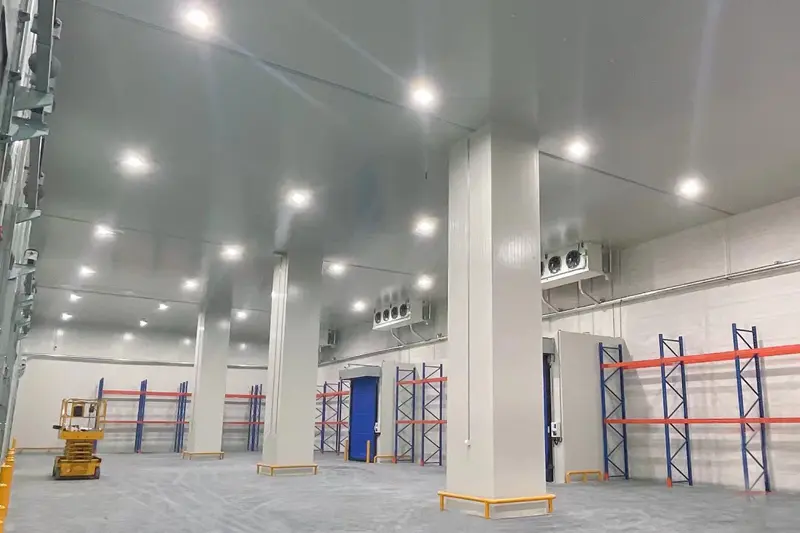
Real Commercial Case: 2000m³ Hawthorn CA Cold Storage in Almaty, Kazakhstan
Project Operator: Central Asia Fruit Import & Export Co., Ltd.
Business demand: Local wild hawthorn deep processing & year-round fresh fruit export to Russia, Uzbekistan
- Warehouse volume: 2,000 cubic meters CA cold storage
- Actual effective loading capacity: ~580 tons fresh hawthorn
- Permanent operation temperature: -1℃ ~ 0℃, gas index strictly maintained O₂ 2.5%, CO₂ 4%
- Full turnkey construction cost: USD 80,000
- Daily average power consumption: 160 – 180 kWh
- Annual net profit growth brought by cold storage: USD 30,000 – 35,000
Profit sources: Reduced rot loss + off-season price spread premium - Verified ROI payback cycle: 2.5 harvest years
Local regional challenge: Summer ambient temperature hits 30–36℃ with strong solar radiation. Our team upgraded oversized condenser and external heat insulation layer, lowering long-term energy consumption by 17%. After 2 full years of operation, the client achieved stable all-year supply and lifted hawthorn export gross margin by 28%.
Frequent Mistakes Leading to Hawthorn Rot, Browning & Quality Loss
- Skip complete two-stage pre-cooling to cut labor cost → field heat trapped inside fruit, mass softening and mold within 1 month
- Stack crates tightly against warehouse walls without airflow gaps → local high-temperature dead zones, uneven ripening
- Build ordinary cold storage but expect 8+ months long-term preservation without CA gas regulation → fruit loses commercial value within 2 months
- Allow frequent door opening during loading/unloading, causing sharp temperature fluctuation over ±1.5℃ → peel fades, pulp develops off-flavor
- Fail to control CO₂ concentration, exceed 8% threshold → irreversible internal carbonization damage
- Ignore humidity adjustment, operate under RH below 80% → hawthorn shrivels, weight loss rate over 12%
FAQ for Hawthorn Cold Storage Operators
Q1: Can regular air cold storage without CA equipment store hawthorn for 8 months or longer?
A: Impossible. Conventional cold rooms only rely on low temperature to slow respiration, with maximum shelf life only 2 months. If you need off-season long-term stock for export sales, Controlled Atmosphere gas adjustment system is mandatory.
Q2: What damage will occur if CO₂ concentration exceeds 8% in CA storage?
A: Excessive carbon dioxide penetrates fruit tissue, leading to internal browning, bitter taste and hollow pulp. Such hawthorn cannot be sold as fresh fruit or used for high-grade processing.
Q3: How to cut daily electricity cost for hawthorn cold storage?
A: 1. Complete full pre-cooling before fruit enters formal storage; 2. Install air curtain & buffer room to reduce hot air inflow during cargo handling; 3. Choose high-efficiency variable-frequency refrigeration units; 4. Maintain warehouse insulation integrity regularly to avoid cold leakage.
Q4: Is pre-cooling necessary for small-batch hawthorn stock less than 10 tons?
A: Yes. Even small batches carry field heat from picking. Without pre-cooling, the whole batch will face uneven temperature and early spoilage during storage.
Q5: Which customer groups are most suitable to build hawthorn CA cold storage?
A: Large hawthorn planting cooperatives, fruit deep-processing factories, cross-border fresh fruit exporters with stable annual supply above 200 tons. Small scattered farmers can choose shared third-party cold storage to save upfront investment.
If you plan to construct hawthorn fresh storage or CA controlled atmosphere warehouse in Central Asia, Southeast Asia or domestic China hawthorn production zones, contact our professional engineering team for customized layout design, detailed equipment list and accurate budget quotation.