 Haocool

For ice cream manufacturers, cold storage is not just about keeping products frozen—it’s about preserving texture, preventing ice crystal growth, meeting export standards, and ensuring profitable large-scale production.
Unlike frozen meat or vegetables, ice cream is one of the most temperature-sensitive frozen foods. A few degrees of fluctuation can ruin an entire batch. This guide provides a complete breakdown of ice cream cold storage costs, capacity planning, temperature requirements, and real-world project examples.
Why Ice Cream Cold Storage Is Different
Ice cream requires two distinct temperature stages:
| Stage | Temperature | Purpose | Duration |
|---|---|---|---|
| Hardening | -35°C to -40°C | Rapid freezing to form micro-crystals | 4–12 hours |
| Long-Term Storage | -25°C or below | Maintain quality, prevent ice crystal growth | Weeks to months |
| Distribution | -20°C to -25°C | Maintain cold chain integrity | Varies |
The industry standard for long-term storage is -25°C (-13°F). The International Dairy Foods Association (IDFA) recommends 0°F (-18°C) or colder for storage, with supermarket freezer cases not exceeding 10°F (-12°C).
⚠️ Critical Warning: A standard -18°C frozen food cold room is not sufficient for ice cream. At -18°C, ice cream is prone to ice crystal growth, texture degradation, and quality loss over time. Ice cream requires dedicated low-temperature storage at -25°C or below.
Storage Density: How Much Space for 1 Ton of Ice Cream?
Ice cream density is approximately 535 kg/m³. However, when packaged (cartons, pallets, and airflow gaps included), the industry standard is:
| Parameter | Value |
|---|---|
| Packaged ice cream density | 400–476 kg/m³ |
| Volume per metric ton | 2.1 – 2.5 m³/ton |
| Density range | 400–476 kg/m³ |
This range accounts for:
- Packaging type: Cartons vs. bulk vs. wrapped pallets
- Stacking method: Block stacking vs. pallet racking
- Airflow requirements: Critical for maintaining consistent -25°C temperature
Capacity Reference Table
| Facility Size | Volume (m³)* | Storage Capacity (tons) |
|---|---|---|
| Small (100 m²) | ~600 m³ (6m height) | 240 – 280 tons |
| Medium (500 m²) | ~3,000 m³ | 1,200 – 1,450 tons |
| Large (1,000+ m²) | ~6,000+ m³ | 2,400 – 3,000+ tons |
*Assumes 6m clear height with standard pallet racking and airflow gaps.
Total Investment: Turnkey Costs by Scale
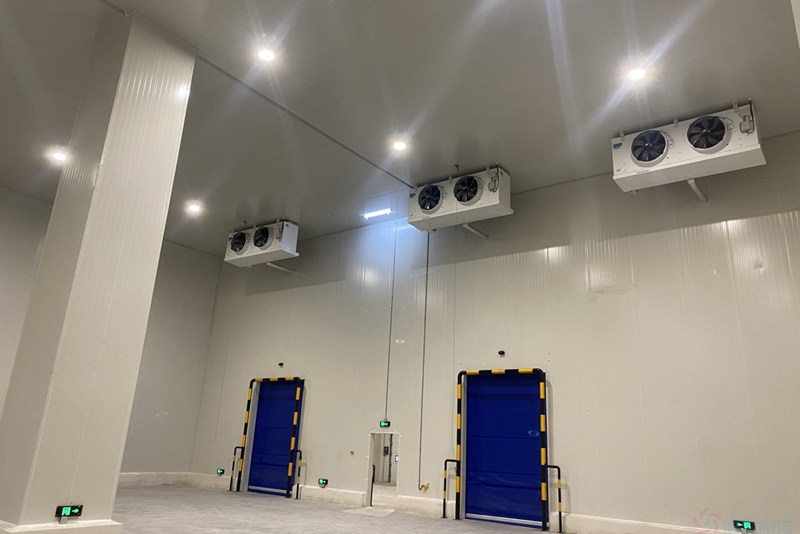
A turnkey ice cream cold storage facility typically costs $57,000 – $385,000 USD, depending on scale.
| Facility Size | Volume (m³) | Storage Capacity | Total Investment (USD) | Cost per m³ |
|---|---|---|---|---|
| Small (100 m²) | ~600 m³ | 240 – 280 tons | $57,000 | $95/m³ |
| Medium (500 m²) | ~3,000 m³ | 1,200 – 1,450 tons | $210,000 | $70/m³ |
| Large (1,000+ m²) | ~6,000+ m³ | 2,400 – 3,000+ tons | $385,000 | $64/m³ |
💡 Economies of Scale: Larger facilities have significantly lower cost per cubic meter—$95/m³ for small vs. $64/m³ for large—because fixed costs (compressor, controls, installation) are spread over more volume.
What’s Included in a Turnkey Price
- ✅ PU insulated panels (150mm for -25°C storage)
- ✅ Low-temperature refrigeration system (Bitzer/Refcomp compressors)
- ✅ Evaporators, condensers, temperature control
- ✅ Installation, commissioning, operator training
- ✅ Basic civil prep (floor insulation, drainage)
Detailed Cost Breakdown (500m² Medium Facility)
| Cost Category | Share | Estimated Cost | Key Specifications |
|---|---|---|---|
| Insulation Panels | 25–30% | ~$55,000 | 150mm PU panels, B1 fire-rated, 0.5mm steel cladding |
| Refrigeration System | 30–35% | ~$70,000 | Bitzer/Refcomp low-temp compressors for -25°C to -35°C |
| Evaporators | 10–12% | ~$25,000 | Low-temp ceiling-mounted units with electric defrost |
| Control System | 5–8% | ~$15,000 | PLC controls + temperature logging (EU export compliance) |
| Floor System | 8–10% | ~$20,000 | XPS insulation + reinforced concrete (frost-heave protection) |
| Doors & Dock Equipment | 3–5% | ~$10,000 | Insulated doors + loading dock |
| Installation & Commissioning | 8–10% | ~$20,000 | On-site build, testing, training |
| Total | 100% | ~$210,000 |
What Determines the Final Price?
- Equipment brand: Bitzer (Germany) vs. domestic compressors — 30–50% difference
- Refrigerant type: Ammonia/glycol systems vs. Freon systems
- Automation level: Basic PLC vs. full WMS + automated temperature logging
- Climate conditions: Hot climates (e.g., Saudi Arabia) require higher-capacity systems
- Export compliance: EU markets require HACCP-compliant insulation and automated temperature logging
Why 150mm Insulation Panels for Ice Cream?
Ice cream cold storage requires thicker insulation than standard frozen food storage:
| Application | Recommended Thickness | Why |
|---|---|---|
| Standard frozen food (-18°C) | 100mm | Sufficient for -18°C |
| Ice cream storage (-25°C) | 150mm | Minimizes heat gain; critical for -25°C stability |
| Ice cream hardening (-35°C to -40°C) | 150–200mm | Extreme temperature differential |
Key specifications:
- Density: 42 kg/m³ PU foam
- Cladding: 0.5mm double-sided color steel
- Fire rating: B1 or B2 (varies by regulation)
- Vapor barrier: Prevents moisture infiltration and ice buildup
💡 Pro Tip: Polystyrene foam costs 40% less but its R-value drops 60% at -25°C and requires replacement every 5–7 years—a false economy for ice cream facilities.
Ice Cream Hardening vs. Long-Term Storage: Two Separate Needs
Many ice cream manufacturers make the mistake of using the same cold room for hardening and storage. This is inefficient and can compromise quality.
| Requirement | Hardening Room | Storage Room |
|---|---|---|
| Temperature | -35°C to -40°C | -25°C |
| Purpose | Rapid freeze, form micro-crystals | Maintain quality, prevent ice crystal growth |
| Duration | 4–12 hours | Weeks to months |
| Door Openings | Minimal | Frequent (picking/packing) |
Recommended Configuration
Most ice cream factories benefit from:
1. Blast freezer / hardening tunnel: -35°C to -40°C, high air velocity
2. Storage cold room: -25°C, stable temperature, minimal fluctuation
3. Buffer zone: -15°C to -20°C for staging before dispatch
Real-World Project: France 600-Ton Ice Cream Cold Storage
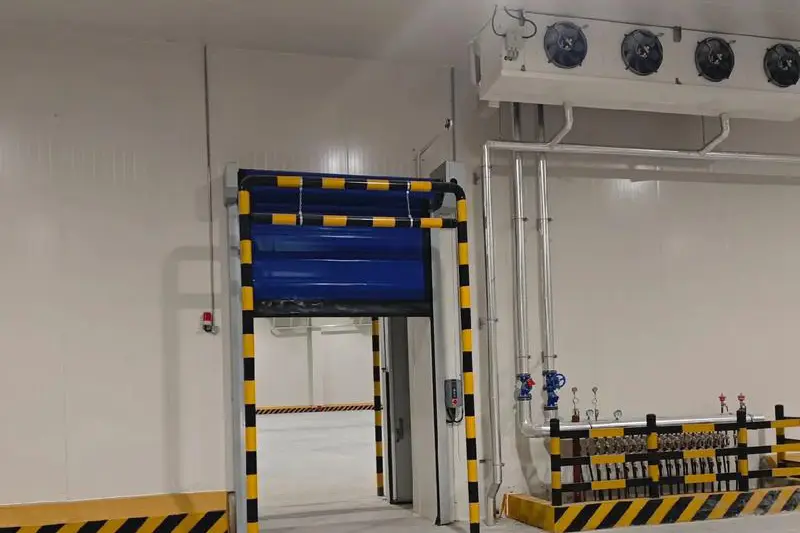
For clients targeting EU markets, cold storage must meet strict hygiene, temperature stability, and traceability standards. A recent example is our 600-ton ice cream cold storage project in France, built for a premium dairy brand exporting across Europe.
Project Overview
| Metric | Details |
|---|---|
| Client | Premium French dairy brand (exporting across Europe) |
| Capacity | 600 tons |
| Temperature | -28°C deep-freeze chambers |
| Compliance | HACCP-compliant insulation, automated temperature logging |
| Key Challenge | Meeting EU regulatory rigor while maintaining cost-effectiveness |
Key Features
- -28°C deep-freeze chambers: Lower than standard -25°C to ensure superior ice cream quality and texture preservation for premium European markets
- Automated temperature logging: Continuous monitoring with audit-ready records for EU regulatory compliance
- HACCP-compliant insulation: Food-safe materials meeting European hygiene standards
- EU regulatory alignment: Full compliance with European food safety and traceability requirements
Why This Project Matters
This project demonstrates that Haocool’s cold storage solutions can meet both emerging-market affordability and European regulatory rigor. The French facility proves that Chinese-engineered cold storage is capable of satisfying the world’s most demanding food safety standards—making Haocool a trusted partner for ice cream manufacturers targeting export markets worldwide.
👉 Explore the full France 600-ton ice cream cold storage case study →
Operating Costs & Total Cost of Ownership (TCO)
Energy is the single largest operating cost for ice cream cold storage—typically 60–70% of total operating expenses.
Energy Consumption Estimates
| Facility Type | Annual Consumption (kWh/m³) | 3,000m³ Annual Total |
|---|---|---|
| Ice cream storage (-25°C) | 200–280 kWh/m³ | 600,000–840,000 kWh |
| Hardening (-35°C) | 400–600 kWh/m³ (during operation) | Varies by duty cycle |
Estimated Annual Operating Costs
| Cost Category | Annual Estimate (500m² facility) |
|---|---|
| Energy | Varies by local electricity rates |
| Compressor maintenance | $5,000–8,000 |
| Evaporator cleaning | $2,000–4,000 |
| Refrigerant top-up | $1,000–3,000 |
| Door seal replacement | $1,000–2,000 |
| Total Maintenance | $9,000–17,000/year |
Frequently Asked Questions
Q1: What’s the difference between ice cream cold storage and standard frozen food storage?
Ice cream requires -25°C or below for long-term storage, while standard frozen food can be stored at -18°C. Additionally, ice cream needs a hardening stage at -35°C to -40°C—a requirement most standard frozen food cold rooms cannot meet.
Q2: Why can’t I just use a -18°C freezer for ice cream?
At -18°C, ice cream is prone to ice crystal growth, which causes a gritty texture and quality degradation over time. For long-term storage, -25°C is the industry standard.
Q3: How much can a 100m² ice cream cold room actually store?
A 100m² facility with 6m height provides ~600m³ of volume. At 2.1–2.5 m³/ton, this stores 240–280 tons of packaged ice cream.
Q4: What is the ongoing operating cost?
Energy is the largest operating cost—typically 60–70% of total operating expenses. For a 500m² ice cream cold room, annual maintenance costs are approximately $9,000–17,000.
Q5: Can I expand the cold storage later?
Yes. Haocool’s modular design allows future expansion. However, expansion requires careful planning of the refrigeration system capacity from the start.
Q6: What compliance is required for EU export?
EU markets require HACCP-compliant insulation, automated temperature logging, and strict hygiene standards. The France 600-ton project demonstrates Haocool’s capability to meet these requirements.
Ready to Build Your Ice Cream Cold Room?
Most ice cream manufacturers start with 300–1,500 ton capacity—enough to cover production buffer, seasonal demand spikes, and export orders.
Tell us:
✅ Monthly production volume
✅ Target markets (local/export)
✅ Required storage temperature (-18°C or -25°C?)
We’ll send you a free layout + cost estimate + tonnage calculation—customized for your country in Vietnam, Nigeria, UAE, Egypt, Indonesia, or beyond.
The storage parameters provided above are for reference only. Optimal cold room conditions vary depending on product formulation, packaging, climate, and operational requirements. Consult with a cold storage specialist for a customized solution.