 Haocool

If you are planning a cold storage project in Metro Manila, the first question is almost always about cost. A 2,000-ton facility is a significant investment, and the final price depends on a wide range of factors — the size of the building, the type of products you are storing, the location, the temperature requirements, and how many compartments you need.
There is no single answer. Every project is different. But here is a practical breakdown of what goes into the cost and what you can expect to pay.
What Affects the Cost of a 2,000-Ton Cold Storage?
Before you can get an accurate quote, you need to clarify a few things. The total cost is made up of several components, and each one can move the number up or down.
Cold storage size and volume: The physical dimensions of the facility — length, width, and height — determine how much insulation material you need and how powerful the refrigeration system has to be. Larger facilities cost more overall, but the cost per ton often decreases as the scale increases.
Temperature requirements: A -18°C freezer costs significantly more than a 0–5°C chiller. Lower temperatures require thicker insulation panels, more powerful compressors, and more robust refrigeration systems. The difference between a chilled room and a frozen room can be 20 to 30 percent of the total cost.
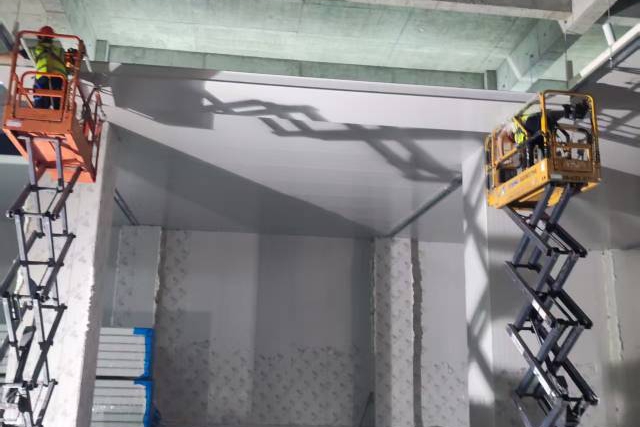
Number of compartments: A single large room is cheaper than multiple smaller rooms. But many operators need separate zones — a blast freezer, a holding freezer, a chilled staging area, or a processing room. Each additional compartment adds cost for insulation walls, doors, and independent refrigeration controls.
Equipment brand and quality: Premium brands like Bitzer, Copeland, or GEA cost more upfront but are more reliable and energy-efficient. For a facility that runs 24/7, the long-term savings often justify the higher initial investment.
Location and site conditions: Building in Metro Manila is different from building in a remote province. Transport costs, labour rates, and access to power and water all affect the final price. If the site requires significant ground preparation, that adds to the budget. Prime warehousing rents in Metro Manila’s outskirts have climbed to PHP 450 per square meter, reflecting strong demand for industrial and logistics space.
Estimated Total Cost: USD 235,000 – 345,000 (PHP 13.5 – 20.0 Million)
Based on recent projects in the Philippines, a 2,000-ton cold storage facility in Metro Manila typically costs between USD 235,000 and USD 345,000 (approximately PHP 13.5 million to PHP 20.0 million, using mid‑2026 exchange rates of 1 USD ≈ 57.5 PHP).
Here is a rough breakdown of where the money goes:
| Component | Estimated Cost (USD) | Estimated Cost (PHP) |
|---|---|---|
| Insulation panels (120–150mm polyurethane) | 62,500 – 90,000 | 3.6 – 5.2 million |
| Refrigeration equipment (compressors, condensers, evaporators) | 76,000 – 111,000 | 4.4 – 6.4 million |
| Floor system and building structure | 42,000 – 62,500 | 2.4 – 3.6 million |
| Electrical and control systems | 25,000 – 39,000 | 1.4 – 2.2 million |
| Doors and dock equipment | 11,000 – 16,500 | 640,000 – 960,000 |
| Installation and labour (Metro Manila) | 14,000 – 21,000 | 800,000 – 1.2 million |
| Engineering, design, and permits | 5,500 – 7,000 | 320,000 – 400,000 |
| Total (approx.) | 235,000 – 345,000 | 13.5 – 20.0 million |
How Much Product Can a 2,000-Ton Cold Storage Hold?
The capacity depends on what you are storing and how it is stacked.
- Meat and seafood (frozen): roughly 3–4 cubic metres per ton
- Fruits and vegetables (chilled): roughly 4–5 cubic metres per ton because the product is bulkier and needs more space for airflow
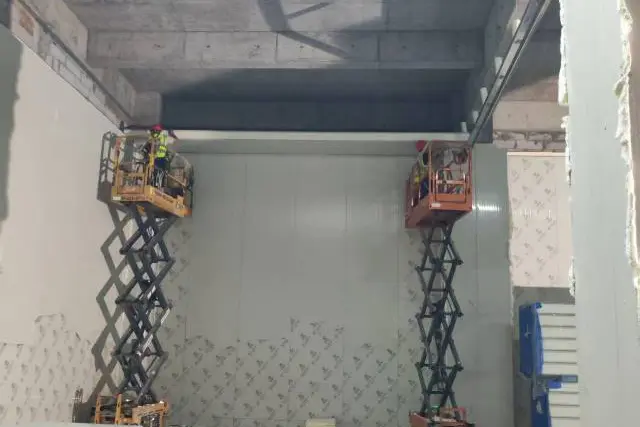
For a 2,000-ton cold storage designed for frozen meat or seafood, you would need roughly 6,000 to 8,000 cubic metres of storage volume. With a clear height of 5 metres, that translates to about 1,200 to 1,600 square metres of floor space.
For a more detailed breakdown of meat and seafood cold storage solutions, visit our meat cold storage and seafood cold storage solution pages. For fresh produce storage, check out our fruit and vegetable cold storage solutions.
Why Metro Manila Makes Sense for Cold Storage
Metro Manila is the Philippines’ largest consumer market and a key logistics hub. The region’s growing population and expanding e-commerce sector are driving demand for cold storage. Prime warehousing rents in Metro Manila’s outskirts have risen to PHP 450 per square meter, with vacancy rates dipping to 5% in high-demand areas.
For businesses handling meat, seafood, frozen food, or agricultural products, a 2,000-ton cold storage in Metro Manila is a strategic asset. It gives you control over your supply chain, reduces spoilage, and allows you to buy and sell at the right time.
Is a 2,000-Ton Cold Storage Worth It?
The short answer is yes — for any business that handles temperature-sensitive products in volume.
Without proper cold storage, post-harvest losses in the Philippines can be significant. With a well-built facility, you can:
- Reduce spoilage from over 20% to under 5%
- Store products during surplus and sell during shortage periods
- Access higher off-season prices
- Supply supermarkets, restaurants, and export markets year-round
Many operators recover their investment within 3 to 5 years through reduced waste and better market timing.