 Haocool

Author: Wang Hao, Senior Large Reserve Cold Chain Engineer
10 years design experience for national food reserve & cross-border food distribution cold warehouses. Familiar with GB 50072-2021 cold storage standard & tropical high-temperature cold room design norms, completed multiple 10,000–20,000 m³ food reserve projects in Africa, Southeast Asia and China inland.
Many food reserve investors only compare unit square meter price while ignoring standardized tonnage calculation, redundant refrigeration and tropical climate extra cost.
1 Scientific 2,800-Ton Capacity Calculation (GB 50072 Formula Basis)
Official calculation formula:
G = (Total Volume × Space Utilization Coefficient × Cargo Density) ÷ 1000
Standard Parameter Matching For 2,800 Ton Frozen Food Warehouse
- Target storage tonnage: 2,800 tons (palletized frozen meat, seafood, frozen vegetables)
- Effective nominal volume: 15,000 m³
- Floor layout: 3,000 ㎡ × 5 m clear height
- GB standard space utilization coefficient: 0.62 (deduct aisle, columns, air cooler space)
- Frozen pallet cargo density: 0.30 t/m³
Calculation verification: 15000 × 0.62 × 0.3 = 2790 tons (matches 2,800-ton design capacity)
Classification Difference
- Frozen goods (meat/seafood): 0.28–0.32 t/m³
- Fresh fruits & vegetables: 0.20–0.24 t/m³
Applicable Scenario
National food security reserve warehouse, cross-border bulk food export distribution hub, large chain central cold storage park.
2 Full Turnkey Total Investment Reference (USD, Excluding Civil Foundation, Land & Standby Generator)
| Warehouse Type | Full Turnkey Budget Range | Core Configuration Difference |
|---|---|---|
| Single Temp -18℃ Frozen Warehouse | $450,000 – 500,000 | Single independent freezing zone, basic pallet rack space |
| Dual-Temp (0~5℃ Chiller + -18℃ Freezer) | $530,000 – 590,000 | Two separated cold chambers, independent parallel unit sets |
Main Price Floating Factors
- Import Bitzer/Copeland parallel screw unit: +8–12% total investment
- Tropical region max ambient >40℃ (T class condenser, double vapor barrier): +9–15% cost
- Add hydraulic loading dock + air curtain buffer hall: Extra $28,000–42,000
- Upgrade AS/RS automated rack system: +35–60% total budget
3 Standard Four-Part Cost Breakdown (Industry Real Proportion, GB Large Warehouse Standard)
Correct cost share for 15,000 m³ medium parallel unit cold storage:
| Module | Industry Fixed Proportion | Core Contents & Cost Floating Points |
|---|---|---|
| Refrigeration Parallel Unit System | 35–45% | Multi-machine one-main-one-standby screw rack, evaporators, piping, refrigerant; biggest price gap between domestic & import brands |
| PU Insulation Enclosure Project | 30–38% | Wall/roof/floor panels, cold sliding doors, full anti-cold-bridge sealant; B1 vs B2 fire grade difference 10–20% |
| Electrical & Intelligent Control System | 10–16% | PLC central control, 5-year non-editable temperature log, multi-level SMS alarm, independent power loop |
| Installation & Auxiliary Works | 12–20% | On-site welding, thermal insulation construction, commissioning, drainage & anti-freeze floor treatment |
Additional Mandatory Reserve Warehouse Expenses (Not Included In Above Budget)
- Secondary power supply + automatic transfer diesel generator (national food reserve mandatory per GB 50072 electrical clause)
- Loading buffer hall & hydraulic lifting docks
- Fire protection system for large cold storage park
4 Standard Refrigeration System Configuration For 2,800-Ton Reserve Warehouse
Critical correction: Single 100HP compressor cannot support full load peak inbound & outbound; must adopt parallel redundant rack design
1. Main Unit Scheme: 3 sets 80HP Bitzer parallel screw compressors (2 duty + 1 standby)
2. Condenser Matching: Tropical T-class oversized air-cooled condenser, withstand 43℃ max ambient temperature
3. Evaporator: Low-speed anti-frost ceiling air coolers with hot gas defrost cycle
4. Safety Design: Automatic unit switching when single machine fault, avoid full batch food scrap during breakdown
5 Real Project Case: 2,800 Ton Food Reserve Cold Storage In Addis Ababa, Ethiopia
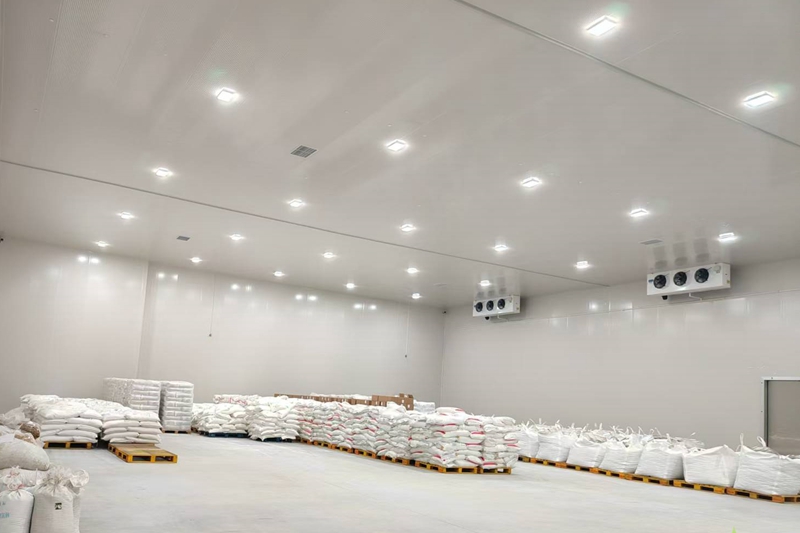
Project Basic Info
- Client: Government-contracted national food security distributor
- Warehouse scale: 15,000 m³ single -18℃ frozen zone, 2,800 tons palletized frozen meat & vegetable storage
- Total turnkey investment: $490,000 (domestic parallel unit standard configuration)
- Local climate: Tropical year-round high temperature, frequent municipal power outages, equipped 800kW standby diesel generator separately
Measurable Post-Operation Benefits After 2 Years Operation
- Spoilage loss reduced from original 12% down to 2.5% via constant temperature stable storage
- Eligible for UN World Food Programme bulk supply tender qualification
- Average daily power consumption 6,200 kWh; inverter parallel unit cuts annual electricity cost by 23%
- Verified full investment payback cycle: 24 months from operation start
6 6 Common Hidden Budget Pitfalls For Large Food Reserve Cold Storage
- Adopt single compressor without standby rack → Peak load overload & breakdown cause whole batch goods loss
- Omit T-class tropical condenser for >40℃ high-temperature regions → Compressor continuous overheat, service life halved
- Quote exclude standby generator & hydraulic dock → Huge extra cost after signing contract
- Select B2 thin insulation panels to cut upfront cost → Annual power expenditure rises over 30%
- No independent secondary power loop for refrigeration system → Power fluctuation triggers unit frequent shutdown
- Simplify full warehouse vapor barrier → Wall condensation, insulation performance decline year by year
7 Simple ROI Calculation Formula For Reserve Warehouse Investors
Annual Net Income = (Seasonal Bulk Purchase Price Difference + Spoilage Loss Reduction − Annual Electricity & Maintenance Cost)
Full Payback Months = Total Full Investment ÷ Average Monthly Net Profit
Industry reference: Standard 2,800-ton frozen reserve warehouse realizes full payback within 22–28 months under normal market supply & demand.
8 FAQ For Food Reserve & Cross-Border Distribution Investors
Q1 Why cannot 2,800-ton cold storage use single compressor instead of parallel rack?
A Per GB 50072 large cold storage design requirement, daily mass inbound/outbound brings drastic load fluctuation; single unit cannot adjust power flexibly and has no backup during failure, leading to massive frozen product loss.
Q2 What extra cost for tropical ambient over 40℃?
A Need T-type high-temperature resistant condenser, double-layer roof vapor barrier and reinforced heat dissipation structure, total construction cost increases 9–15%.
Q3 Is standby generator mandatory for national food reserve warehouse?
A Yes, GB 50072 electrical standard stipulates food reserve cold storage belongs secondary power load, must equip automatic switching diesel generator to avoid power outage scrap loss.
Q4 What’s the volume difference between 2,800-ton frozen and fresh vegetable warehouse?
Frozen pallet density reaches 0.3 t/m³; fresh vegetable only 0.22 t/m³, same ton fresh warehouse needs extra 4,000 m³ volume.
Custom 2,800 Ton Reserve Cold Storage Inquiry
If you plan to build single / dual-temperature food reserve warehouse, provide local maximum ambient temperature and main stored goods type, we can send free layout drawing & itemized full cost breakdown.