 Haocool

Author: Li Ming
Senior Cold Storage Engineer
10+ years experience in export vegetable cold chain engineering. Participated in construction and operation optimization of more than 20 vegetable cold storage projects in Yunnan, Shandong, Mexico and Southeast Asia. Member of China Cold Chain Logistics Association.
Table of Contents
- Can Broccoli Be Preserved for 60 Days in Cold Storage?
- Core Storage Parameters for Fresh Broccoli
- Two Standard Pre-Cooling Solutions for Harvested Broccoli
- Daily Operation & Risk Control Inside Broccoli Cold Storage
- Reference Data: Capacity, Loading Density & Cold Storage Investment Cost
- Practical Project Case: Broccoli Cold Storage in Puebla, Mexico
- Common Mistakes Causing Broccoli Yellowing & Rot
- FAQ
1. Can Broccoli Be Preserved for 60 Days in Cold Storage?
Many vegetable growers hope to stockpile broccoli during harvest season and sell in off-seasons for higher profit. It is necessary to clarify a key industry threshold first:
Ordinary air circulation fresh cold storage (0–1℃) can only keep broccoli fresh for 28–35 days (UC Davis Postharvest Research Center, 2025).
Only Controlled Atmosphere (CA) Cold Storage with adjustable oxygen and carbon dioxide concentration can extend the shelf life to up to 60 days.
If you use a regular fresh storage without gas regulation, do not expect a 60-day storage cycle. Long-term storage without CA equipment will cause flower head yellowing, lignification and huge weight loss.
Broccoli is highly sensitive to temperature fluctuation. After harvesting, the respiration rate remains high. Without timely cooling, quality deterioration will start within 24 hours.
2. Core Storage Parameters for Fresh Broccoli
| Item | Standard Requirement | Risk If Not Met |
|---|---|---|
| Core Temperature | 0 ~ 1℃ | Below -1℃: Freezing spots & browning; Above 3℃: Rapid yellowing |
| Relative Humidity | 90% – 95% | Low humidity: Severe water loss; Excess humidity: Gray mold & soft rot |
| O₂ Concentration (CA Storage) | 3% – 5% | High oxygen accelerates aging |
| CO₂ Concentration (CA Storage) | 5% – 8% | Excessive CO₂ causes internal tissue damage |
| Allowed Temperature Fluctuation | ≤ ±0.5℃ | Frequent fluctuation activates oxidase |
Reference standard: GH/T 1509—2025 Vacuum Pre-cooling Technical Specification for Fresh Vegetables
3. Two Standard Pre-Cooling Solutions for Harvested Broccoli
Pre-cooling is the most critical procedure ignored by many small farms. Field heat carried by freshly harvested broccoli must be removed before entering long-term storage.
3.1 Forced-Air Pre-Cooling (Most Popular for Export Farms)
- Pre-cooling duration: 12 ~ 24 hours
- Loading limit: Goods occupy no more than 60% of pre-cooling room volume
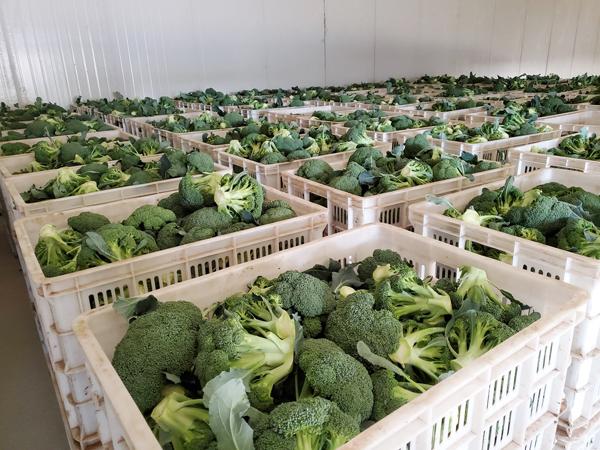
- Operation tip: Leave uniform gaps between turnover crates to ensure air circulation
- Applicable scenario: Medium and large broccoli planting bases with low investment budget
3.2 Vacuum Pre-Cooling (High-Grade Export to EU / North America)
- Target pressure: 500 ~ 700 Pa
- Completion time: 25 ~ 35 minutes
- Advantage: Fast temperature drop, effectively reduce respiration intensity
- Measured effect: Yellowing rate controlled within 3% under standardized management
Packaging Matching Suggestion: Use perforated export cartons or breathable PE film. Reasonable packaging can control long-term storage weight loss below 3.2%.
Industry data: Skipping pre-cooling directly leads to a 15%+ increase in overall postharvest loss.
4. Daily Operation & Risk Control Inside Broccoli Cold Storage
- Inspection Schedule
Record temperature and humidity twice every day; check air blower operation regularly and clean dust every 2 weeks. - Goods Stacking Rules
Do not attach crates directly against warehouse walls. Blocked airflow creates local high-temperature zones and yellow flower heads. - Emergency Power Failure Plan
If power fails for more than 4–6 hours, broccoli faces massive spoilage. For export-oriented warehouses, a standby generator is strongly recommended. - Mildew Prevention
Carry out regular ventilation and disinfection in high-humidity seasons to inhibit gray mold and soft rot bacteria.
5. Reference Data: Capacity, Loading Density & Cold Storage Investment Cost
Table 1: Broccoli Storage Density Reference
| Packing Method | Storage Volume (per 100 m³) | Average Weight Loss Rate | Suitable Market |
|---|---|---|---|
| Bulk Plastic Crate | 20 – 24 tons | 2.8% | Domestic & regional wholesale |
| Sealed Export Carton | 16 – 19 tons | 0.9% | Cross-border ocean export |
Table 2: Turnkey Investment — 500 m³ 0~1℃ Vegetable Cold Storage (2026 Global Price)
| Region | Total Investment (USD) | Core Cost Factor | Daily Power Consumption |
|---|---|---|---|
| Mexico & Latin America | 28,000 – 35,000 | Import equipment tariff 8%~12% | 100 – 130 kWh |
| Southeast Asia | 24,500 – 30,000 | Low local labor cost | 110 – 140 kWh |
| EU & North America | 38,000 – 46,000 | Strict food safety & FDA standard | 90 – 115 kWh |
6. Practical Project Case: Broccoli Cold Storage in Puebla, Mexico
Project Operator: Fruvemex S.A. DE C.V., Puebla
Supply chain target: Export fresh broccoli to supermarkets in the United States and Canada
- Harvest seasons every year: April–May, September–October
- Operation mode: Stock broccoli in CA cold storage for up to 60 days to avoid oversupply during picking season
- Profit calculation
In harvest season purchase price: $220 / ton
Off-season export selling price: $420 – $470 / ton
Gross profit spread: $200 – 250 / ton
Annual fixed expenditure includes electricity, labor, packaging and equipment depreciation: around $9,200.
Under normal sales conditions, the project can recover about 70% of cold storage investment within one harvest season, and full payback within 1 ~ 2 seasons.
Local challenge: Ambient temperature reaches 32 ~ 38℃ in summer. The project adopted enhanced condenser to reduce long-term energy consumption.
7. Common Mistakes Causing Broccoli Yellowing & Rot
- Skip pre-cooling to cut labor cost → sharp rise of loss rate
- Crates stacked closely against walls, poor air circulation → partial overheating
- Using ordinary cold storage and expecting 60-day preservation without CA gas system
- Allow temperature frequent fluctuation during daily loading and unloading
- Ignore humidity control, either too dry or overly humid
8. FAQ
Q1: Can ordinary cold storage without CA system keep broccoli fresh for 60 days?
A: No. Conventional air cold storage only supports maximum 35 days storage. If you need 60-day long-term preservation, you must upgrade to controlled atmosphere cold storage.
Q2: What will happen if broccoli storage temperature keeps higher than 3℃?
A: Broccoli respiration accelerates obviously. Flower heads turn yellow within one to two weeks, lose commercial value.
Q3: How to lower the electricity bill of broccoli cold storage?
A: Optimize pre-cooling process, reduce frequent door opening; select high-efficiency screw refrigeration units; strengthen warehouse insulation maintenance.
Q4: What is the difference between vacuum pre-cooling and forced-air pre-cooling?
A: Vacuum pre-cooling is faster and achieves uniform cooling, suitable for high-value export orders but higher equipment investment. Forced-air pre-cooling is cost-effective and widely used for large-volume ordinary fresh vegetable bases.
If you are planning to build a broccoli fresh storage or controlled atmosphere cold storage project in Southeast Asia, Latin America or the Middle East, contact our engineering team for customized layout design and budget quotation.