 Haocool

Author: Wang Hao, Senior Refrigeration Installation Engineer
10 years full-set cold storage system construction experience, specialized in evaporator matching, refrigeration piping and electrical debugging. Familiar with GB 51440-2021 Cold Storage Design Standard & HACCP food cold chain specifications, participated in over 200 fruit, frozen and pharmaceutical cold storage installation projects.
1 Pre-Installation Inspection & Preparation Work
Before hoisting, complete full equipment & material acceptance to avoid post-install hidden faults:
1. Complete unpacking visual inspection
– Check all frame bolts, fan motor fixing screws for looseness caused by long-distance transportation, re-tighten all fasteners;
– Rotate fan blades manually to confirm no friction with safety guard, no deformation or crack on blades;
– Inspect coil fin for bending, collision damage during shipment; damaged fins need combing repair before installation.
2. Factory nitrogen pressure leakage test verification
All evaporator coils are sealed with nitrogen filling at factory. Cut the sealing capillary before installation:
– If clear gas outflow sound: coil airtight intact, qualified for construction;
– No gas release: internal leakage exists, must return for maintenance before hoisting.
3. Supporting material pre-check
Heat insulation nylon suspension bolts, 4# steel load-bearing beam, 32mm rubber thermal insulation, drain pipe, electric defrost heating cable, U-trap water seal fittings shall be prepared in advance.
2 Standard Hoisting & Mounting Specifications (GB 51440-21 Compliance)
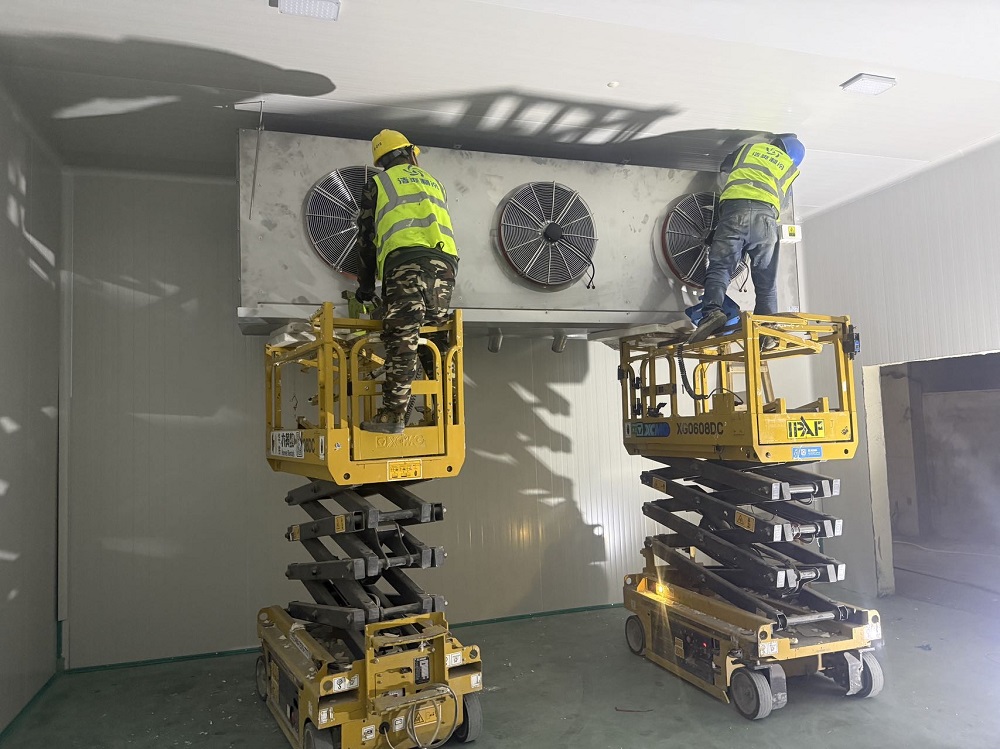
Ceiling mounted evaporator air cooler hoisting installation drawing
2.1 Load-Bearing Reinforcement Requirements
- Small evaporators (below 22㎡ cooling area): Use nylon 66 thermal insulation suspension bolts, add 100mm thick wooden load-bearing cushion under roof plate to prevent panel depression and cold bridge;
- Large evaporators (above 30㎡): Install cross 4# angle steel load-bearing beam across adjacent roof panels to disperse weight, avoid long-term deformation of PU plates;
- All bolt through holes must be fully sealed with food-grade anti-cold-bridge sealant after installation.
2.2 Wall Clearance & Level Standard
- For fan diameter ≤400mm: Reserve 250–300mm gap between evaporator and side wall for air circulation & daily maintenance;
- Fan diameter >400mm: Wall clearance expand to 350–500mm;
- Horizontal calibration: Level deviation ≤2mm/m, unbalanced installation will cause condensate backflow, fan abnormal vibration and noise.
2.3 Airflow Layout Principle
- Avoid installing behind beams, columns or pallet stacking barriers that block air supply throw distance;
- For e-commerce high-frequency access cold storage: Do not mount above cold roll-up doors, hot air entering the warehouse will cause rapid frost accumulation on coils.
3 Condensate Drainage System Standard Construction
Drainage failure is the most frequent installation defect causing goods soaking:
1. Pipe slope standard: All drain pipes maintain 1:30 downward gradient toward outside warehouse;
2. Mandatory U-trap water seal: Install independent U-bend outside cold room, keep residual water inside to block external hot & humid air backflow;
3. Low-temperature warehouse (-18℃ frozen zone): Wrap drain pipe with thick insulation + self-limiting heating cable to prevent pipeline icing and blockage;
4. Pipe material recommendation: Stainless steel or thick PPR pipe, thin PVC pipe is easy to aging under low temperature environment.
4 Thermal Expansion Valve (TXV & Sensing Bulb Installation
- Sensing bulb fixing: Firmly bind bulb to the upper horizontal section of compressor suction pipeline, full metal surface contact without gap;
- External full insulation wrap: Cover bulb and suction pipe with 32mm thick flame-retardant rubber insulation to avoid warehouse temperature interfering with temperature sensing accuracy;
- Pipeline optimization: Set oil return bend at rising section of return pipe to ensure smooth lubricant backflow to compressor.
5 Defrost Circuit & Electrical Wiring Standard
5.1 Three-Phase Defrost Heater Wiring Rule
- Small unit (≤22㎡): Single-phase heating circuit, simple terminal connection;
- Large D-series evaporator (≥30㎡): Adopt Y (star) three-phase connection with neutral wire reserved; neutral wire can avoid phase burning damage caused unbalanced heating load.
5.2 Interlock Protection Mandatory Rule
Defrost power and fan power must be mutually interlocked: When heating defrost starts, fan power supply is automatically cut off, preventing hot air from blowing into warehouse and raising product temperature.
5.3 Defrost Timer Setting Reference
| Warehouse Type | Daily Defrost Cycles | Single Defrost Duration | Delay After Defrost |
| —- | —- | —- |
| 0–4℃ Fresh Vegetable Storage (High RH) | 3–4 times | 18–25 mins | 5–8 mins fan delay startup |
| -18℃ Frozen Meat Storage (Low RH) | 1–2 times | 12–18 mins | 3–5 mins fan delay startup |
Delay function requirement: After heating stops, delay fan operation to discharge residual hot air, prevent temperature spike inside storage.
6 Post-Install Inspection & Full Commission Checklist
- Air circulation test: Power on fan separately, check rotation direction is consistent with air outlet mark, no abnormal vibration & noise;
- Drainage test: Pour clean water into evaporator water tray, verify smooth outflow without backflow or accumulation;
- Electrical safety test: Measure heating tube insulation resistance, no short circuit or leakage risk;
- Full defrost cycle simulation: Run complete defrost process, observe water discharge and fan interlock action;
- Monthly maintenance reminder: Regularly clean coil dust with compressed air, blocked fins reduce cooling efficiency by over 30%.
7 Most Common Installation Mistakes & Consequence Remediation
- Use iron suspension bolts without insulation → severe cold bridge, large amount of condensation on ceiling panels, power consumption increased 18%+
Fix: Replace nylon thermal insulation bolts + full hole sealing glue - Omit U-trap water seal → external hot humid air enters coil, heavy frost accumulates daily
Fix: Reconstruct independent U-shaped water seal outside warehouse - Sensing bulb wrapped incompletely → TXV misjudge temperature, insufficient cooling or liquid backflow to compressor
Fix: Re-bind bulb and add complete thick insulation layer - No fan interlock during defrost → hot air spread in warehouse, fruit & vegetable premature ripening
Fix: Rewire control circuit to add power interlock program - Drain pipe without heating cable in frozen warehouse → pipeline full ice, water overflow soaks goods
Fix: Add self-limiting heating wire + full pipe insulation
8 FAQ For Refrigeration Installers & Cold Storage Contractors
Q1 What load-bearing reinforcement do large evaporators need on PU ceiling panels?
A Large air coolers must cross lay 4# angle steel beam to disperse weight, single PU panel cannot bear long-term vibration load, easy to crack and leak cold air.
Q2 Why cannot we omit neutral wire for three-phase defrost heaters?
A Three heating tubes cannot guarantee fully balanced resistance; neutral wire can protect the other two groups from burnout if single tube breaks down.
Q3 What’s the difference between fresh and frozen cold storage defrost setting?
High-humidity vegetable warehouses have heavy water vapor, require more frequent & longer defrost cycles; low-temperature frozen warehouses have less frost accumulation, reduce defrost frequency to save electricity.
Q4 How to judge nitrogen filling leakage test is qualified?
Cut the sealing tube and obvious gas outflow proves coil airtight; no gas means internal puncture during transportation, cannot be hoisted for installation.
Custom Evaporator Matching Inquiry
If you need ceiling-mounted air cooler model selection, installation drawing and construction technical guidance for fruit, frozen and pharmaceutical cold storage, send warehouse temperature range and indoor area to get free parameter matching scheme.