 Haocool

If you grow or trade chillies in Indonesia, especially on Java island, you know the problem well. Chillies are colourful – red, green, yellow, purple – and in high demand all year. But they spoil fast. A few days after harvest, they start to shrink, change colour, and rot. That’s why a chilli pepper cold storage is essential for anyone supplying local markets or even exporting.
A farmer in Central Java recently asked us: “How much to build a 100‑ton chilli cold storage on my farm?” Let me walk you through the estimate, the key factors, and what temperature works best for chillies.
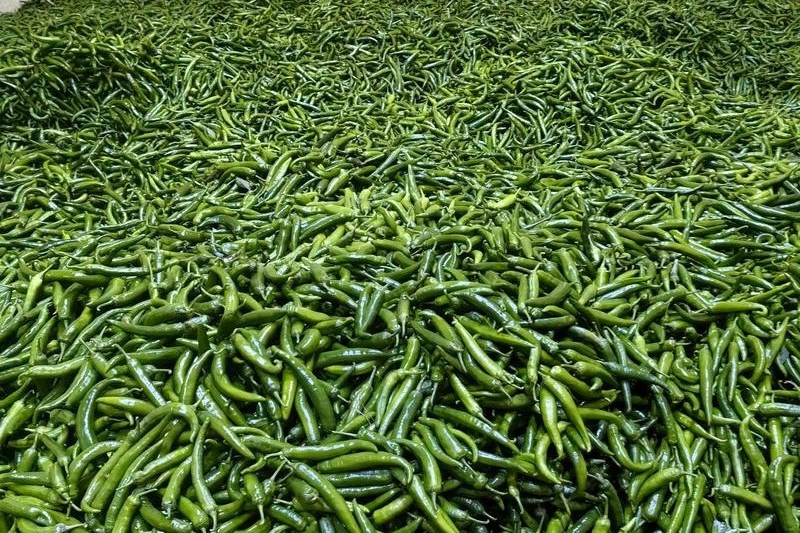
First, How Much Space for 100 Tons of Chillies?
Fresh chillies are not very dense. A common rule is 5 cubic metres per ton for bulk storage (including pallets and aisles). So for 100 tons:
- Net volume = 100 × 5 = 500 m³
If your cold room has a ceiling height of 3.5 metres, the floor area needed is about:
- 500 m³ ÷ 3.5 m = 143 m² (roughly 150 m²)
So a 100‑ton chilli cold storage will be around 140–150 square metres.
Estimated Cost in Java, Indonesia
Based on current equipment prices, shipping to Java, and installation labour, a 150m² chilli cold storage (500m³) costs approximately:
$39,000 – $55,000 USD
That’s for a standard fresh‑keeping cold room with temperature control at 10°C and humidity around 85–90%. The price includes insulation panels, refrigeration unit, evaporators, controls, and installation. It does not include land, foundation, or electricity.
What Temperature Do Chillies Need?
Chillies are sensitive to both cold and heat.
- Recommended range: 8°C – 12°C (46–54°F)
- Ideal set point: 10°C
- Below 6°C: chilling injury – the skin pits, turns dark, and the fruit rots faster.
- Above 15°C: chillies lose water quickly, wrinkle, and become soft.
So keep your chilli cold storage at a steady 10°C. A good controller will keep fluctuations within ±1°C.
Humidity should be 85–90% to prevent shrivelling. Too dry, and your chillies look old in a week. Too wet, and mould grows.
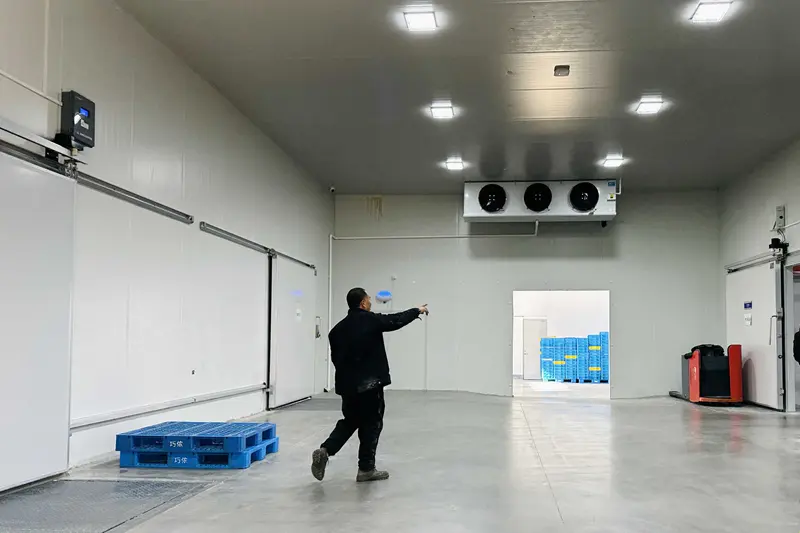
Three Main Factors That Affect the Cost
1. Type of Cold Storage
For chillies, you have three common options:
| Type | Storage life | Cost level | Best for |
|---|---|---|---|
| Standard fresh‑keeping room | 2–4 weeks | Low | Short‑term storage, local sales |
| Fruit/vegetable storage (pre‑cooling focus) | 4–6 weeks | Medium | Weekly distribution |
| Controlled atmosphere (CA) room | 8–12 weeks | High (1.5–2x) | Export or off‑season sale |
Most farmers in Java choose the first type. It’s enough to hold chillies for 2–4 weeks, which covers the gap between harvest and market. If you need longer storage, consider a vegetable cold storage unit with better humidity control.
2. Room Size and Number of Chambers
A single 150m² room is cheaper than two 75m² rooms. But if you grow different chilli varieties (green vs. red, hot vs. sweet), separate chambers let you store them at slightly different temperatures. More chambers = higher cost.
Also, larger rooms cost less per square metre than small ones. A 150m² room might cost $260–360 per m², while a 30m² room could cost $400–500 per m².
3. Equipment and Insulation Choices
- Insulation panels: 100mm polyurethane is standard for 10°C rooms. Thicker panels (120mm) cost more but save electricity in Java’s hot climate.
- Compressor brand: Local Indonesian or Chinese brands are affordable and work well. European brands (Bitzer, Copeland) cost 20–30% more but last longer.
- Controls: Basic thermostat is cheap. Digital controllers with remote monitoring add $1,000–2,000.
Your cold storage construction cost will go up if you choose premium options.
Real Example from a Recent Project
We quoted a 100‑ton chilli cold storage for a client in Bandung, West Java. The room was 150m², 3.5m high. We used 100mm polyurethane panels, a 10HP condensing unit (Chinese brand), and two evaporators. Total came to $47,000 USD including installation. The client added an automatic humidifier for an extra $1,500.