 Haocool

How should corn be stored in a cold storage facility? What temperature is best for corn cold storage, and how long can corn be stored?
The answer depends on the type of corn and its intended use. Fresh sweet corn, frozen processed corn, grain corn and corn seed require different storage conditions. Choosing the wrong temperature, humidity level or pre-storage treatment can lead to quality deterioration, moisture loss, mold growth or reduced seed viability.
This guide explains the recommended storage conditions for different types of corn and the key factors to consider when designing a corn cold storage facility.
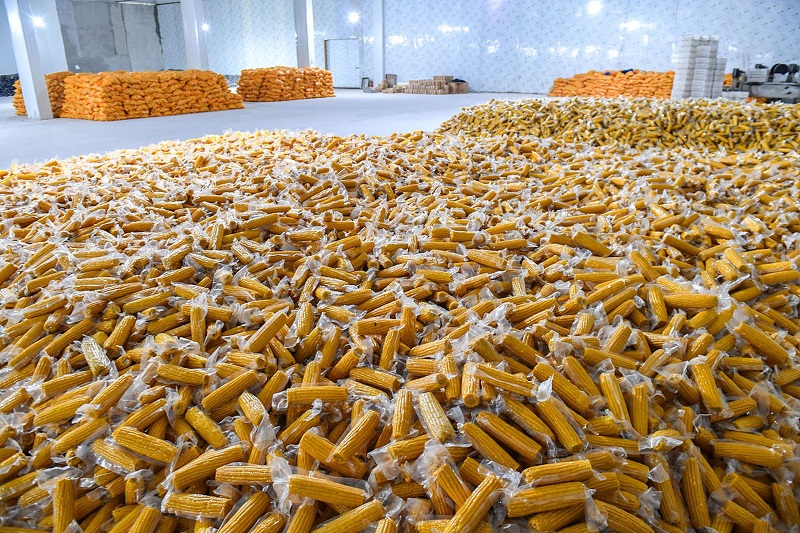
What Temperature Is Best for Corn Cold Storage?
There is no single storage temperature that applies to all corn products.
| Corn Type | Typical Storage Temperature | Relative Humidity / Moisture Considerations | Typical Storage Purpose |
|---|---|---|---|
| Fresh sweet corn | 0–1.5°C (32–34.7°F) | About 95–98% RH | Short-term fresh storage |
| Frozen corn | -18°C (0°F) or below | Controlled packaging and frost protection | Long-term frozen storage |
| Grain corn | Depends on moisture and storage duration; often cooled to around 0–5°C (32–41°F) for longer storage | Grain moisture is critical | Long-term grain storage |
| Corn seed | Controlled cool, dry conditions | Low moisture and low RH are important | Maintaining germination and seed vigor |
The correct setting should be determined by the corn variety, product condition, moisture content, packaging, required storage period, turnover rate and local food or agricultural regulations.
1. Fresh Sweet Corn: Around 0–1.5°C
Fresh sweet corn is highly perishable because quality begins to decline rapidly after harvest. Rapid removal of field heat is therefore essential.
For fresh sweet corn, an appropriate storage target is approximately 0–1.5°C (32–34.7°F) with 95–98% relative humidity. UC Davis recommends this range and notes that standard sweet corn is generally stored only for a few days, with total storage and transit time normally kept within about seven days for short-term marketing. Some super-sweet varieties can maintain acceptable market quality for longer under ideal conditions.
A commercial fresh-corn cold room should therefore focus not only on room temperature, but also on:
- Rapid field-heat removal
- High relative humidity
- Uniform airflow
- Appropriate packaging
- Fast receiving and dispatch
- Continuous temperature monitoring
Fresh sweet corn can suffer freezing injury at temperatures below its freezing point. UC Davis reports that freezing injury begins at approximately -0.6°C (31°F), which is why the room should be controlled slightly above freezing rather than simply set as cold as possible.
2. Frozen Corn: Store at -18°C or Below
Corn intended for frozen food production is handled differently from fresh-market corn.
After harvesting, the corn is normally processed, cleaned and prepared for freezing. Once properly frozen, the product should generally be maintained at -18°C (0°F) or below for frozen-food storage. USDA guidance uses 0°F (-17.8°C) as the freezer temperature for maintaining the quality of frozen foods.
However, freezing does not mean that quality can be maintained indefinitely. USDA notes that recommended frozen-food storage periods are primarily related to quality rather than safety, provided the food remains continuously frozen.
For commercial frozen-corn storage, the refrigeration system should therefore be designed for:
- Rapid product freezing or a separate freezing process
- Stable -18°C storage conditions
- Adequate refrigeration capacity
- Low temperature fluctuation
- Appropriate insulated panels and vapor barriers
- High-performance cold storage doors
- Temperature monitoring and alarm systems
For large frozen-corn projects, it is often more efficient to separate the freezing process from the frozen storage room, rather than expecting a normal cold room to perform the entire freezing operation.
3. Grain Corn: Moisture and Temperature Determine Storage Life
Grain corn is different from fresh sweet corn.
For dry grain storage, simply installing a refrigerated cold room is usually not the first priority. Grain moisture content, temperature, aeration and pest control are critical to storage life.
Iowa State University research shows how strongly temperature and moisture affect allowable storage time. For example, corn at 17% moisture has an estimated storage life of about 5.3 months at 10°C (50°F) compared with about 9.4 months at 4.4°C (40°F) under the referenced conditions.
More recent guidance also emphasizes that wetter and warmer corn deteriorates much faster, so wet corn should be conditioned and cooled as quickly as possible.
This means a commercial grain-corn storage project may require:
- Grain drying
- Aeration fans
- Temperature monitoring cables
- Moisture monitoring
- Ventilation
- Pest management
- Grain bins or bulk storage systems
rather than a conventional insulated cold room alone.
4. Corn Seed: Cool and Dry Storage
Corn seed has different requirements again.
The main objective is not simply preventing spoilage but maintaining germination rate and seed vigor.
Seed quality can deteriorate quickly under high temperature and high humidity. Long-term seed storage therefore requires stable, controlled environmental conditions, together with appropriate seed moisture and packaging. Iowa State Extension materials note that seed viability can be maintained under cool storage conditions, while longer storage benefits from temperatures around 0–5°C and relative humidity around 50% or lower.
For commercial seed projects, the actual specification should be determined according to:
- Seed moisture content
- Seed variety
- Required storage period
- Packaging
- Germination requirements
- Local seed-storage standards
A seed warehouse should not automatically use the same high-humidity conditions required for fresh sweet corn.
How Long Can Corn Be Stored in a Cold Storage Facility?
There is no single answer because corn storage life depends heavily on the product type.
Fresh sweet corn
Under ideal conditions, fresh sweet corn is generally a short-term storage product. UC Davis recommends keeping total storage and transit time for standard sweet corn to about seven days or less, while some super-sweet varieties may maintain acceptable quality for up to about 21 days at 0°C under suitable conditions.
Frozen corn
Frozen corn can be stored for much longer because freezing greatly slows microbial and enzymatic activity. However, storage duration should be evaluated based on the required quality standard, packaging and temperature stability. USDA emphasizes that frozen-food storage recommendations are generally quality-based rather than a fixed food-safety expiration period.
Grain corn
Grain-corn storage life depends strongly on moisture content and grain temperature. Iowa State data demonstrates that reducing temperature can substantially extend allowable storage time, but warmer or wetter grain has a much shorter storage life.
Therefore, instead of promising that “corn can be stored for X months,” a professional cold-storage design should calculate the expected storage period based on the actual moisture content, temperature and intended use.
Does Corn Need a Cold Room or a Refrigerated Warehouse?
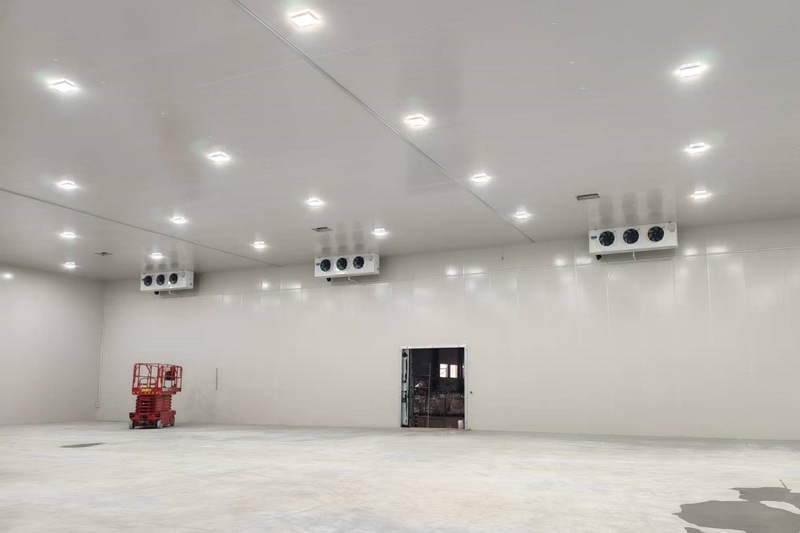
This is an important distinction for corn-storage projects.
A conventional insulated cold room may be suitable for fresh sweet corn or packaged frozen corn, while large-scale grain storage often requires a different engineering system based on drying, aeration and bulk grain handling.
Before designing the facility, determine:
- What type of corn will be stored?
- Is it fresh, frozen, dried grain or seed?
- What is the incoming product temperature?
- What is the corn moisture content?
- How many tons or pallets need to be stored?
- How long will the product remain in storage?
- What is the daily receiving and dispatch volume?
- Will the facility use pallet storage, racks, bins or bulk storage?
- What are the local temperature, humidity and food-safety requirements?
These factors directly affect the refrigeration load, room volume, insulation specification, equipment selection and project cost.
Corn Cold Storage Design Considerations
For a commercial corn cold storage facility, the design should consider the entire material flow rather than only the cold room.
A typical project may include:
- Receiving area
- Pre-cooling or rapid-cooling area
- Sorting and grading area
- Processing area
- Fresh or frozen cold rooms
- Frozen storage
- Dry storage or grain storage
- Packaging area
- Loading and dispatch area
- Refrigeration plant room
- Temperature monitoring system
- Electrical and control system
For fresh corn, rapid removal of field heat is especially important. UC Davis notes that prompt cooling and continuous refrigeration are essential for maintaining sweet-corn quality.
How Much Does a Corn Cold Storage Cost?
The cost of a corn cold storage facility cannot be accurately determined from floor area alone.
The total project cost depends on:
- Storage capacity in tons or pallets
- Cold room volume
- Storage temperature
- Product incoming temperature
- Daily throughput
- Freezing or pre-cooling requirements
- Insulated panel thickness
- Refrigeration capacity
- Refrigeration system type
- Cold storage doors
- Flooring
- Racking or bulk storage equipment
- Electrical capacity
- Monitoring and automation
- Building structure and civil works
- Installation and commissioning
- Project location
For example, a 200 m² fresh-corn cold room and a 5,000-ton grain storage facility may both be described as corn storage projects, but their engineering systems and costs can be completely different.
For this reason, a professional quotation should be based on the actual storage capacity, temperature requirements, product characteristics and project location.
What Information Is Needed for a Corn Cold Storage Quotation?
To prepare a preliminary design and quotation, provide:
| Project Information | Example |
|---|---|
| Corn type | Fresh sweet corn / frozen corn / grain / seed |
| Storage capacity | 500 tons / 1,000 tons / 5,000 pallets |
| Required temperature | 0–1.5°C / -18°C / other |
| Storage period | 7 days / 3 months / 12 months |
| Daily throughput | Tons received and dispatched per day |
| Product condition | Whole ear / kernels / packaged / bulk |
| Incoming temperature | Harvest temperature or processing temperature |
| Moisture content | Especially important for grain and seed |
| Project location | City and country |
| Building size | Existing building or new construction |
| Automation | Manual / semi-automatic / automated |
| Scope | Cold room only / refrigeration / complete EPC |
With these details, the refrigeration load, storage volume, equipment configuration and estimated investment can be evaluated more accurately.
Corn Cold Storage: Temperature Is Only the Beginning
The correct temperature is important, but a successful corn cold storage project also depends on rapid cooling, humidity management, airflow, product preparation, insulation, refrigeration capacity and operating procedures.
For fresh sweet corn, the focus is rapid cooling and high humidity.
For frozen corn, the focus is stable low-temperature storage and maintaining the frozen chain.
For grain corn, moisture content, drying and aeration are often more important than installing a conventional cold room.
For seed corn, stable cool and dry conditions are essential for protecting seed viability.
The best storage solution should therefore be designed around the actual product and business requirements rather than using one standard temperature for every type of corn.
Request a Corn Cold Storage Quote Today
Contact us for a customized corn cold storage design and quotation based on your corn type, storage capacity, temperature requirements, storage period and project location.
We can provide cold storage design, refrigeration systems, insulation, electrical and control systems, installation, commissioning and complete turnkey solutions for commercial corn storage projects.