 Haocool

Author: Senior Agricultural Cold‑Chain Engineer, hands‑on experience delivering root‑crop cold‑storage projects for domestic farms and overseas agri‑cooperatives.
Disclaimer: All cost figures below are reference turn‑key observations aggregated from our completed domestic Chinese cold‑storage EPC projects. Quoted prices assume local mainland‑China material sourcing and standard site shell conditions. Final investment will shift based on overseas import duties, local climate, curing‑room add‑on requirements, insulation grade and refrigeration redundancy specifications. Request our site‑specific layout for formal itemised quotation.
Sweet potatoes are highly chilling‑sensitive root crops, requiring precise 10‑15 °C constant‑temperature storage instead of standard low‑temperature fruit cold rooms. Many farm investors make costly early‑planning mistakes: applying regular vegetable cold‑room design parameters for sweet‑potato stock, which leads to chilling injury, massive tuber spoilage and wasted capital expenditure.
This practical guide covers reference construction budgets, critical storage‑environment parameters, and common project pitfalls for sweet‑potato cold‑storage builds. For complementary preservation knowledge, read our dedicated article: sweet potato preservation techniques and storage methods.
Reference Sweet‑Potato Cold‑Storage Turn‑Key Cost Table (China‑Based Project Baseline)
Baseline assumption: Existing building shell available; price includes insulation panels, refrigeration hardware, humidity‑control system, installation & commissioning. Excludes civil‑structure work, land, transformer and curing‑treatment chamber upgrades.
| Storage Scale | Estimated Cost (CNY) | Approximate Equivalent USD |
|---|---|---|
| 100 m² | ¥90 000–¥120 000 | ≈ $12 600–$16 800 |
| 200 m² | ¥170 000–¥200 000 | ≈ $23 800–$28 000 |
| 300 m² | ¥250 000–¥300 000 | ≈ $35 000–$42 000 |
| 400 m² | ¥330 000–¥400 000 | ≈ $46 000–$56 000 |
| 500 m² | ¥400 000–¥500 000 | ≈ $56 000–$70 000 |
| 1000 m² | ¥800 000–¥1 000 000 | ≈ $112 000–$140 000 |
💡 Practical note: Adding a dedicated post‑harvest curing chamber (27‑29 °C high‑humidity wound‑healing room) will increase total project budget by an extra 12‑18 %. This curing step drastically reduces tuber rot loss for large‑volume commercial stock.
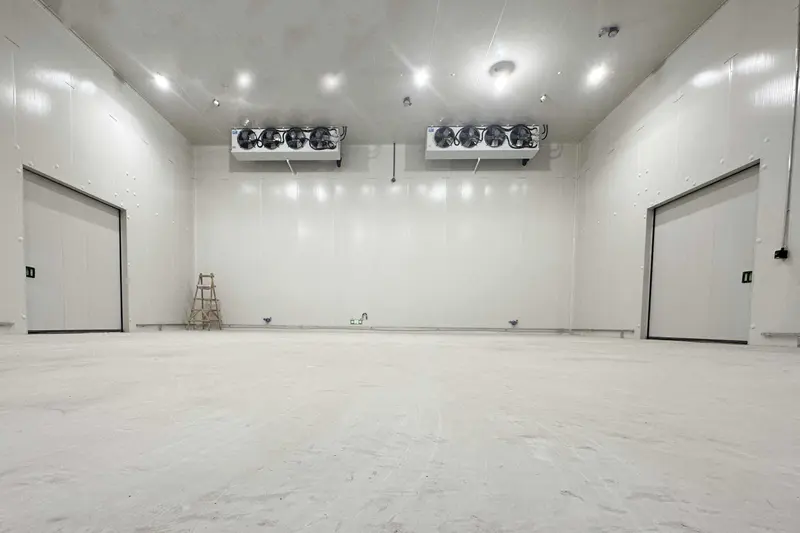
Sweet potato cold storage room with stacked tubers, constant temperature root crop warehouse
Two Distinct Sweet‑Potato Storage Modes
Sweet‑potato storage cannot adopt generic vegetable cold‑room set‑points; wrong temperature creates irreversible quality loss:
- Fresh root‑tuber cold‑storage (commercial market sale)
Target environment: 12‑14 °C, RH 85‑90 %. Keep temperature fluctuation within ±1 °C. Storage life reaches 3‑6 months.Critical risk: Long‑term temperature below 10 °C triggers chilling injury: internal browning, hard‑core texture and bitter flavour, rendering tubers unsaleable. Temperatures persistently above 15 °C causes sprouting and rapid weight‑loss.
- Frozen‑processed sweet‑potato storage (frozen chips / puree raw‑material)
Condition: ‑18 °C or lower. This configuration requires heavier‑duty low‑temp refrigeration hardware and thicker insulation, driving up total construction and running‑power expenses. Suitable for deep‑processing factories only, not for fresh tuber preservation.
Non‑Negotiable Engineering Requirements For Fresh Sweet‑Potato Cold‑Rooms
Summarised from our root‑crop cold‑storage site‑commissioning experience:
– Stable narrow temperature band 12‑14 °C; avoid system over‑cooling.
– Independent humidification setup to sustain RH 85‑90 %; prevent both tuber dehydration and surface mould growth.
– Gentle low‑velocity air circulation; high‑speed air coolers cause severe weight‑loss.
– Reserved ventilation capacity for periodic CO₂ gas purging from tuber respiration.
– Optional but strongly recommended: separate curing chamber for post‑harvest wound‑healing after harvesting.
Common Costly Sweet‑Potato Cold‑Storage Project Pitfalls
Real‑world mistakes repeatedly observed on farm cold‑storage builds:
1. Copy‑paste regular 0‑4 °C vegetable cold‑room design for sweet potatoes → mass chilling‑injury spoilage of tubers.
2. Omit dedicated humidification hardware, rely purely on refrigeration dehumidification → either heavy shrivelling or mould breakout.
3. Skip curing‑treatment chamber for large harvest batches → high post‑storage rot rate, shortening usable shelf‑life.
4. Specify high‑velocity evaporator fans → excessive moisture loss, large percentage of commodity downgraded.
5. Ignore air‑exchange design for respiratory‑gas removal → CO₂ accumulation accelerates quality degradation.
FAQ For Sweet‑Potato Farm Operators & Agricultural Investors
Q1: Can I store fresh sweet‑potato tubers inside an ordinary 0‑4 °C vegetable cold‑room?
A: Not recommended. Sweet‑potatoes are chilling‑sensitive root crops. Long‑term exposure below 10 °C will produce irreversible internal browning and bitter taste, destroying commercial value. Fresh stock requires specialised 12‑14 °C constant‑temperature cold‑storage.
Q2: What extra cost will be added if I need a curing room for post‑harvest wound‑healing?
A: A dedicated curing chamber (27‑29 °C high‑humidity healing environment) typically raises total project investment by 12‑18 %, but greatly reduces rot loss for large‑scale commercial stock.
Q3: What is the main difference between fresh sweet‑potato cold‑storage and frozen‑processing‑grade cold‑storage?
A: Fresh tuber preservation runs at 12‑14 °C with precise humidity control. Frozen‑processing raw‑material storage operates at ‑18 °C, needing thicker insulation and heavy‑duty low‑temperature compressors, leading to higher upfront and operational power‑cost.
Request Your Custom Sweet‑Potato Cold‑Storage Layout Proposal
If you plan sweet‑potato cold‑storage construction, share your planned storage area, expected tuber tonnage, whether you require a curing‑treatment chamber, and local peak ambient‑temperature conditions. Our agricultural cold‑chain engineering team can deliver concept layout drawing and itemised USD‑denominated budget reference.